



Can you imagine selling your cryptocurrency, confirming the money has arrived in your bank account, and then discovering that you gave away far more cryptocurrency than you were actually paid for?
We’re not talking about fake payment receipts, stolen passwords, or hacked wallets.
We’re talking about genuine bank transfers used to deceive the seller.
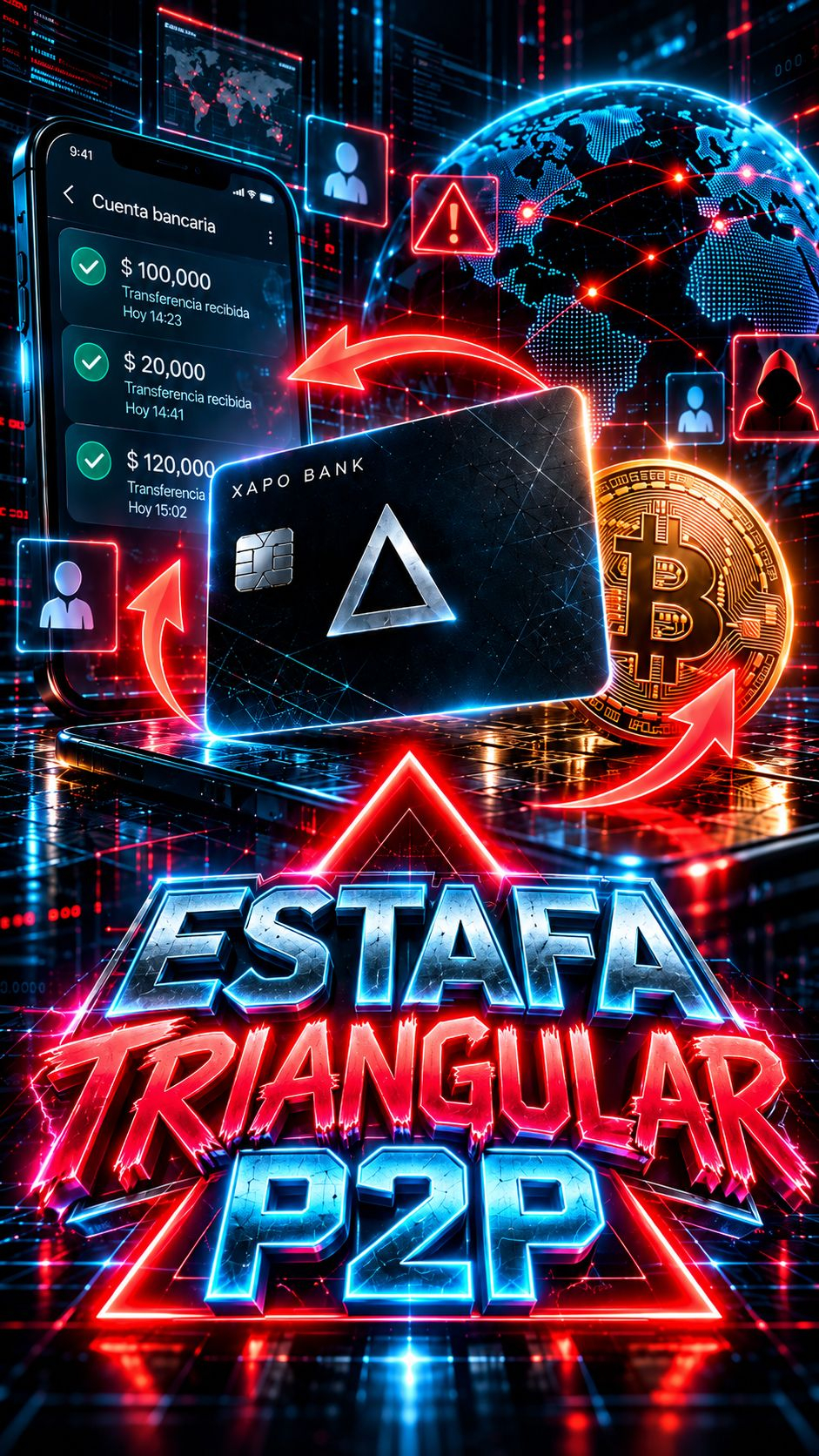
This scheme is known as a P2P TRIANGULAR SCAM, and Binance has officially documented it... But how does it work?
First, let’s understand something simple.
On platforms like Binance P2P, people can buy and sell cryptocurrency directly with each other. For example, someone sells USDT, and the buyer transfers Argentine pesos to their bank account.
The platform temporarily holds the cryptocurrency until the seller confirms they've received the payment and authorizes its release.
So far, this is a normal transaction.
HERE'S WHERE THE SCAM HAPPENS.
Imagine you post an ad to sell your USDT.
Two scammers working together open two transactions with you almost simultaneously.
The first one, whom we'll call A, wants to buy 100 USDT from you for $100,000.
The second one, B, wants to buy 120 USDT from you for $120,000.
You have two pending transactions. In total, you should receive $220,000 before releasing the corresponding cryptocurrency.
But the scammers have another plan.
Scammer B transfers $100,000 of real money to your bank account.
Meanwhile, scammer A marks their transaction as paid.
You log in to your bank, see that you've actually received $100,000, and assume it's for the first sale.
So you release the 100 USDT to buyer A.
YOU'VE JUST MADE THE FIRST MISTAKE.
Because that money didn't come from buyer A, but from buyer B, who also has another transaction open.
So what happens next?
Buyer B transfers another $20,000 and shows you receipts for both transfers.
Now they tell you they've paid the full $120,000 for their purchase.
You check your bank and find two genuine deposits: one for $100,000 and another for $20,000.
Everything seems to add up...
Since you've already released the cryptocurrency for the first transaction, you think those payments justify releasing the 120 USDT for the second one too... And you release them.
THAT'S WHEN THE SCAM IS COMPLETED.
Let's do the math.
You sent 100 USDT to buyer A and 120 USDT to buyer B.
In total, you sold 220 USDT, which, in this example, had an agreed price of $220,000.
But only $120,000 came into your bank account.
YOU JUST LOST $100,000.
The scammers got you to interpret the same transfer as payment for two different transactions.
And the most surprising thing is that they didn't need to falsify any bank transactions....
The money really did come in.
What they manipulated was your understanding of which transaction each payment was for....
HOW CAN YOU AVOID IT?
The most important precaution is as simple as it is crucial: never release cryptocurrency just because you see money in your account.
You need to verify each transaction separately.
If you sold 100 USDT for $100,000, check that the payment specifically corresponds to that buyer and that order.
Check the amount, the identity of the account holder who made the transfer, and the transactions that actually cleared.
If you have several open transactions, don't mix up the payments or let the same receipt be used to justify two sales.
And don't accept transfers from third-party accounts as if they were normal payments from the buyer.
If anything doesn't match, don't release the cryptocurrency. Use the platform's appeal process.
THIS IS WHAT'S TRULY CONCERNING.
In cybersecurity, we often talk about malware, phishing, password theft, and computer vulnerabilities.
But this scam shows that you don't always need to breach a system to get money.
Sometimes, scammers take advantage of something much simpler: human confusion when several transactions are happening at once.
And once you've authorized the release of the cryptocurrency, getting those funds back can be extremely difficult.
Because in a P2P triangle scam, the problem isn't necessarily that the money never arrived.... The problem is that they made you believe the same transfer was paying twice...
#Cybersecurity #DigitalScams #DigitalFraud #InformationSecurity