Beginner Lesson 11: How to Read the Order Book and Trading Volume. Check These Two Things Before Taking a Short-Term Trade
We’ve finished the ten basic lessons. Starting with this one, we’ll focus more on practical trading. When trading short term (for example, using 15-minute or 1-hour charts), many people focus only on candlesticks and overlook the order book and trading volume. These two things can’t guarantee you’ll make money, but they can help you avoid traps like “false breakouts” and “fake pump-ups.”
I. What is the order book?
The order book is a list of buy and sell orders: buy orders are on the left (or at the top), sell orders are on the right (or at the bottom), and the latest traded price is in the middle.
A large number of buy orders means people are willing to buy at lower prices; a large number of sell orders means people are willing to sell at higher prices.
Beginners shouldn’t treat it as a prediction that the price will “definitely rise” or “definitely fall.” It only shows current order intentions, and orders can be canceled or filled at any time.
II. What to watch first when reading the order book
1) Is the bid-ask spread wide? A wide spread indicates poor liquidity. Even a small order can push the price around, making it more expensive to enter and exit. Major coins like $BTC and $ETH usually have tighter spreads, while lesser-known coins require caution.
2) Has a very large order suddenly appeared at a price level? It may be a genuine order, or it could be an intimidating “wall” that gets canceled moments later—a common occurrence. Don’t impulsively chase the price just because you see a large buy order.
3) When the price is moving up, are sell orders above it being filled one by one, or are the orders being canceled first? The former looks more like genuine buying pressure; the latter looks more like a vacuum pump, which often reverses quickly.
4) Take a look before placing your own order: market orders can be eaten up by slippage; limit orders let you control the price, but may not fill immediately.
III. What is trading volume?
Trading volume is how much was actually traded during a candlestick (or over a period of time). It’s a bit more concrete than “orders sitting on the book without being filled”: actual money has changed hands.
When looking at $BTC and $ETH , a sudden increase in volume means more people are participating in that move. If volume keeps shrinking, the price may be moving around because only a few people are pushing it.
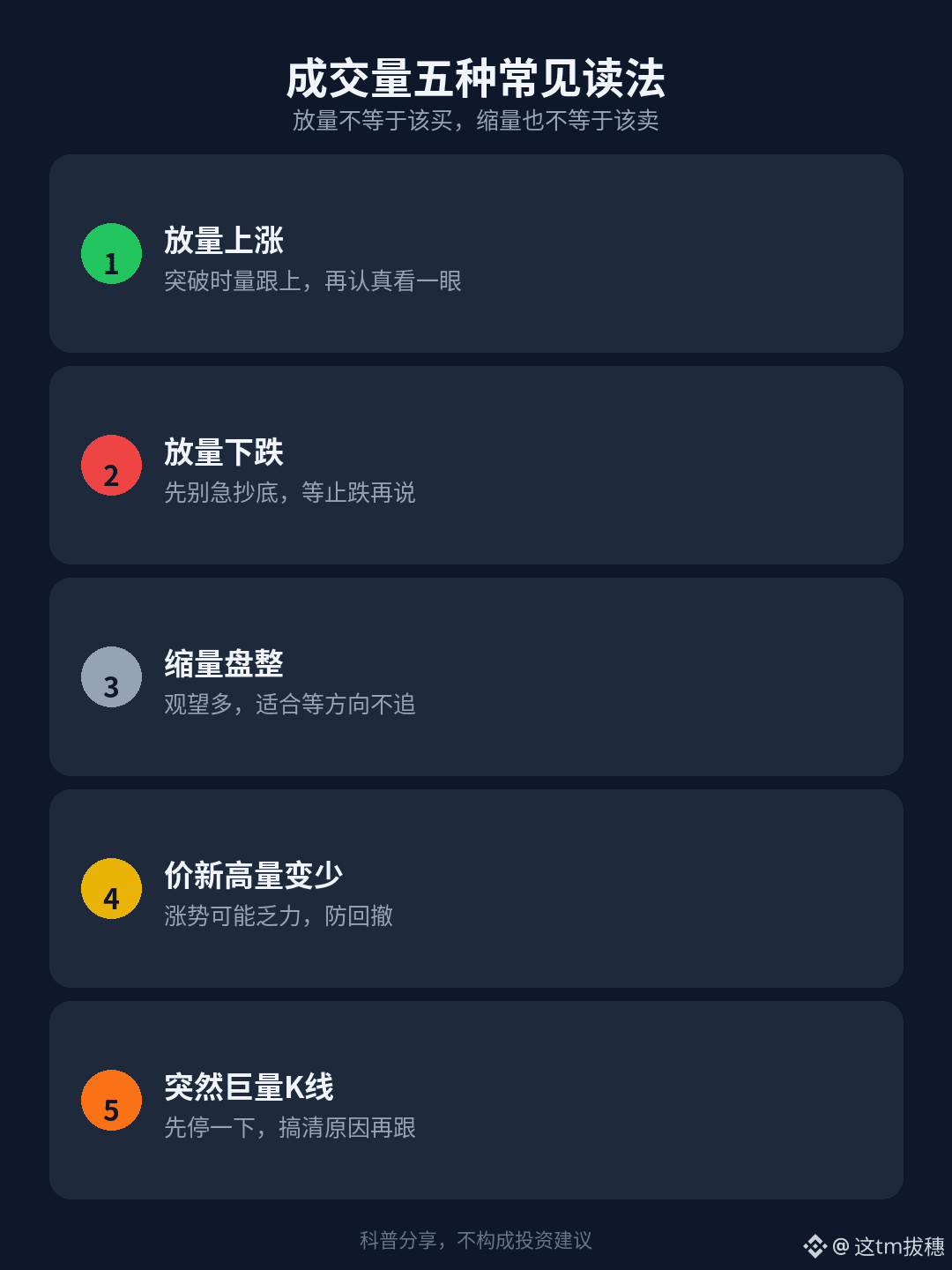
IV. Common ways to interpret trading volume (practical guide)
1) Rising price on increasing volume: When the price breaks upward, a clear increase in volume is more worth paying attention to than a slow decline on shrinking volume. But rising volume can also indicate distribution, so don’t look at direction alone.
2) Falling price on increasing volume: This could be panic selling or a major player dumping. Don’t rush to buy the dip; wait for signs that the decline is stopping before acting.
3) Consolidation on shrinking volume: Price isn’t moving much in either direction, and many people are waiting on the sidelines. It’s a good time to patiently wait for direction, not to chase blindly.
4) Price reaches a new high, but volume keeps falling: Watch out for weakening momentum; a pullback may follow.
5) A sudden, exceptionally large bearish or bullish candle: Pause and figure out whether it was caused by news, liquidations, or a sudden drop in liquidity before deciding whether to follow the move.
V. The order book + trading volume are more useful together
Looking only at the order book makes it easy to be fooled by canceled orders; looking only at volume doesn’t tell you how orders are structured right now. For short-term trading, you can make a habit of:
1) Before chasing a breakout: Check whether volume is increasing and whether sell orders above are being filled or canceled first;
2) Before buying a dip: Check whether buy orders are genuinely absorbing selling, and whether volume is increasing as the price falls or has already started to shrink;
3) When trading in $USDT: Pay attention to spreads and slippage. Even with small amounts, don’t ignore the costs.
VI. Common beginner pitfalls
1) Treating a “large order” as an impenetrable wall: Orders can be canceled, so they’re no guarantee;
2) Treating rising volume as a universal signal: Rising volume doesn’t mean you should buy, nor does it mean the trend will definitely continue;
3) Applying major-coin experience uncritically to illiquid altcoins: The order-book depth of $BTC and $ETH is very different from that of altcoins;
4) Staring at the screen until your eyes blur to try to be “more accurate”: Even short-term trading needs a plan. The order book is only an aid, not a substitute for stop-losses and position sizing.
In a nutshell: The order book shows current order intentions, while trading volume shows whether people are actually taking action. When the two line up, acting is less blind than simply chasing candlesticks.
Next time, we can talk about how to set conditional orders and take-profit and stop-loss orders, so you don’t have to keep your eyes glued to the screen. Do you usually check the order book before placing an order? Let’s talk in the comments.
The content above is for educational purposes only and does not constitute investment advice. Crypto assets are extremely volatile, and short-term trading carries even greater risk. Only trade with money you can afford to lose, and check your exchange’s interface documentation yourself.
#新手入门 #盘口 #TradingVolume