


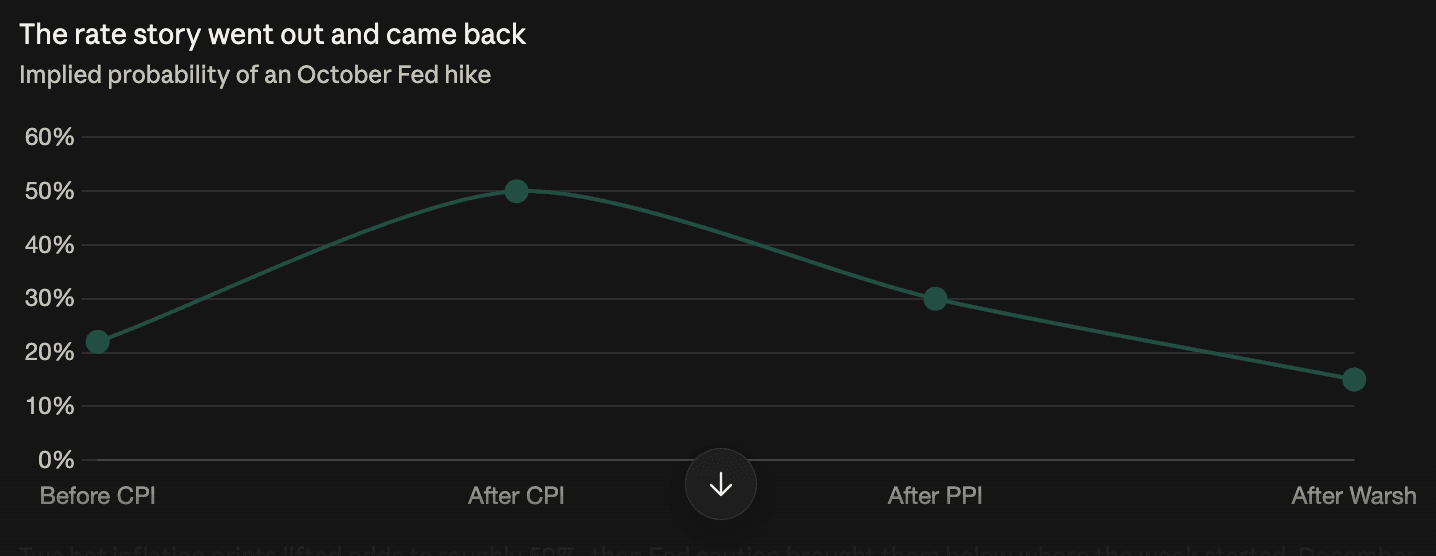
Global markets spent the week caught between inflation data, Fed communication and a reassessment of how AI investment gets funded. September CPI and PPI both came in above forecast and briefly pushed October hike odds toward 50%, before cautious comments from Fed officials — including Chair Kevin Warsh in Bangkok — returned a pause to the base case at around 15%. A further hike this year remains priced, with December near 90%. Meanwhile the AI trade split along a single line: companies generating cash held up, companies borrowing to expand did not.
The Hike Was Delayed, Not Cancelled
The sequence matters more than any single reading. October hike odds sat near 22% before Wednesday’s CPI, spiked to roughly 50%, fell to 30% after Thursday’s producer prices, and ended the week near 15% — below where they started, despite two hot inflation reports.
The move came from communication rather than data. Warsh declined to signal either remaining 2026 meeting, saying only “I don’t prejudge meetings,” and markets read the absence of a hawkish signal as a dovish one.
That reading is incomplete. December hike odds remain around 90%, so what changed is the timing, not the direction. The target range stands at 3.75% to 4.00% after September’s unanimous quarter-point increase.
The AI Question Changed From Demand to Funding
TSMC reported third-quarter net profit up 69% year on year, above the roughly 65% analysts expected. That settles the demand question — AI chip orders are real and converting to profit.
CoreWeave answered the other question. Its bond yields briefly exceeded 15% during the week against a debt load above $51 billion, and the shares fell 25%.
The gap between those two outcomes is the week. Markets are now separating companies with stable cash flow from companies funding expansion with debt, and pricing the second group on borrowing costs rather than on growth.
The sharpest evidence came from TSMC’s own share price, which fell on Friday despite the beat and an upbeat outlook. When the best earnings in the sector cannot lift a stock, the constraint is not demand.
Credit Isolated It Precisely
Goldman Sachs found AI-related high-yield bond spreads widened 25 basis points over the week while non-AI spreads barely moved.
“We view AI-related corporate bonds, from either neoclouds or firms with significant frontier lab exposure, as being at the epicenter of the funding cost debate,” said the bank’s Amanda Lynam.
That containment is the reason this looks like a repricing rather than a credit event. Banks were barely touched; 96% of semiconductor stocks sit more than 20% below their June highs against about 4% of banks.
The Rotation Was Visible in the Indices
The Nasdaq Composite fell 4.48% on the week while the Dow Jones rose 0.68% — the widest weekly gap between them since July 2002.
South Korean equities rebounded Friday after seven consecutive declining sessions but still recorded their worst week in 18 years. The Philadelphia Semiconductor Index fell for an eighth straight session, its longest run since 2008, shedding roughly $2 trillion in value.
One index rising while another falls that hard is capital moving between sectors, not leaving the market.
Energy Supply Risk Kept Building
Brent crude settled near $110 a barrel and WTI rose to $101.71, a seventh consecutive daily gain, as two separate supply risks persisted.
The Russia-Ukraine energy ceasefire failed to hold, with both sides resuming strikes on energy facilities. In the Middle East, Saudi Arabia escalated its intervention in Yemen.
Two MSCI Decisions, One Review Cycle
Indonesian stocks fell sharply on MSCI’s consideration of downgrading the market from emerging to standalone status, which would trigger capital outflows from funds tracking emerging market benchmarks.
Separately, MSCI signalled a screening change that could threaten Strategy’s index membership, which is why the stock fell 9.2% on Friday while Bitcoin lost about 1%.
For crypto readers the useful framing is that both decisions emerged from the same routine methodology review. The Strategy screening is not an action aimed at digital assets; it is one outcome of a process that also caught a sovereign equity market.
Bank Trading Split the Same Way Everywhere
Third-quarter results from the six largest US banks diverged along a consistent line: equities trading grew while fixed income came under pressure.
JPMorgan’s numbers described the sector. Equities revenue rose 49% to $5.0 billion; fixed income fell 4% to $5.4 billion. The bank reported net income of $15.3 billion, up 6%, and missed EPS estimates at $5.57 against $5.90 expected.
Gold: One Seller Against Record Buying
Kazakhstan’s central bank plans to reduce gold from roughly 78% of reserves to 75%, which the source attributes to high rates prompting reserve rebalancing.
That cuts against the aggregate trend — central banks bought a record 288.9 tonnes in the second quarter, up 62% year on year. But a 78% gold allocation is extraordinarily concentrated, and a three-point trim is a marginal adjustment from an extreme position rather than a reversal of the diversification case.
Gold itself sits around $4,112, down about 27% from its January record of $5,608.
What Settles Next Week
Technology earnings. Five companies — Microsoft, NVIDIA, Meta, Apple and Alphabet — produced 93% of the S&P 500’s gains since July, and their reports address whether AI revenue supports capital expenditure at current levels.
Oil holding above $110 Brent and the October 28 Fed decision are the other two. For crypto, Bitcoin has defended the $80,000 area three times, with the options market converging on $78,000 as the level below it.