


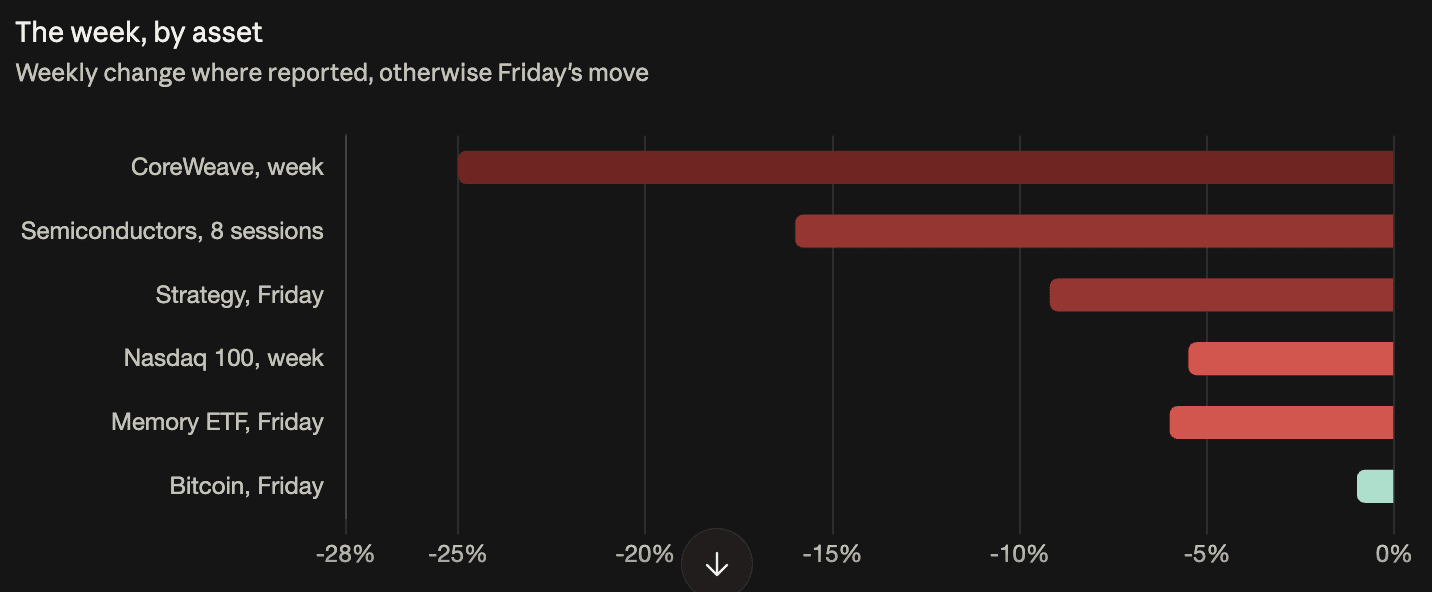
The Nasdaq 100 fell 5.5% this week to close at 29,187.55, its worst week in 18 months, as AI infrastructure financing concerns collided with an oil shock. The Philadelphia Semiconductor Index declined for an eighth consecutive session, down roughly 16% and shedding about $2 trillion in market value in its longest losing streak since 2008. For crypto desks, the week’s most misread move was Strategy’s 9.2% Friday fall, which came from an index decision rather than anything to do with Bitcoin.
Strategy Fell on MSCI, Not on Crypto
Strategy shares reversed Thursday’s gains after MSCI said it would adopt a new screening approach that could put the company’s index membership at risk.
Index removal forces selling by every passive fund tracking those benchmarks, regardless of what the fund manager thinks of the company. That is a mechanical flow risk with a known trigger.
It explains a divergence that otherwise looked like a signal. Strategy dropped 9.2% on a day Bitcoin lost about 1%, and these equities normally amplify Bitcoin’s direction rather than decoupling from it. The gap was not the equity market pricing a crypto risk the spot market had missed. It was index mechanics.
CoreWeave’s $51 Billion Is the Number That Matters
CoreWeave fell almost 12% on Friday, extending its weekly decline to 25% — its worst week since November last year — and leaving the stock more than 50% below its year-to-date high.
Some of its bonds yielded above 15% at one point. The figure that makes that meaningful is the balance sheet behind it: total debt has grown past $51 billion.
A 15% yield on a small issue is a curiosity. A 15% yield against $51 billion of obligations is a repricing of what it costs to finance AI infrastructure, and it is why the concern has shifted from whether compute demand exists to whether the returns justify the borrowing.
Memory Is Still the Epicentre
Within the semiconductor selloff the damage is not evenly spread. The Roundhill Memory ETF fell about 6% on Friday against 3% to 4% for the broad semiconductor funds, with Micron, Nvidia and Broadcom among the decliners.
That ordering has held all week. Korean and Japanese memory names fell 9% to 11% on Thursday as Seoul triggered its tenth circuit breaker of the year, and in Friday’s pre-market every US memory name declined while optical communications stocks rose.
Morgan Stanley’s breadth data puts a figure on it: 96% of semiconductor stocks now sit more than 20% below their June highs, against about 4% of banks.
Credit Priced It More Precisely Than Equities Did
Goldman Sachs found that AI-related high-yield bond spreads widened 25 basis points this week while non-AI spreads barely moved.
“We view AI-related corporate bonds, from either neoclouds or firms with significant frontier lab exposure, as being at the epicenter of the funding cost debate,” said the bank’s Amanda Lynam.
That isolation matters for reading the week. This is not a broad credit event or a general flight from risk. It is one sector’s cost of capital being marked up, which is why banks are barely touched and why the S&P 500 held near records while half the Russell 3000 sat in a bear market.
The Oil Shock Removed the Hedge
Brent crude rose to around $110 a barrel and WTI gained 3.8% on Friday to $101.71 — an $8.29 spread between the international and US benchmarks that is worth naming rather than calling either one “oil.”
The consequence was in the bond market. The 10-year Treasury yield rose to 5.097%, having traded as high as 5.125% intraday, which stripped Treasuries of their usual function during an equity decline.
Thursday had worked the conventional way: stocks fell, the 10-year dropped 13.6 basis points, gold rose. Friday inverted it. Stocks fell, oil jumped, and yields rose. Falling equities with falling yields price weaker growth and bonds hedge it. Falling equities with rising yields price higher costs, and nothing in a conventional portfolio hedges that.
The Case That This Is Contained
Angeles chief investment officer Michael Rosen said mounting debt warrants monitoring but that current levels are “not remotely close” to systemic danger.
Cathie Wood’s ARK Investment Management added to CoreWeave and Cerebras Systems, though buying into drawdowns is that firm’s established pattern and reads more as house style than signal.
The stronger argument is in the spread data itself. Non-AI credit has not moved, which means the market is discriminating rather than panicking — and discrimination is what a repricing looks like, not a crisis.
Crypto’s Exposure Runs Through Equities, Not Spot
Bitcoin fell about 1% on Friday against the Nasdaq 100’s 2.5%, holding the $80,000 area it has defended three times this week.
The more exposed names are the ones that migrated into AI. Hut 8, IREN, CleanSpark, Keel Infrastructure and Cipher Mining each fell roughly 6% on Friday — former Bitcoin miners now hosting AI compute, priced off data centre funding costs rather than off the coin. For a crypto desk, that is a reclassification worth tracking: mining equity risk has moved from the Bitcoin price to the credit market.
What Decides Next Week
Technology earnings. Five companies — Microsoft, NVIDIA, Meta, Apple and Alphabet — produced 93% of the S&P 500’s gains since July, with Microsoft alone contributing 181 of the index’s 330-point advance.
The question those reports answer is whether AI revenue supports capital expenditure at current levels. If it does, the funding cost debate loses its premise. If it does not, the narrow leadership holding the index up becomes the next thing to reprice.
Oil above $110 Brent and the October 28 Fed meeting, where hike odds sit near 15% against roughly 90% for December, are the other two variables.