


A late surge in oil prices turned a modestly negative session into a rout on Friday, with the Nasdaq closing down 2.3%, the S&P 500 off 1.25% and the VIX up 22%. WTI crude rose 3.8% to $101.70, a one-month high and a 16% gain over ten days. The significant part was the bond market: Treasury yields rose to 5.112% rather than falling, reversing the pattern that held all week.
Bonds Offered No Hedge This Time
On Thursday, equities fell and the 10-year Treasury yield fell with them, dropping 13.6 basis points to 5.054% while gold rose about 1%. Money moved into fixed income.
On Friday, equities fell and the 10-year moved the other way, trading near the day’s high at 5.112% after an early dip to 5.07%. Government bonds, in the source’s phrasing, “aren’t seeing a bid today.”
That reversal is a change in what the market thinks the problem is. Falling stocks with falling yields price weaker growth, and bonds work as a hedge. Falling stocks with rising yields price higher costs, and nothing in a conventional portfolio hedges that. Two sessions, two diagnoses.
The trigger was visible. Oil climbed through the afternoon in stages — $99.40, then past $101, then $101.70 — and the source notes Treasury yields swung from declines to gains in the hour the move began.
Bitcoin Outperformed Almost Everything
Bitcoin fell about 1% to roughly $81,350, having traded near $82,000 earlier in the day.
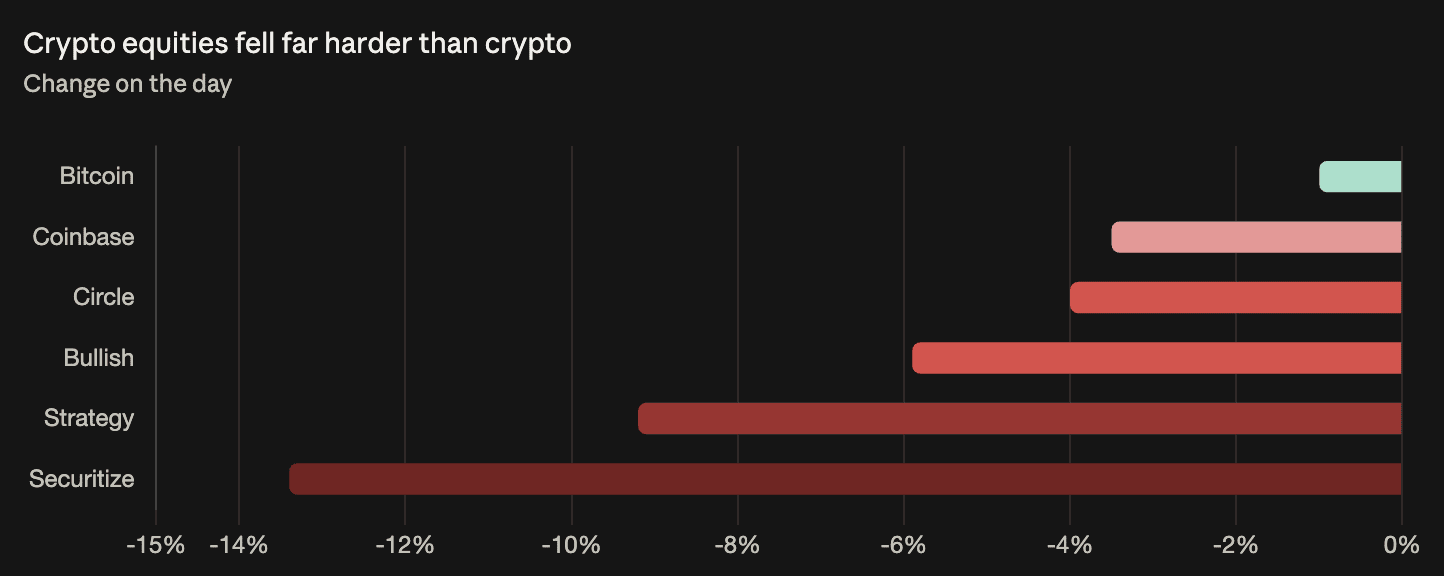
Against a 2.3% Nasdaq decline, a 22% VIX spike and crypto equities down between 3.5% and 13.4%, a 1% loss is relative strength. Bitcoin dipped alongside stocks in the morning and then stabilised as equity losses deepened in the afternoon.
One session does not establish decoupling, and Bitcoin has traded closely with rate expectations all month. But on a day when the correlation would have predicted a far larger fall, it did not come.
Strategy Fell Nine Times as Much as Bitcoin
Strategy dropped 9.2% to $136.83. Securitize fell 13.4%, Bullish 5.9%, Circle 4% and Coinbase 3.5%.
These equities normally act as leveraged proxies, amplifying Bitcoin’s direction. A 9.2% decline against Bitcoin’s 1% is not amplification of anything — it is the equity market pricing something the spot market is not.
The pattern has been building. On Friday morning, crypto equities fell in pre-market trading while Bitcoin rose. By the close the gap had widened considerably. Whatever is being sold in these names, it is not a view on the coin.
Goldman Quantified the AI Credit Problem
The clearest datum of the week came from Goldman Sachs credit research. Non-AI high-yield bond spreads were barely higher across the week, while AI-related spreads widened by 25 basis points.
“We view AI-related corporate bonds, from either neoclouds or firms with significant frontier lab exposure, as being at the epicenter of the funding cost debate,” said the bank’s Amanda Lynam.
That isolates the stress precisely. It is not a broad credit event and not a general risk-off. It is a repricing of the cost of financing AI infrastructure, and it explains why Korean memory names fell 9% to 11% on Thursday while optical communications stocks rose on Friday morning.
Former Bitcoin Miners Are Trading as AI Credit
CoreWeave fell 8%, extending its weekly decline past 20%. Hut 8, IREN, CleanSpark, Keel Infrastructure and Cipher Mining were each down roughly 6%.
Thursday’s bounce in the group, when many closed green after sharp early declines, lasted a single session.
Several of these companies are former Bitcoin miners that converted to hosting AI compute. They are now priced off data centre funding costs rather than off the Bitcoin price, which is why they can fall 6% on a day Bitcoin loses 1%. For a crypto desk, that is a reclassification worth tracking — the mining sector’s equity risk has migrated.
The Tech Selloff Resumed After One Day’s Relief
Selling restarted in US trading after Thursday’s recovery. Micron, Intel, AMD, Dell, SanDisk and KLA Tencor fell between 3% and 5%.
Declines among the largest technology names were more contained. Tesla opened with sizeable gains following an event the previous night and turned lower during the session. Apple was the only gainer among the megacap group, up 1.1%.
US refined product inventories remain at decade lows according to government data cited on social media, which gives the oil move a supply-side underpinning beyond any single headline.
Separately: NYC Comptroller Asks Anthropic to Delay Its IPO
New York City Comptroller Mark Levine wrote to Anthropic chief executive Dario Amodei this week urging the company to pause its planned initial public offering “until the company fully and transparently addresses the artificial intelligence safety, governance, and development pace concerns it has raised.”
Levine noted his role as investment adviser, custodian and trustee of New York City pension funds, which hold more than $325 billion in assets.
On the Black Monday Framing
Monday marks 39 years since the October 19, 1987 crash, when the S&P 500 fell more than 20% in a session.
The comparison does not hold up on the numbers. The Friday before that crash saw the S&P 500 drop about 5%; Friday’s Nasdaq decline was 2.15%. Thirty-nine years is also not an anniversary in any meaningful sense. The calendar coincidence is worth a line at most, not a frame.