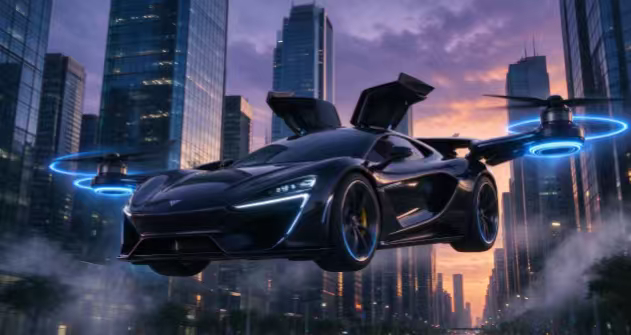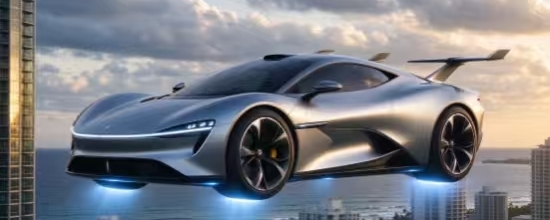

A lot of people have seen the news: Tesla has made a car that can fly. Let’s be clear: it’s not the kind of little car that can freely zip around over a city.
1. What makes it fly?
Regular cars drive on the ground using wheels. This Tesla flying car is equipped with high-pressure air tanks and nozzles. The tanks store compressed air, which is blasted downward to briefly lift the car through the force of the thrust—like a balloon shooting off with a whoosh when you let it go.
Key point: It can only jump into the air and fly for a short time. It can’t stay airborne for long. Once it runs out of air, it drops back down. It can’t be used for long-distance flights between cities, and it’s definitely not an airplane. It’s just a sports car with a jump-and-lift-off feature—an experimental vehicle for showing off its technology, not a finished car for everyday use by the general public.
2. The biggest challenge: There are no roads or traffic lights in the sky, so how do you prevent collisions?
On the ground, cars have roads, lane markings, traffic lights, and road signs to keep them within their lanes. The sky is three-dimensional: you can move in any direction, and there are no physical road markings of any kind.
Human eyesight simply isn’t up to the task! The sky is full of more than just other flying cars—it also has buildings, cranes, birds, and power lines. If people control the vehicles manually, it’s easy to miss something and collide with it.
So, to fly safely, the vehicles would have to be under computer control the entire time:
1. An air traffic management system, like air traffic police, would assign each flying car an altitude and route. Some might fly at 20 meters, others at 50 meters, keeping them at different heights to avoid head-on collisions.
2. Each vehicle would have its own radar and cameras to constantly scan for obstacles nearby. Even if the air traffic management system failed, the vehicle could avoid them automatically.
Even then, risks would remain high in heavy fog or rain, when sensors can’t clearly detect signals.
3. Can people adapt to riding in these flying cars?
Many people overlook this point: just because a vehicle can fly doesn’t mean people can handle the ride.
1. Motion sickness: Ground vehicles generally move smoothly forward, backward, and side to side. Flying cars would bob up and down, sway slightly, and climb or descend quickly. It would be like riding in a small helicopter, which makes many people feel airsick and nauseous. People who get carsick would probably feel even worse in a flying car.
2. Fear: You’d be dozens of meters above the ground, with nothing beneath your feet. Many people are instinctively afraid of heights, and turbulence could easily make them feel tense and panicky.
3. Physical forces: During an emergency maneuver or a rapid climb or descent, passengers would feel pushed back into their seats or experience weightlessness. Older people, children, and people with heart disease or high blood pressure might not be able to ride.
4. The cost: Would it be expensive to use?
Whether it’s Tesla’s jumping flying car or a genuine air vehicle for everyday transport in the future, it will cost a lot more to operate than an ordinary car.
1. The vehicle itself would be expensive: It would need compressed-air equipment, numerous radar sensors, an automated flight computer, and multiple safety systems. It would have far more components than an ordinary car, and its price would be much higher than that of a gas-powered car or a regular electric car.
2. Operating costs:
Tesla’s model relies on high-pressure gas, so it has to be refilled after every flight. Other electric flying cars would use a huge amount of power: the same battery that can take you hundreds of kilometers on the ground would provide less than half that range in the air.
3. High maintenance and inspection costs: It’s an aircraft, not an ordinary car. Regulations would require regular inspections by specialists, including checks of the propulsion system and sensors. Inspection standards would be much stricter than for cars, making maintenance more expensive.
4. Infrastructure costs: Roads and parking lots are everywhere on the ground. Flying cars would need dedicated takeoff and landing platforms, on rooftops or in open areas; they couldn’t just land anywhere. The cost of building these sites and providing charging and refueling facilities would ultimately be passed on to users.
5. Expensive insurance: An accident in the air could have far more serious consequences than a road accident, so insurance premiums would be very high.
5. A host of other practical challenges
1. Noise: If low-flying cars repeatedly passed over residential areas, the constant noise from jets or motors would be unbearable for residents below, leading to numerous noise complaints.
2. Safety in the event of a failure: If the propulsion system failed mid-flight, the vehicle might have a parachute, but the risk of losing control and plummeting through the air would be far greater than the risk of a car breaking down on the ground.
3. Regulation and oversight: On the ground, you just need a driver’s license. Aircraft flying at low altitudes must follow airspace management rules, but it’s still unclear who would oversee them and who would be liable in an accident. The entire regulatory framework is still incomplete.
6. When will ordinary people actually be able to use them?
In the short term (the next 10 years): Flying cars won’t be something every household owns. Even if the technology matures, they’ll only be used in a few pilot programs—for example, sightseeing in tourist areas, emergency medical services, and short trips between cities and suburbs. They’ll follow fixed routes and fly fully autonomously. Ordinary people will only be able to take one occasionally, like booking a ride-hailing car, not buy one and fly it wherever they want.
In the long term: Even if all the technical challenges are solved, airspace will still be strictly controlled. People won’t be allowed to fly wherever and whenever they like. There’s limited room in the sky, and if private flights were unrestricted, the risk of collisions would still increase as the number of vehicles grew, no matter how advanced the system was.
Summary
This Tesla flying car only demonstrates the technology that lets a vehicle briefly lift off the ground. The hardest part of making it practical for everyday commuting isn’t getting it to fly—it’s preventing collisions, ensuring a comfortable ride, keeping operating costs affordable, and addressing a host of regulatory and infrastructure issues.
Flying cars can be built, but making them as commonplace for everyday travel as today’s cars is still a very long way off.