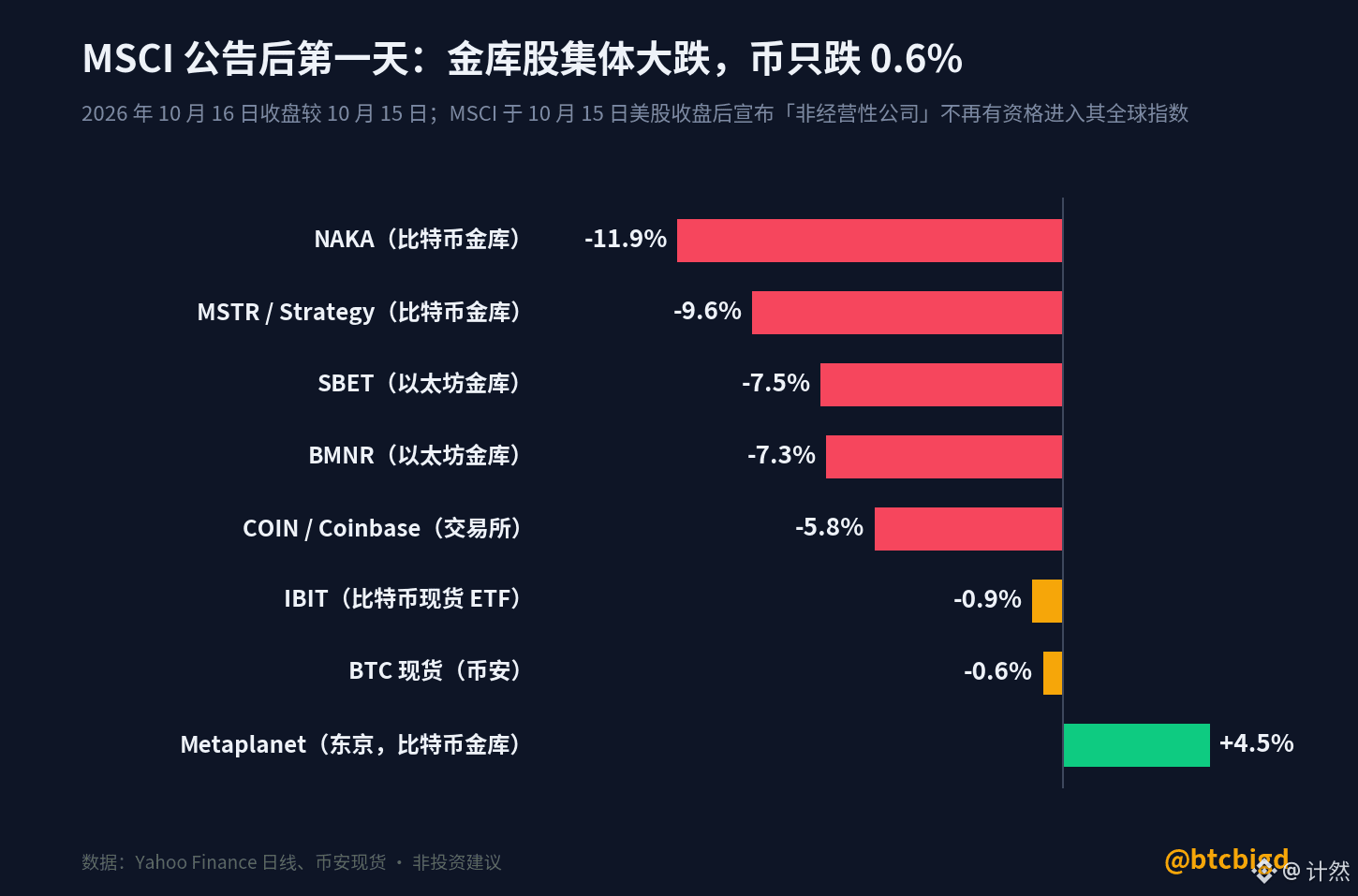
MSCI makes its move: MSTR plunges 9.6% in a day, Bitcoin treasury stocks tumble across the board, while Bitcoin falls just 0.6%
【First, two names to know】
“MSCI”: One of the world’s largest index providers. The MSCI Global Indexes are tracked by a large number of index funds. When a company is included in an index, those funds have to buy its shares in proportion; when it’s removed, they have to sell. Inclusion in an index directly determines whether a stock gets passive buying support.
“MSTR”: Strategy (formerly MicroStrategy), Michael Saylor’s company. It used to make software, but since 2020 it has put all the money raised by issuing shares and borrowing through bonds into buying Bitcoin. It now holds 848,250 coins—the most of any publicly listed company—which is why it’s called a “Bitcoin treasury stock.” Its share price has long traded above the value of the coins it holds. That premium has been sustained by continuously issuing shares and buying more Bitcoin.
【What happened】
- After the U.S. market closed on October 15, MSCI announced: “Non-operating companies” will no longer be eligible for the MSCI Global Investable Market Indexes. It will first check whether a company has substantial operating assets. Companies that fail that test will then be assessed against five financial ratios; those that meet four or more of the criteria will be excluded.
- Existing index constituents will be removed only if they fail to qualify for two consecutive annual reporting periods. “The list will be announced on November 11 and take effect after the close on November 30.”
- MSCI will also end its previous temporary freeze on companies whose “digital assets account for ≥50% of total assets.” These companies will be assessed under the general rules going forward.
【The reaction on October 16】
- “MSTR closed at 136.83 (−9.56%),” with 31.77 million shares traded—1.9 times the average volume over the previous five days. Other treasury stocks: NAKA −11.9%, SBET −7.5%, BMNR −7.3%; $COIN fell 5.8%.
- “$BTC spot closed at 81,745 (−0.61%),” while spot ETF IBIT fell 0.9%. Bitcoin barely moved; it was the premium of treasury stocks relative to their Bitcoin holdings that fell.
- Metaplanet in Tokyo, by contrast, rose 4.5%; the Japanese market has yet to follow suit.
【Why it matters】
- Removal means passive funds tracking MSCI have to sell. Analysts have reportedly warned that the resulting passive selling could run into billions of dollars.
- MSTR’s flywheel is “issue shares / preferred stock / convertible bonds → buy Bitcoin.” Passive demand from its index membership is one of the factors supporting its ability to issue shares at a premium. Without that support, “the premium could narrow, reducing the efficiency of issuing shares to buy Bitcoin.”
- From October 6 to 11, it bought only 250 coins; that same week, it repurchased $192 million worth of its STRC preferred stock.
【What’s still undecided】
- We won’t know until November 11 whether MSTR will make the removal list; the announcement didn’t say whether it has failed to qualify for both annual reporting periods.
- Saylor’s response on October 16 was a 21-second AI video: wearing a suit, he walks into a Tokyo alley, knocks over two bears, and walks out. Not a word spoken.
Do you think MSCI will really kick it out?