


Binance enabled the option to fund (deposit) and withdraw bolivars (VES) directly from its platform to Venezuelan banks via Pago Móvil or bank transfer, without having to find an individual counterparty in the P2P market.
Who is behind this agreement?
Binance: Operates under its international corporate framework. Binance does not directly process or custody bolivars in Venezuela.
Casa de Cambio Insular, S.A.: This is the Venezuelan financial institution that processes and provides custody for the local-currency (bolivar) on- and off-ramp. It is formally established as an entity under the supervision of SUDEBAN and the Central Bank of Venezuela (BCV).
2. Links to the Venezuelan Government and Allegations
Here’s where it gets good! ⬇️⬇️👀
What connections have been reported by journalistic investigations?
Carlos Lomeña Soto Rosa: According to journalistic investigations by independent outlets such as Armando.info, Carlos Lomeña is listed as the president/shareholder of Casa de Cambio Insular, S.A. The outlet’s investigations identify him as a business associate of the Abou Nassif family.
Abou Nassif family: Various investigations (including those by Armando.info and Vozpópuli) identify brothers Yussef, Omar, and Jamal Abou Nassif as businesspeople connected to multimillion-dollar state contracts for food imports and distribution (such as the CLAP food boxes through Corpovex and the Ministry of Food). The official greenback laundering machine! 🧼💸
Political connection: Various investigative reports link Yussef Abou Nassif romantically to Delcy Rodríguez (the country’s vice president), attributing privileged access to foreign currency allocations and government contracts to this relationship. A little $500K kiss! 💰💸
Have they been accused of crimes?
Some investigations: Allegations concerning the Abou Nassifs and their associates have been formally documented in investigative journalism reports regarding alleged overpricing, irregularities in government contracts, and corruption in food imports.
Legal status / sanctions: Although they have been the subject of international media reports, they have not been formally convicted in a public ruling by Venezuelan courts. However, these companies and individuals are widely mentioned in journalistic investigations linked to the regime’s network of contractors.
You can’t hide the sun with one finger! 👆🏼
3. Legal Framework and Oversight Regime
Which legal provisions govern this agreement?
General Law on Banks and Other Financial Institutions: Regulates the operations, foreign exchange transactions, and licensing of exchange houses in Venezuela. Casa de Cambio Insular, S.A. is legally required to comply with SUDEBAN’s supervisory frameworks.
Organic Tax Code (COT): Requires all financial and banking institutions in the country to cooperate with the Tax Administration (SENIAT), providing information about users’ financial movements and transactions automatically or upon request.
BCV Exchange Agreements: Establish the rules governing the official exchange rate and the purchase/sale of foreign currency or assets through authorized entities.
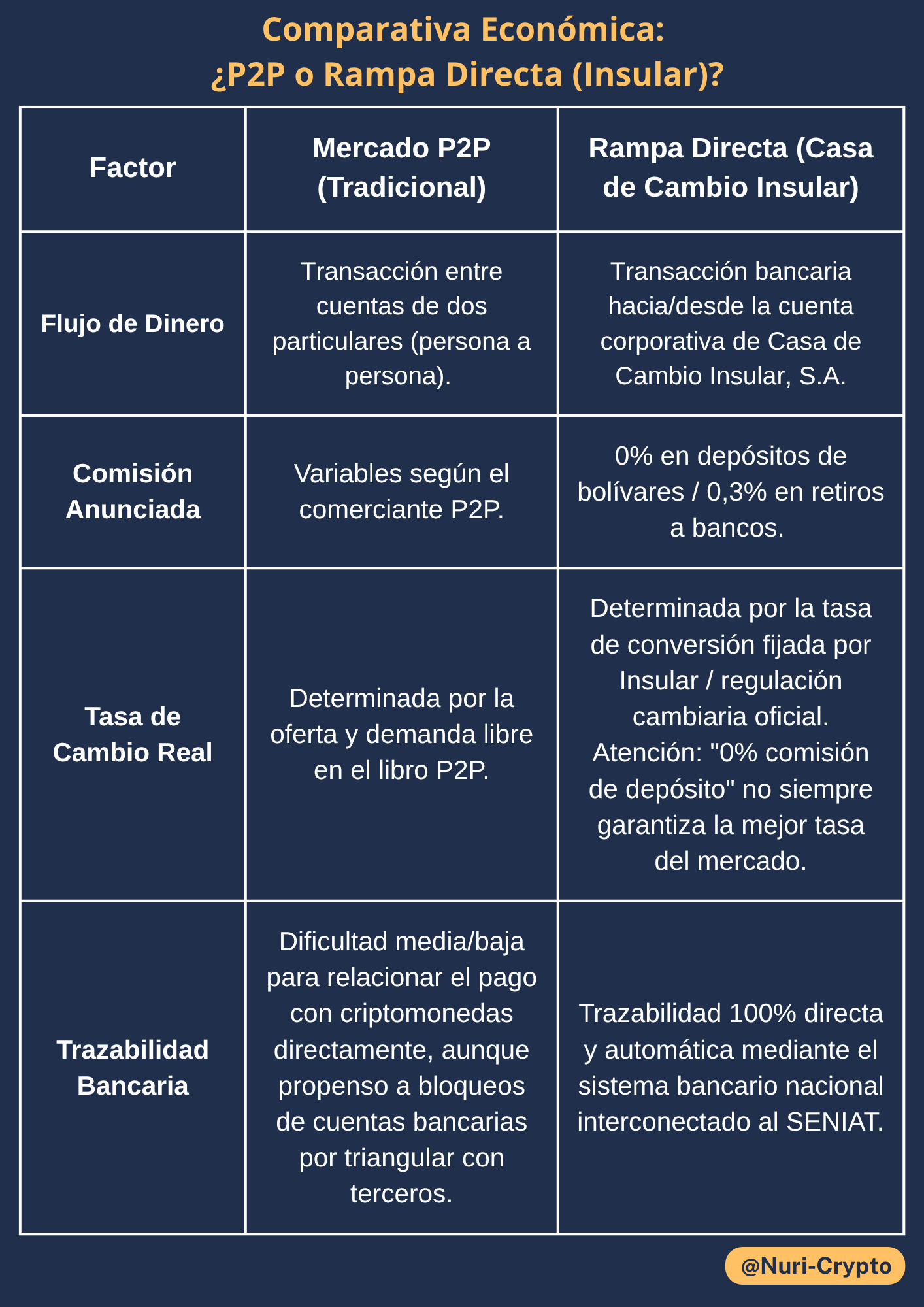
4. Economic Comparison: P2P or Direct On-Ramp (Insular)?
5. Consequences for the Average Citizen
Financial and Operational Consequences
Automatic Reporting of Data to SENIAT: Since SENIAT and SUDEBAN share data with banks and regulated entities, depositing or withdrawing bolivars through Casa de Cambio Insular automatically adds the user’s banking details and transaction amounts to the financial history monitored by the tax authorities.
Income and Tax Audits: Transacting significant or regular amounts through this official method increases the likelihood that SENIAT will require proof of the source of funds or payment of income tax (ISLR) or the Tax on Large Financial Transactions (IGTF) on those transactions.
They’ll soon come up with even more taxes to squeeze more “commissions” out of the average citizen. And just so we’re clear 👀, I’m not saying people should evade taxes, but everyone can decide whether to keep feeding these corrupt people’s bottomless wallets.
Greater Convenience / Lower Risk of P2P Scams: The operational advantage for users is that they don’t depend on a third party’s reputation or response time in P2P transactions, reducing the risk of scams or bank account freezes caused by triangulation.
In short:
If a citizen uses the Direct On-Ramp (Insular), they gain speed and eliminate the risk of falling victim to P2P scams; however, all their bolivar activity is fully formalized and banked, and visible to SENIAT and supervisory bodies. Traditional P2P, on the other hand, remains at a distance from the State’s official on-ramp, although it comes with the inherent risks of dealing with third parties and banking interruptions.
⚠️ This is not financial advice. Do your own research (DYOR).
I’d like to know what you think.
Will you try this new feature, or do you prefer to stick with P2P? Leave your answer in the comments.
Give me a like 👍 if you found this information useful, and follow me for more informative content. Share and quote 🔁 this article with your friends so they can learn about this new option too, and save it 💾 in case you need it later.
🔥 Join our public groups:
Trading is fantastic! 🔥🚀💵
Cryptocurrencies and stocks 💜🌹🔥
Los Fantásticos del Trading Classroom 📚
May the power of the trend be with you! 🔥💚🦁🔥
#BinanceLatam #venezuela #losfantasticosdeltrading #nuricrypto


