


AI is no longer content with just answering… it’s started paying too 🤖💰
For a long time, discussions about AI revolved around its ability to write text, analyze data, create images, and program.
But a new development has begun to change the picture:
What if an AI agent could pay for the service it needs itself?
📊 Figures that reveal the shift
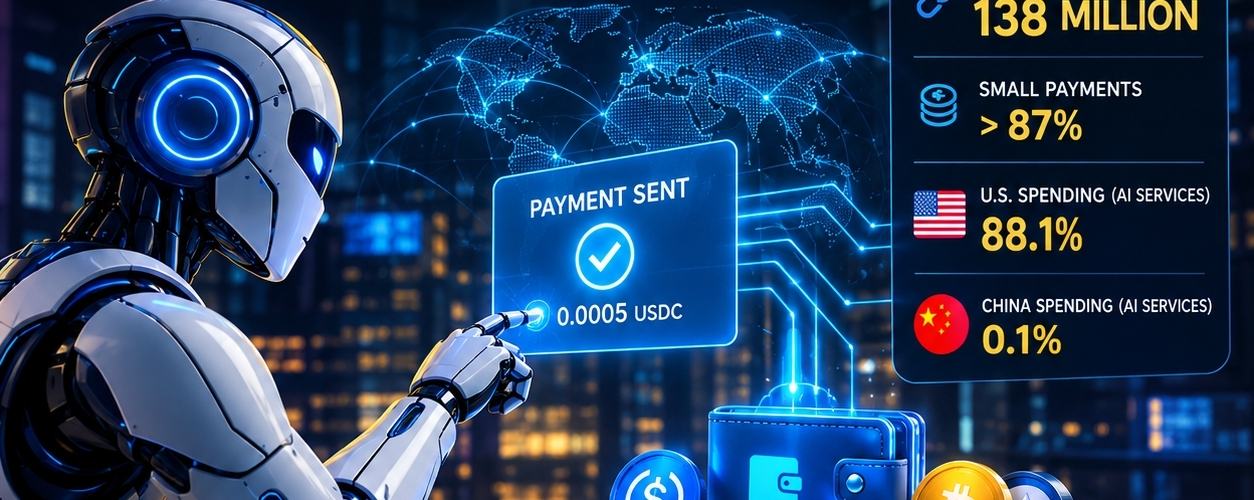
· Recent data from Chainalysis indicates that AI agents made more than 138 million cryptocurrency payments through the x402 protocol on the Base network over the year leading up to July 2026.
· More than 87% of the payments were very small payments.
· This reveals a different use for cryptocurrency: recurring automated payments of small amounts for digital services.
⚙️ How does it work?
Imagine an AI agent that operates around the clock.
It needs to:
· Retrieve specific data.
· Use another AI model.
· Purchase computing power.
· Access an API.
· Perform an analysis or security check.
Instead of waiting for human intervention each time, the agent can automatically send a small digital payment and receive the service.
🔗 This is where blockchain’s power comes in
Cryptocurrency can give software a way to pay online without needing a traditional bank account or human involvement in every transaction.
🇺🇸 The United States leads the way
The data also reveal significant differences between countries:
· Wallets linked to the United States accounted for about 88.1% of geographically identified payments for AI model inference services.
· By contrast, wallets linked to China accounted for about 0.1% of this type of spending.
· But China stood out in another area: wallets linked to the country accounted for about 90% of geographically identified payments for code security and analysis services.
This means that competition between AI and blockchain is not just about who has the best model, but also about who has the infrastructure that lets these models operate and interact economically with one another.
🤖 From “human user” to “automated user”
Perhaps this is the most important change.
Today, most blockchain users are human.
But in the economy of the future, we may have:
Human → AI agent → digital wallet → blockchain → digital service
In other words, AI could evolve from a tool used by humans into an economic actor capable of making decisions and spending small amounts to complete tasks.
This is where blockchain speed, low transaction costs, stablecoins, and micropayments become very important.
🚀 Are we seeing the emergence of a new trend?
It’s too early to say this will completely change the financial system.
But 138 million transactions suggest this is no longer just a theoretical idea.
The next stage may not simply be:
“Humans use AI.”
But rather:
“AI interacts economically with other AI.”
When millions of agents need to independently purchase data, computing power, software, and services, blockchain could become one of the most important infrastructures enabling these automated economies to operate.
The future may not be just a digital economy for humans… but an economy where machines also interact with one another. 🤖⛓️