


The biggest industry news recently is that StandX, built by the former founding team of Binance Futures, has officially announced that it will no longer issue a governance token. The project will gradually wind down, and early users will receive DUSD stablecoins as a one-time airdrop.
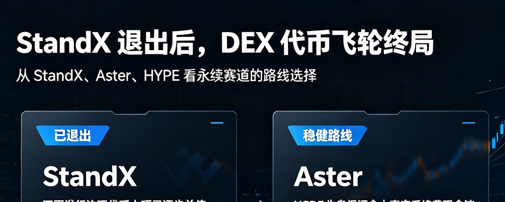
Many people may be surprised: StandX had a strong foundation. Its team members were veterans of Binance Futures, its product strategy was well thought out, and it focused on yield-bearing DUSD margin. After launch, it climbed to become one of the top four perpetual DEXs in the industry, with peak TVL exceeding $200 million, daily trading volume reaching as high as $700 million, and more than 230,000 users. It had no VC investment, and the market was expecting a token launch through a TGE. Instead, the team chose to abandon the token and cease operations. Comparing StandX, Aster, and HYPE reveals three completely different paths—and why only HYPE delivered a 100x run.
StandX: An elegant product model, but caught between token narrative and a cash-flow loop
StandX's underlying design was once compared side by side with Aster and HYPE. Its core offering was an interest-bearing DUSD stablecoin paired with an order-book perpetual DEX. Users could deposit DUSD as trading margin without staking anything extra, and the margin would automatically earn yield. At the time, this interest-bearing margin model was considered smoother than Aster's or HYPE's.
With Aster's USDF, users have to take manual steps to earn yield on their margin; HYPE's early USDH also required users to opt in. StandX's DUSD, by contrast, earned interest automatically as soon as it was deposited into a trading account, making it theoretically optimal in terms of capital efficiency.
The team came from Binance Futures and understood derivatives trading and risk management. It built a polished, professional product. But its biggest dilemma was that the business could work, while the token economics were difficult to make work.
The original plan was to issue a governance token whose value would be backed by platform fees and returns from the DUSD ecosystem. But after evaluating the situation, the team realized that issuing a token would bring the same challenges faced by Aster and HYPE: token valuation, selling pressure, community expectations, and the market's approach to pricing derivatives DEX tokens.
Once a token is issued, the team has to design inflation, unlocks, and incentives—and then keep dealing with token supply dynamics. Even without VCs, early-user airdrops and mining incentives can create enormous potential selling pressure.
In the end, the team made an unusual choice: issue no token, shut down the project, and wrap things up by airdropping stablecoins to users. In effect, it chose to give up on token capitalization altogether.
In short: the product could generate trading volume, but the team judged that it would be difficult to replicate HYPE's “fees → buybacks and burns → deflationary flywheel.” It didn't want to enter a long struggle over token supply dynamics.
Aster: Real cash flow, modest valuation, and a conservative, steady approach
Aster is also in the interest-bearing margin sector. USDF is its core stablecoin, and perpetual trading on the platform generates real fees and tangible cash flow.
Its Aster token was issued, but the approach is relatively conservative. The business generates real revenue, so the market is willing to value it based on cash flow, but not at the kind of premium HYPE commands.
Aster's model generates revenue, but it lacks HYPE's powerful flywheel of automatic protocol buybacks and burns. More of the yield goes to stablecoin users, so the token is less effective at capturing cash flow.
Its strengths are a stable foundation and risks that the market has already priced in, without any extreme token supply shakeout. Its weakness is the lack of a powerful deflationary engine, making a long-term, hundredfold trend like HYPE's difficult to achieve. It earns steady money from its business, not money from expectations and a premium on market consensus.
HYPE: The only one to build “trading fees → automatic buybacks and burns” into a protocol-level flywheel
HYPE (Hyperliquid) took the path that the StandX team gave up: the most difficult route, but also the one with the greatest upside.
Hyperliquid also operates a perpetual DEX and earns real trading fees. Its protocol rules are explicit: the vast majority of fees flow into the Assistance Fund, which automatically buys back HYPE on the secondary market and burns it.
This closed loop is the key difference: higher trading volume means more fees, which means stronger automatic buying pressure. The circulating token supply keeps shrinking, creating a virtuous flywheel.
This was paired with the design of its early airdrop allocation: tokens went to genuine traders, with no lockups. After launch, the token traded sideways for a long time, shaking out many zero-cost airdrop recipients and completing a change of hands. Once the weak hands had been cleared out, the ongoing buyback-and-burn flywheel helped drive a hundredfold rally from 3.9U to nearly 100U.
A comparison of the three core approaches
1. StandX: Strong product, gave up on token capitalization, and exited outright
It could generate trading volume and had an interest-bearing stablecoin, but the team judged that building a HYPE-level token flywheel would be too difficult. It wasn't willing to take on the token supply battles and pressure from community expectations that come after a token launch. So it chose not to issue a token and wound things down in an orderly way. This is the key lesson: trading volume for a perpetual DEX does not mean its token will succeed. No matter how good the trading product is, if the tokenomics can't hold up, the project is unlikely to gain traction.
2. Aster: Issued a token and has real cash flow, but lacks a powerful automatic deflationary flywheel
The business is stable and its cash flow is tangible, making it a lower-risk, lower-upside proposition. It can keep growing steadily over the long term, but is unlikely to create the kind of self-reinforcing upward cycle HYPE has. The token is mostly for governance, with limited yield capture, and lacks the underlying buying pressure of protocol-mandated buybacks and burns.
3. HYPE: A complete loop that turns business cash flow directly into permanent buying pressure for the token
The product, airdrop-driven shakeout, and buyback-and-burn flywheel all work together. Trading fees automatically become buyback funds, continuously reducing the circulating supply. Even when the broader market pulls back, the protocol's buying continues, giving it significantly greater resilience. That's why it has been able to deliver a major long-term rally.
What StandX's exit tells us about the sector
Many people assume that if you build a good perpetual DEX product and attract trading volume, a token launch will take off. StandX's outcome dispels that illusion.
In the derivatives DEX sector, the product is the foundation, but the tokenomics flywheel is what determines the ceiling.
• Product without a token flywheel: StandX is an example. The business worked, but the team gave up on the token narrative and ultimately shut it down.
• A business and a token, but no powerful deflationary mechanism: Aster is steady, but is unlikely to deliver an explosive rally.
• Business activity plus protocol-level automatic buybacks and burns, combined with token supply management: this is HYPE's approach. It's the most difficult to pull off, but it can deliver an enormous trend.
Of course, risks remain. HYPE's entire thesis depends heavily on DEX trading volume. If trading activity declines, fees will fall and buybacks will weaken. It also faces risks such as regulation, competition, and selling pressure from team token unlocks. Aster also runs the risk of trading volume growth falling short of expectations. The StandX case also shows that even a top-tier team from Binance Futures may choose to forgo issuing a token. The bar for token capitalization is far higher than simply building a product.
Summary
StandX's exit wasn't a product failure. The team simply decided it didn't want to recreate HYPE's high-difficulty game of token supply management and a deflationary flywheel.
Aster took a middle path: it kept its token and is growing gradually through real cash flow. HYPE, meanwhile, is one of the very few projects in this sector to have fully established a virtuous flywheel in which business activity generates fees that are automatically used for buybacks and burns.
Comparing the three makes one thing clear: in the perpetual DEX sector, trading volume is just the entry ticket. A token's ability to capture cash flow, manage its supply, and complete a deflationary loop are the real dividing lines that determine whether a project can deliver a major rally.