

When you deposit money on a cryptocurrency exchange, one question matters more than almost anything else: what happens to your assets if something goes wrong?
A platform may offer advanced security features, publish wallet addresses and report that customer assets are backed by reserves. But these measures serve different purposes. Preventing unauthorized access is not the same as proving that customer balances are backed by assets, and neither automatically guarantees that users will recover their funds after every possible incident.
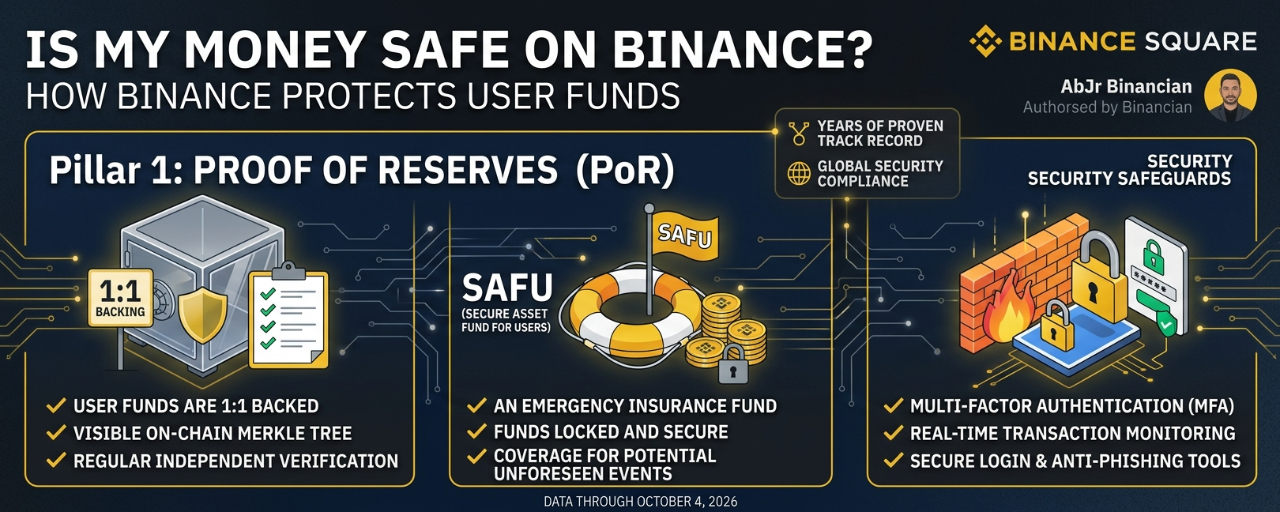
Binance uses several layers of protection, including Proof of Reserves (PoR), the Secure Asset Fund for Users (SAFU), account security controls and systems designed to detect suspicious activity.
Understanding how these mechanisms work and what they cannot guarantee helps users make more informed decisions about storing and managing crypto.
How Does Binance Protect Customer Funds?
Binance's approach combines asset transparency, emergency reserves and account-level security measures.
Each layer addresses a different risk. Proof of Reserves provides evidence about the assets held against customer balances. SAFU is an emergency fund intended to help protect users in qualifying security incidents. Account safeguards help reduce the likelihood of unauthorized access, fraudulent withdrawals and other suspicious activity.
For individual users, security also depends on how their accounts are configured and used. A well-protected exchange account can still be compromised if someone reveals their authentication details, approves a fraudulent transaction or transfers funds to a scammer.
Binance's security guidance recommends layered protections such as biometrics, passkeys and an Anti-Phishing Code. Its security systems may also flag suspicious activity and temporarily restrict withdrawals while additional checks are performed.
Read Binance's 2026 account security guide.
The important point is that no single measure covers every risk. Asset backing, emergency compensation, account protection and responsible user behavior work together, but they are not interchangeable.
What Is Binance's Proof of Reserves and How Does It Work?
Proof of Reserves is a mechanism that allows users to examine evidence that an exchange holds assets corresponding to its reported customer balances.
Binance's PoR system is designed to demonstrate that covered customer assets are backed on a 1:1 basis, with additional reserves. Users can inspect published reserve information and independently verify that their account balances were included in a particular verification snapshot.
View Binance's official Proof of Reserves page.
Merkle trees: Making account balances verifiable
Binance uses a cryptographic structure called a Merkle tree to organize account-balance information.
Individual records are hashed and combined into a structure that produces a single summary value known as a Merkle root. If information in the underlying records changes, the resulting root changes too.
This structure allows a user to verify that their balance was included in the relevant dataset without being given access to other customers' private account information.
Binance also uses zero-knowledge succinct non-interactive arguments of knowledge (zk-SNARKs) to help verify properties of the reported balances while preserving privacy. The system is designed to establish that account balances are included in the aggregate calculation and that the relevant balance constraints are satisfied.
In practical terms, users can check whether their account was included in a particular PoR snapshot rather than relying exclusively on a general statement from the exchange.
How can you check your Binance balance?
Binance's published verification guidance describes the following process:
Open Binance's official website and sign in.
Navigate to Wallet and select the verification option.
Choose the relevant verification date.
Review your record information and use the available verification method to check that your account was included in the reported balance data.
Binance publishes monthly PoR snapshots, with the snapshot taken on the first day of the month at 00:00 UTC and results scheduled for release by the seventh, according to its verification FAQ updated in August 2026.
Read the official account verification instructions.
What Proof of Reserves does not prove
PoR is a transparency mechanism, not an unlimited guarantee of financial solvency.
A snapshot shows information at a particular point in time. It does not, by itself, establish that the exchange will remain solvent in the future, that every possible liability has been captured, or that every asset can be liquidated immediately under all market conditions.
It is therefore important to distinguish evidence of reserve coverage from a comprehensive assessment of an institution's financial position. Users should consider the methodology, scope and limitations of the published verification rather than treating the phrase “1:1 backing” as a guarantee against every possible failure.
What Is Binance's SAFU Fund and How Does It Protect Users?
SAFU stands for Secure Asset Fund for Users. Binance established it as an emergency fund intended to help protect users' assets in qualifying security incidents.
Binance originally allocated a portion of trading fees toward building the fund. According to its official FAQ, as of January 2026, SAFU comprised approximately US$1 billion in USDC. The fund's value and composition can change, and the current amount should be checked against Binance's latest disclosures.
What happened during the 2019 Binance hack?
On May 7, 2019, Binance disclosed a security breach in which attackers withdrew approximately 7,000 BTC from its hot wallet. Binance said the incident affected its BTC hot wallet, which held around 2% of its total BTC holdings at the time.
The exchange subsequently stated that affected users would not bear the loss and that the incident would be covered by SAFU.
The incident demonstrated the intended role of an emergency reserve: to provide a financial resource for responding to a qualifying security event without passing that particular loss on to affected users.
Read Binance's original security breach announcement.
Does SAFU guarantee reimbursement after every incident?
No. SAFU should not be interpreted as unconditional insurance for every loss experienced by every user.
Its purpose is to help protect users in qualifying circumstances, particularly security incidents. Whether a specific loss is covered depends on the circumstances and applicable terms. A loss caused by a user sending funds to a scammer, for example, is not automatically equivalent to a breach of the exchange's own security.
SAFU also does not replace Proof of Reserves. One is an emergency fund; the other provides evidence about asset backing. They address different questions.
How Does Binance Use AI and Security Technology to Protect User Assets?
Security involves more than keeping assets in reserve. Exchanges also need to protect accounts, identify suspicious behavior and prevent unauthorized transactions from being completed.
Binance describes several layers of account protection and risk monitoring.
Passkeys and biometrics can strengthen authentication by using cryptographic credentials or device-based identity verification on supported devices. These methods can reduce reliance on passwords alone.
Anti-Phishing Codes help users distinguish official Binance communications from fraudulent messages. Users should configure the feature through the official platform and verify that the expected code appears in applicable communications.
Risk monitoring and withdrawal controls can help detect unusual account behavior. Binance says it may temporarily pause withdrawals when risk signals indicate a potential threat, pending security checks and confirmation from the account holder.
AI-assisted security analysis can help process signals and identify suspicious patterns at scale. However, AI should be understood as one component of a broader security system, not a guarantee that every scam, account takeover or fraudulent transaction will be detected.
These protections work best as layers. A suspicious message may bypass neither a user's awareness nor their authentication controls, while withdrawal monitoring may provide another opportunity to stop an unusual transaction.
Explore Binance's account security guidance.
Users should also take responsibility for their own security: never share passwords or authentication codes, avoid unknown links, secure the email account associated with Binance, enable available authentication features and review withdrawal addresses carefully.
What Happens to My Assets if a Crypto Exchange Becomes Insolvent?
This is one of the most important questions for anyone holding cryptocurrency on a centralized platform.
If an exchange becomes insolvent, the outcome can depend on its legal structure, the custody arrangements for customer assets, applicable laws, the treatment of customer claims and whether the assets available are sufficient to meet its obligations.
Customers may face restrictions on withdrawals while administrators, courts or relevant authorities determine how assets and claims should be handled. Recovery could take time, and full recovery is not guaranteed.
Proof of Reserves can provide useful evidence about the assets reported at a particular snapshot. However, it does not independently resolve every question about off-chain liabilities, future obligations or the legal treatment of customer property during insolvency.
Similarly, SAFU is an emergency protection mechanism, not a blanket guarantee that every customer will recover every asset if Binance or another exchange becomes insolvent.
For users, the practical lesson is to consider not only security features, but also custody arrangements, transparency, applicable terms and the amount of money they are comfortable keeping on a centralized platform.
Long-term storage decisions deserve particular attention. Some users choose self-custody for assets they do not need to keep readily available for exchange trading, but self-custody introduces its own risks, including losing a recovery phrase or signing a malicious transaction. Neither approach eliminates every risk.
Frequently Asked Questions
Is my money safe on Binance?
Binance provides multiple safeguards, including Proof of Reserves, SAFU, account security features and risk monitoring. These mechanisms can reduce certain risks and provide evidence about asset backing, but they cannot guarantee that losses will never occur. Your risk also depends on account security, your own transactions, product terms and broader market or institutional conditions.
What happens to my money if Binance shuts down?
The outcome would depend on the circumstances, applicable laws, custody arrangements and the assets and liabilities involved. Withdrawals could be delayed or restricted during an insolvency or restructuring process, and full recovery is not guaranteed. Proof of Reserves and SAFU should not be interpreted as a promise that every customer will recover all funds in every shutdown scenario.
What security measures does Binance use to prevent unauthorized transactions?
Binance offers security measures including passkeys, biometrics on supported devices, Anti-Phishing Codes, account verification and risk-based monitoring. It may also temporarily pause withdrawals when suspicious activity is detected. Users should enable appropriate security settings, protect their authentication credentials and verify transactions before approving them.
How is Binance's SAFU fund different from Proof of Reserves?
Proof of Reserves provides evidence about whether covered customer balances are included in a reported reserve-verification process. SAFU is an emergency fund intended to help protect users in qualifying security incidents. PoR concerns asset transparency and backing; SAFU concerns emergency financial protection. Neither replaces the other.
Does Binance reimburse users if funds are stolen in a hack?
Binance has previously covered user losses following a major security incident. In May 2019, after approximately 7,000 BTC was stolen from its hot wallet, Binance stated that affected users would not bear the loss and that SAFU would cover the incident. However, this historical response does not establish automatic reimbursement for every future hack, scam, account compromise or user-caused loss. Coverage depends on the incident and applicable terms.
Final Takeaway
Understanding how an exchange protects user funds requires looking beyond a single security claim.
Binance's Proof of Reserves system gives users a way to verify inclusion in reported account-balance data. SAFU provides an emergency financial resource intended to help protect users in qualifying security incidents. Account-level safeguards and risk monitoring aim to reduce the chance of unauthorized access and suspicious transactions.
Each mechanism has a different purpose and limitations.
For users, the most useful approach is to verify the available evidence, enable strong account security, understand the risks of the products they use and avoid assuming that any exchange can guarantee complete protection under every circumstance.
Transparency can help you assess risk. Security controls can reduce risk. Emergency funds can help respond to certain incidents. None should be mistaken for a guarantee that loss is impossible.
Disclaimer
This article is for educational and informational purposes only and is not financial, legal or investment advice. Descriptions of Binance's security measures and funds are based on its published documentation and should not be treated as an independent guarantee of solvency or reimbursement. Fund values, features and terms can change. Verify current disclosures directly with Binance and consider your own risk tolerance before deciding how to store digital assets.