


Polygon emerged with an important mission in the world of cryptocurrencies: to help solve one of Ethereum’s biggest challenges—the cost and processing capacity of transactions.
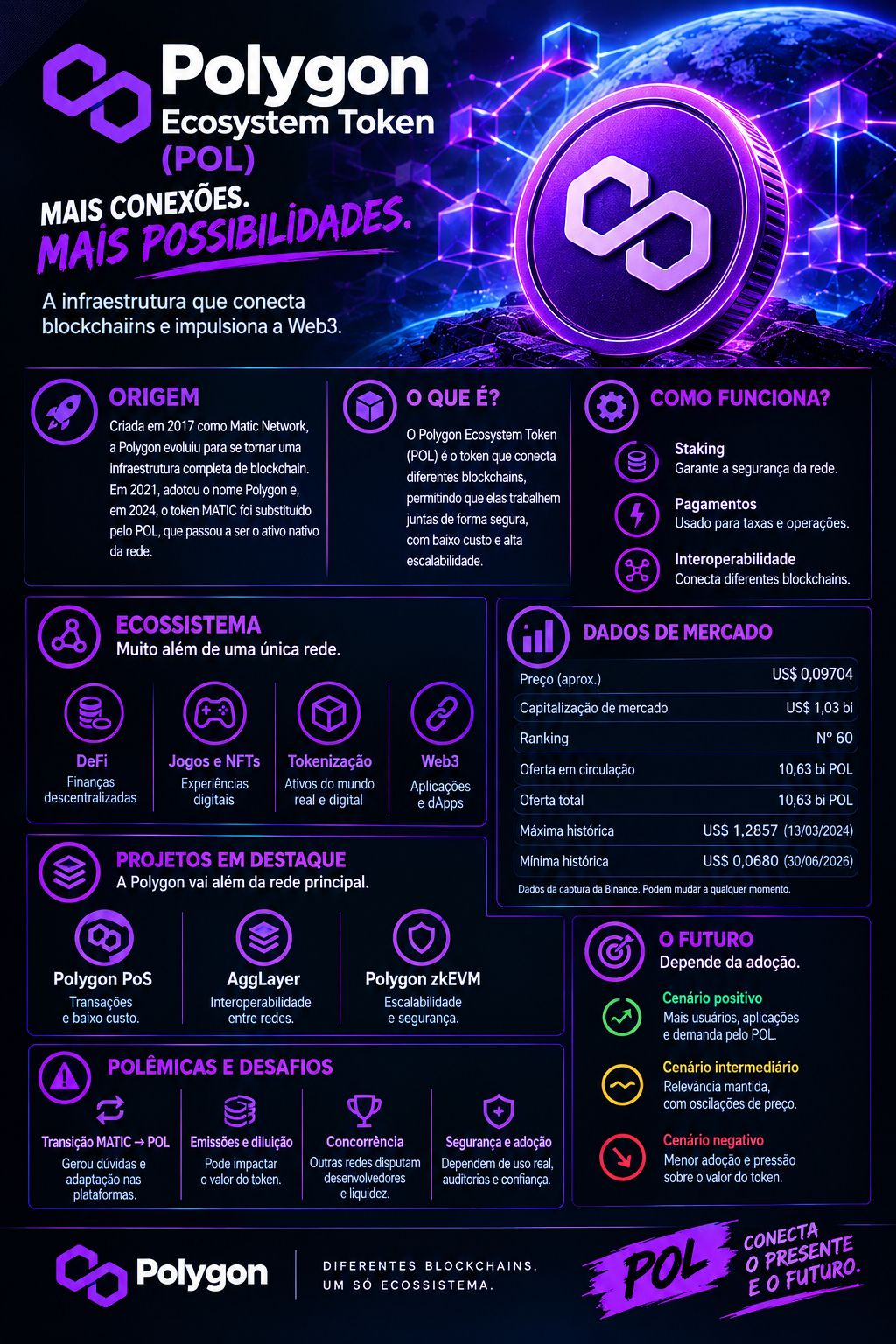
Originally known as Matic Network, the initiative began in 2017 and gained prominence by developing solutions to make blockchain applications more accessible. In 2021, the project adopted the name Polygon and expanded its vision beyond a single network, aiming to provide infrastructure for decentralized applications, games, digital finance, and other Web3 services.
During this evolution, the MATIC token became known for being used to pay fees and secure the Polygon PoS network. In September 2024, an important change took place: MATIC was replaced by POL, which became the native fee and staking token of Polygon PoS.
Polygon is a blockchain infrastructure ecosystem associated with Ethereum. Its Polygon PoS network enables transactions and applications compatible with the Ethereum environment, generally with lower costs and faster processing.
This makes the infrastructure useful across different segments:
- DeFi: lending, trading, and other decentralized financial services.
- Payments: digital transfers with potentially lower fees.
- Gaming and NFTs: applications that need to record many operations.
- Tokenization: digital representation of assets and other rights.
- Web3 applications: services that use smart contracts and digital wallets.
Polygon PoS is one of the best-known parts of this ecosystem. At the same time, the project is developing a broader vision of interoperability, seeking to facilitate communication between different blockchains.
POL is the native asset of Polygon PoS and has practical functions within the network.
1. Paying fees
The token is used to pay transaction fees on Polygon PoS. The greater the economic activity and network usage, the greater the asset’s operational demand may be—although this alone does not determine its price.
2. Staking and security
POL can be delegated to validators to help secure the network. In return, participants may receive rewards, subject to protocol conditions and validator performance. Staking involves risks and does not guarantee a fixed return.
3. Ecosystem development
The project proposes expanding POL’s utility as the Polygon infrastructure evolves, including potential functions related to interoperability and AggLayer. The implementation of these functions depends on technical development and the corresponding governance decisions.
It is important to distinguish existing utility from a future possibility: expanding POL’s role is a development thesis, not a guarantee of appreciation.
Polygon has technology and products in development, but it also faces significant challenges.
1. The transition from MATIC to POL
The token change required wallets, platforms, and users to adapt. On Polygon PoS, migration occurred automatically for holders on the network itself, while certain balances on other networks required specific procedures. Confusion between the MATIC and POL tickers may continue to raise questions, especially for those who hold assets across different environments.
2. Issuance and dilution
POL’s initial tokenomics design provided for benchmark annual issuance of 2%, allocated to network security and ecosystem development, with the possibility of changes through community decisions. Issuance can fund validators and growth initiatives, but it also needs to be assessed in relation to demand and holder dilution.
3. Intense competition
Polygon competes for market share with other Ethereum networks and scaling solutions, as well as independent blockchains. Low fees alone do not guarantee a competitive advantage: developers and users also consider liquidity, security, ease of use, and application availability.
4. Real adoption and sustainability
Infrastructure growth needs to be reflected in concrete indicators, such as active users, meaningful transactions, application volume, liquidity, and developer activity. Announcements and partnerships can generate optimism, but they do not replace evidence of consistent usage.
5. Security and interoperability
Bridges between networks and smart contracts can introduce technical risks. The greater the integration between different blockchains, the more important it becomes to assess audits, protective mechanisms, and incident response procedures.
Polygon began by seeking to make the Ethereum experience more accessible, and today it is trying to broaden its role to become infrastructure capable of connecting different networks and applications.
POL has concrete functions on Polygon PoS, mainly in paying fees and staking. Its long-term outlook, however, depends on more than the change from MATIC to POL or the promise of interoperability: it depends on the network gaining consistent usage and turning technological development into real demand.
The key question for investors is not just whether Polygon has promising technology, but whether it can maintain its relevance in an increasingly competitive market.
If adoption grows and the vision of interoperability materializes, POL could benefit from the ecosystem’s development. Even so, market risks, competition, issuance, and execution challenges remain.