

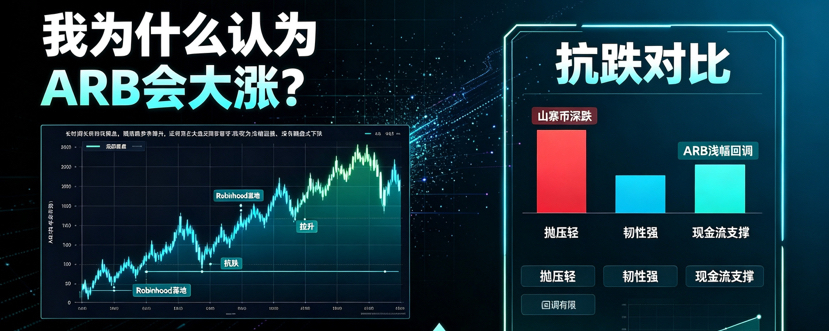

The overall crypto market has been in rough shape lately. Many altcoins have lost half their value from their highs. You can scroll through the charts and find sharp drops everywhere. But many people have noticed one clear thing: although ARB has dipped slightly along with the broader market, it hasn’t fallen much, and there’s been no crash-like sell-off. Looking back at the past six months makes it clear this isn’t a coincidence—there have been real, tangible changes in the fundamentals.
April–June: A long stretch of bottoming out, with no one bullish on L2s
In April and May this year, all the market hype was around meme coins and various new, low-quality tokens. Hardly anyone was talking about Layer 2. ARB traded sideways near the bottom, with its price stuck in the $0.07–$0.13 range for a long time.
At the time, the market’s consensus was simple: competition in the L2 space was too fierce, and ARB only had voting and governance rights, with no claim on business revenue. Its income came mostly from on-chain transaction gas fees, making a major rally seem unlikely. Most people saw it as a mature, established L2 whose growth had peaked and that had no new story to tell.
But things were already changing quietly on-chain. Arbitrum had finished refining its Orbit chain solution for tenants and was beginning to work with traditional financial institutions. Its plans for tokenized RWA assets were already taking shape, but ordinary retail investors rarely paid attention to these underlying developments. On-chain trading volumes and stablecoin transfer volumes had stabilized, and the ecosystem wasn’t shrinking just because the market was quiet.
July: A key turning point for the market—Robinhood Chain launches
July was the most important moment in this ARB market cycle. Robinhood Chain—the chain for tokenized U.S. stocks—is built on Arbitrum Orbit. Under the agreement, a share of the net revenue generated by the chain will flow back into the Arbitrum DAO treasury.
This is completely different from gas fees generated by transfers within crypto: it’s new cash flow from retail investors outside crypto trading tokenized stocks. Robinhood is just the first real-world example, and the Orbit tenant-chain model can be replicated. Other financial institutions can build their own dedicated chains on Arbitrum, with each tenant chain continually generating revenue shares for the DAO.
The market gradually caught on: ARB was no longer just an L2 earning gas fees. It had become foundational infrastructure for traditional financial institutions building their own blockchains.
August: Capital flows in and ARB rallies
As trading volume on Robinhood Chain kept rising, the market began to take notice of the potential new revenue. ARB started climbing, surging from $0.13 to a high of $0.20—nearly a 150% gain at its peak.
This rally wasn’t the kind of move driven by hot money pumping prices overnight. The price action felt more like long-term capital entering gradually, pushing prices up while shaking out weaker hands—a relatively steady climb. The DAO treasury’s assets were also growing steadily. It held not only ARB but also a substantial amount of stable assets, making its reserves increasingly solid.
September–October: As the broader market sold off, ARB showed its resilience
Later, sentiment across the broader market weakened and fear spread, sending many altcoins sharply lower. ARB stood out by comparison. Although it pulled back along with the market, its losses were limited, with none of the signs of a collapse driven by investors rushing for the exits at any price.
Even amid market volatility, trading activity on Robinhood Chain and the revenue share going to the Arbitrum DAO did not stop.
This resilience ultimately reflects investors’ choices. When conditions turn bad, capital flees small tokens that rely solely on hype and lack real business activity. ARB has the prospect of new revenue, a well-funded treasury, and a leading Ethereum L2 ecosystem behind it. Long-term investors are less willing to give up their holdings, so selling pressure is naturally much lighter.
Why I’m bullish on ARB over the medium to long term
1. Foundational infrastructure for RWAs, with far greater potential than ordinary projects
UNI facilitates the trading and exchange of assets, while ARB provides the on-chain infrastructure for these RWA assets. Real-world assets such as tokenized stocks and bonds need a secure, reliable L2 for on-chain trading, and Orbit tenant chains are an appealing option for institutions. Robinhood is only the first deal; this model can expand further and bring traditional capital from outside crypto into the ecosystem.
2. The treasury continues to accumulate assets, reshaping the token’s value proposition
The main reason people were previously bearish on ARB was that the token had no claim on business revenue and could only be used for voting. Now, tenant chains are generating a steady stream of cash flow, all of which goes into the DAO treasury, steadily building up its reserves.
Although the funds are not currently being used to buy back and burn ARB directly, the treasury holds a large amount of stable assets. The community can vote on how to use those funds in the future, potentially helping to ease selling pressure on the token. This is a very different proposition from the one investors saw in previous years.
3. The leading L2’s moat is clear, and its ecosystem is built on solid foundations
Arbitrum has the largest ecosystem among Ethereum L2s, and its security and reliability have been tested by the market over many years. A wide range of DeFi, derivatives, and RWA projects have chosen to deploy there. This isn’t a new project making up a story from scratch—its users, trading volume, and developer resources have all been built up over time.
4. This market pullback has already tested the resilience of holders
This downturn served as a stress test. When panic selling hit the broader market, ARB wasn’t dumped indiscriminately, suggesting that many long-term investors are willing to hold at current levels. If market sentiment improves while RWA activity continues to grow, ARB could easily see another round of revaluation.
Risks also need to be viewed objectively
1. Regulation is the biggest variable. If the U.S. tightens its policies on tokenized stocks and RWAs, Robinhood Chain’s business could face restrictions, directly affecting its new revenue.
2. Token unlock pressure. Tokens will continue to unlock through 2027, potentially creating periodic selling pressure.
3. Governance uncertainty. The DAO community decides how treasury funds are used through a vote, and revenue may not translate directly into buying pressure.
4. Competition in the sector. Other L2s are also competing for institutional tenant-chain business, so customers could be drawn away.