

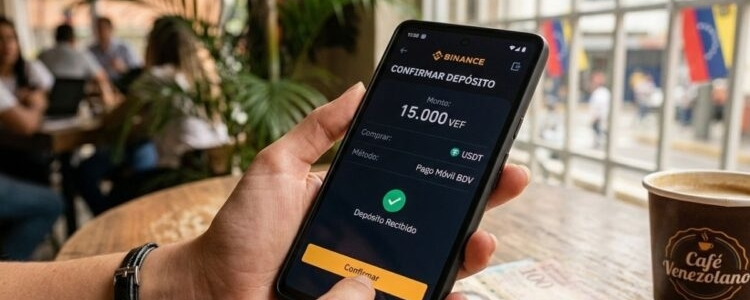

The cryptocurrency exchange has added commission-free deposits in the local currency via bank transfers and Pago Móvil.
Binance stipulates that the money must come from a bank account in the user's own name
Binance expects to enable the feature for transferring bolivars to third-party accounts soon.
Processing is handled through the regulated entity Casa de Cambios Insular.
The cryptocurrency exchange Binance has enabled bolivar deposits for users in Venezuela. The feature lets users add funds via Pago Móvil or bank transfers with no fees, providing direct access to stablecoin purchases.
With the deposited bolívares, users can trade USDT, USDC, USD1, U, and other stablecoins—assets designed to maintain a value equivalent to the U.S. dollar—according to Binance’s website.
Although Binance says the service is already active, it has not yet been rolled out to all accounts. CriptoNoticias was able to verify firsthand that the tool is still not enabled for all users in the country.
The process is handled through the mobile app. Users must tap “Deposit,” choose the “VES” option—the international code for the bolívar—and select “Deposit Bolívares.” The system then asks them to choose a payment method and enter the required details.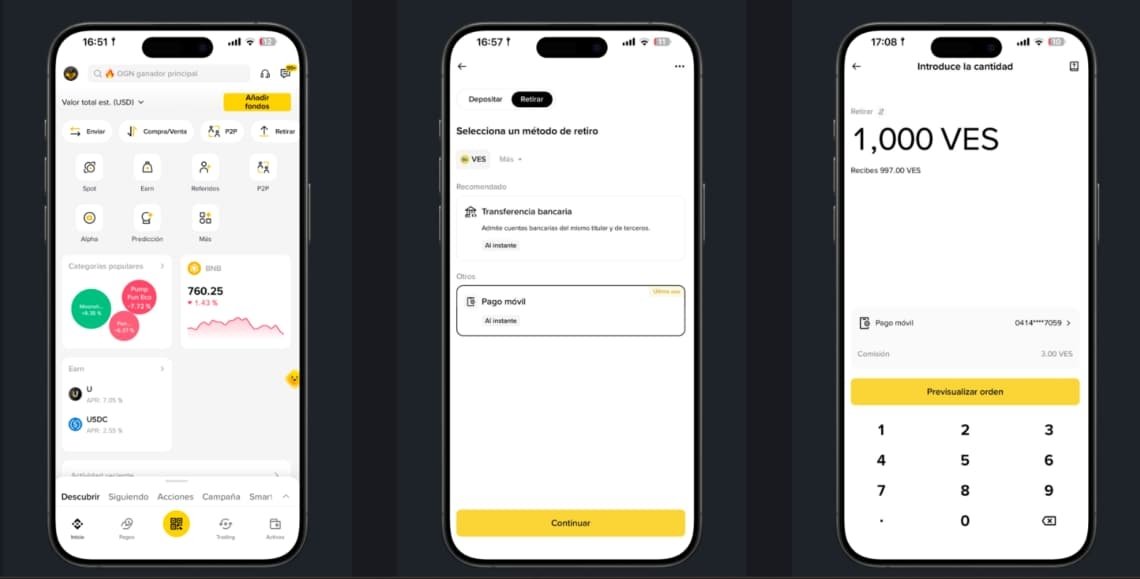
Step-by-step guide to buying USDT with bolívares on Binance
As a mandatory condition for the source of funds, Binance requires the money to come from a bank account in the account holder’s name. The company does not detail what measures it takes if the transfer comes from another person.
Deposits are available Monday through Sunday, continuously from 00:01 to 20:59. Once the bolívar balance has been credited, users can exchange it for stablecoins using the “Convert” option in the “Trade” section.
The reverse process— withdrawing bolívares to bank accounts or Pago Móvil—is a service that will be available soon, according to Binance. The platform said these withdrawals will incur a 0.3% fee once the tool is operational.
Likewise, sending bolívares to third parties is still a pending feature. The company says customers will be able to register accounts belonging to other beneficiaries “when this feature becomes available.”
Regarding the legal framework, Binance clarified that fiat currency services—in bolívares—are provided by Casa de Cambios Insular, S.A. The platform explains that this entity is licensed and regulated by Venezuela’s Superintendency of Banking Sector Institutions (SUDEBAN) and the Central Bank of Venezuela (BCV).
Binance specifies that its users buy and sell virtual assets using local funds processed by Insular, clarifying that the process “does not involve fiat currency services or the receipt or processing of funds by Binance,” an entity that operates from Abu Dhabi.
This operational integration is particularly significant in the Venezuelan market, following the launch of Binance’s Mastercard card in the country last August. The product allows users to make payments on online platforms and at international merchants using their platform balance, settling transactions in digital dollars to purchase goods and services abroad.
#venezuela #BinanceSquare #BinanceSquareFamily #BinanceVenezuela #binancevenezuela🇻🇪 $BTC