

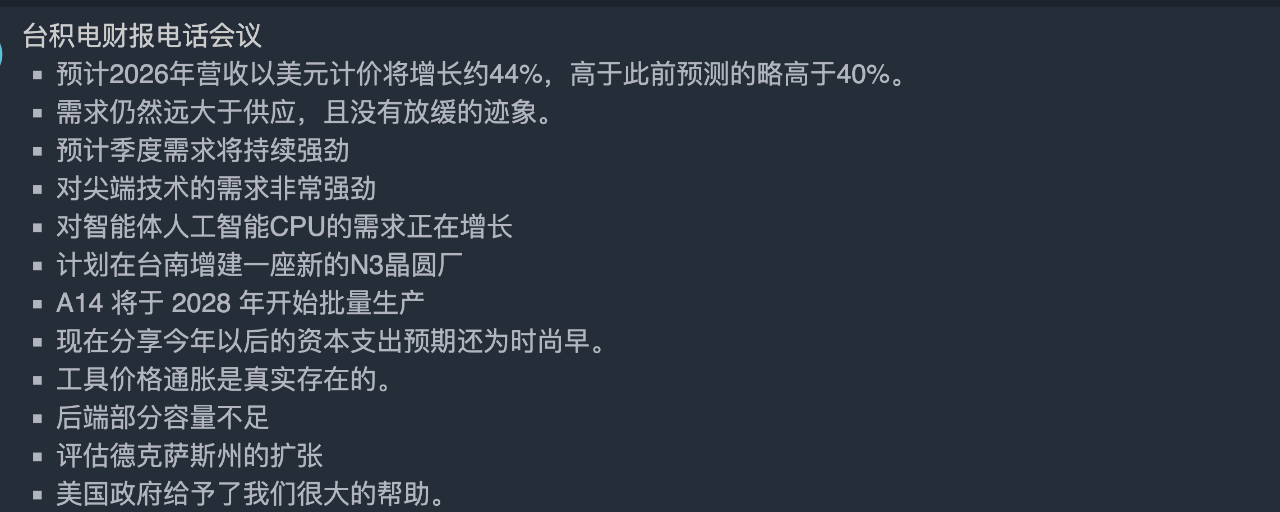

TSMC’s “evolution”—its financial results tell the market that high-performance computing revenue has surged, and semiconductor companies are transforming into AI infrastructure companies!
Let’s briefly review TSMC’s financial results. Simply put, they’re strong—very strong, and even stronger than expected!
1. Revenue in U.S. dollars grew 41% year over year, while net profit surged 69%, with EPS of $4.6. This means the current AI cycle isn’t simply about pouring capital expenditure into revenue growth; profitability is driven by capacity utilization, product-mix upgrades, and premiums on advanced processes.
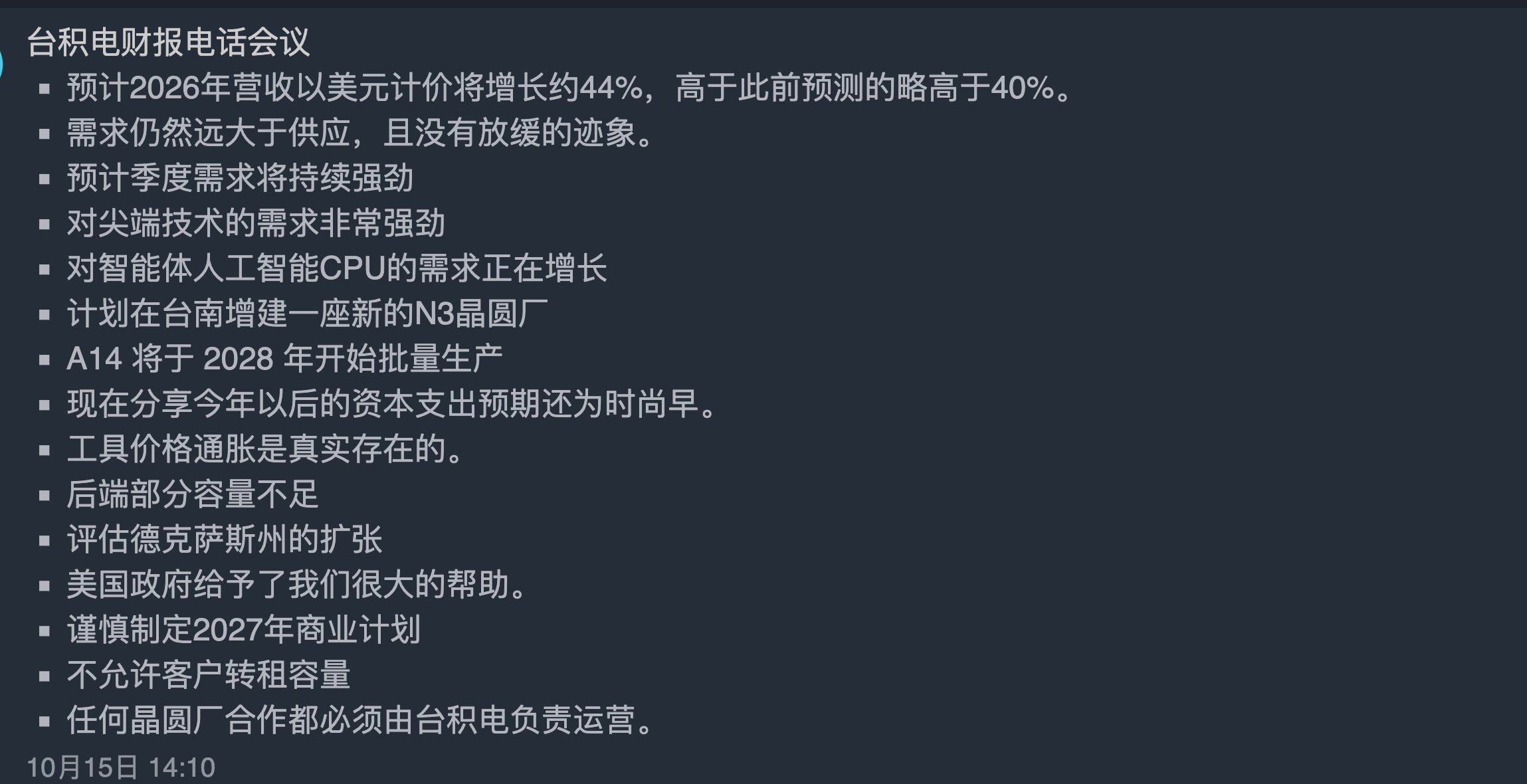
2. In Q3, HPC (high-performance computing) grew from 57% of platform revenue last year to 68%. This means TSMC has become a comprehensive AI infrastructure company and occupies a key tollbooth upstream in AI capital expenditure.
3. Wafer revenue: 2nm revenue grew rapidly to 8%, while revenue from 7nm and below rose to 79%. The revenue mix is gradually shifting toward the 2nm series. Management expects 2nm capacity to double in 2027.
4. The company again raised its full-year 2026 revenue growth forecast in U.S. dollars to 44%. The CEO said demand for advanced process nodes remains very strong, and the AI supply-demand gap persists, so there is no need to worry about TSMC orders declining in the short term.
5. The CEO said that as open-source AI models become more widespread, they will lower the barriers to using AI and thereby expand end demand.
Of course, strong earnings do not necessarily mean a strong share price—TSMC proved that today!
In fact, TSMC’s share price fell due to a combination of factors, including pricing concerns.
1. There is little more to say on the macro front: expectations of interest rate hikes are weighing on risk appetite, while elevated long-term yields are competing for risk capital.
2. Earnings fundamentals: the results were strong, but capital expenditure continues to expand, and gross margin is being diluted by 2nm chips.
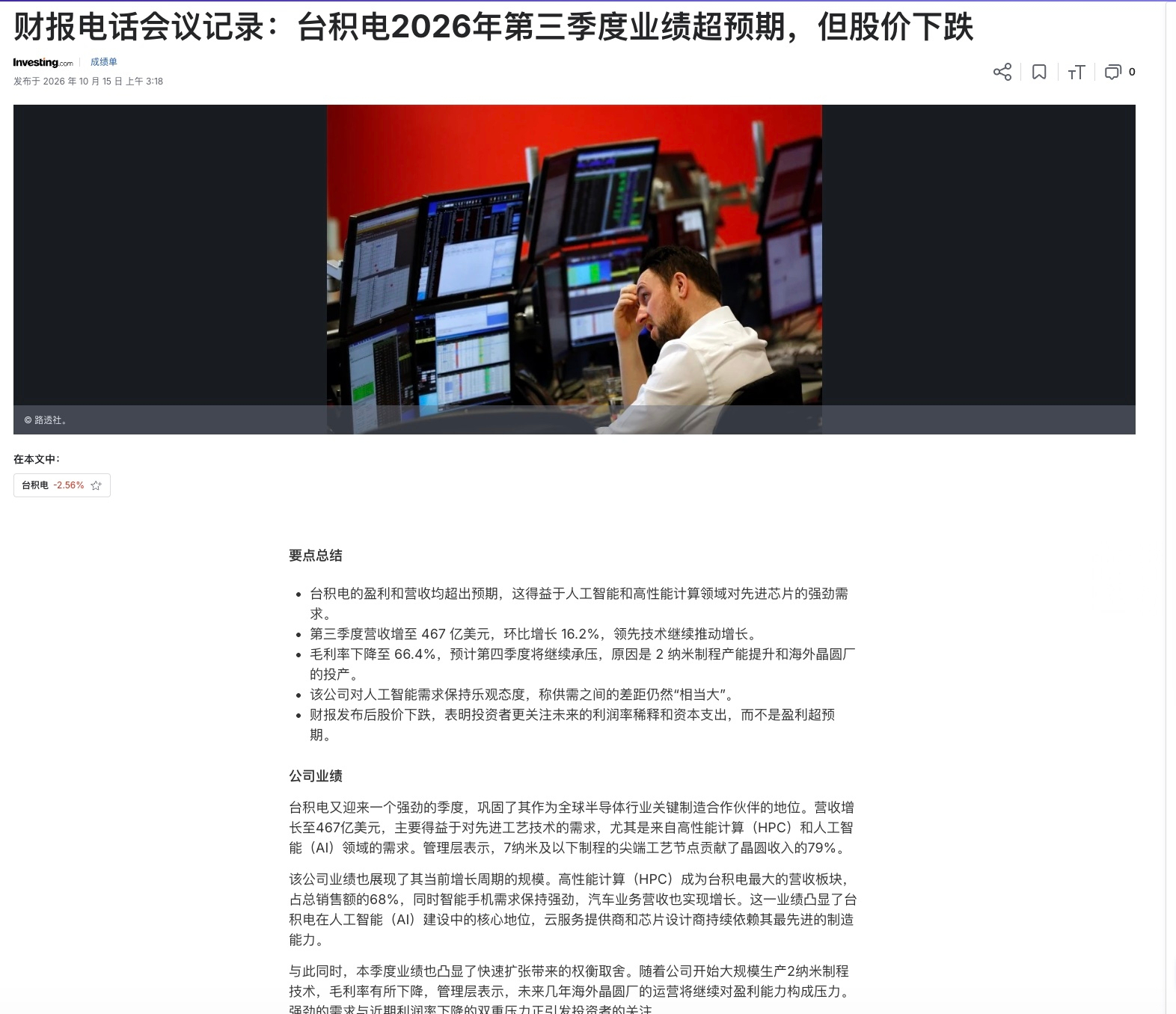
On this earnings call, management said 2026 capital expenditure would remain at $60–64 billion. It also made clear that capital expenditure in 2026–2028 would be higher than in the previous three years. Gross margin fell from 67.7% in Q2 to 66.4% in Q3, while operating margin declined from 60.3% to 58.7%.
Put simply, the company is continuing to spend—and spend more. Revenue is growing overall, but margins are under pressure. Against the current macroeconomic headwinds, this has led the market to reassess TSMC’s share price.
With TSMC’s earnings report out, the major U.S. earnings releases for this week have largely wrapped up. Overall, the banking sector is providing a steady supply of capital. Although the share prices of the two key AI supply-chain companies, TSMC and ASML, have taken a hit in the short term, their earnings remain strong, confirming that AI fundamentals are still healthy.
The logic from here is very straightforward: macroeconomic pressures are significant, so U.S. equity valuations may need to undergo a correction. But fundamentals remain sound. Once the valuation pullback is over and macro pressures ease, the trend should resume. The outlook remains optimistic!