


The U.S. Producer Price Index (PPI) for September came in far above market expectations, reigniting inflationary pressures. Bitcoin weakened alongside U.S. stocks, falling below the $80,000 mark for the first time since mid-September. Despite the inflation data greatly exceeding expectations, U.S. Treasury yields continued to decline, reflecting concerns that tech stocks may be overvalued and the artificial intelligence (AI) investment boom could cool—concerns that continue to influence capital allocation.
Data released by the U.S. Bureau of Labor Statistics showed that the PPI rose 1.3% month over month in September, far above August’s 0.4% and well above the market forecast of 0.5%. The annual increase accelerated from 5.4% in August to 6.3%, exceeding the 5.3% forecast. Core PPI, which excludes food and energy, rose 0.7% month over month, topping the previous month’s 0.2% and the market forecast of 0.3%. Its annual increase reached 5%, also exceeding August’s 4.6% and the forecast of 4.4%.
Despite an unexpected increase in inflation data, Bitcoin remained under pressure. After U.S. markets opened, Bitcoin briefly fell below $80,000, dropping into the $70,000 range for the first time since mid-September. Among U.S. stocks, selling pressure on technology shares was concentrated in semiconductor and AI-related stocks. The Nasdaq’s intraday loss briefly widened to 1.4%, while the S&P 500 fell 0.6%. Micron, Intel, and Advanced Micro Devices (AMD) all lost more than 4%, while Dell, Arista Networks, and SanDisk fell about 7%, reflecting continued portfolio adjustments in AI-related investments.
Meanwhile, U.S. Treasury prices rose and yields fell. The 10-year Treasury yield briefly dropped about 15 basis points to 5.04%, reaching a nearly one-month low. The ETF tracking U.S. Treasury bonds with maturities of more than 20 years (TLT) rose about 2% in premarket trading, extending its rebound from recent lows to 5%. The bond market rally continued despite PPI coming in far above expectations, indicating that concerns about the economy and technology stock valuations remain in focus.
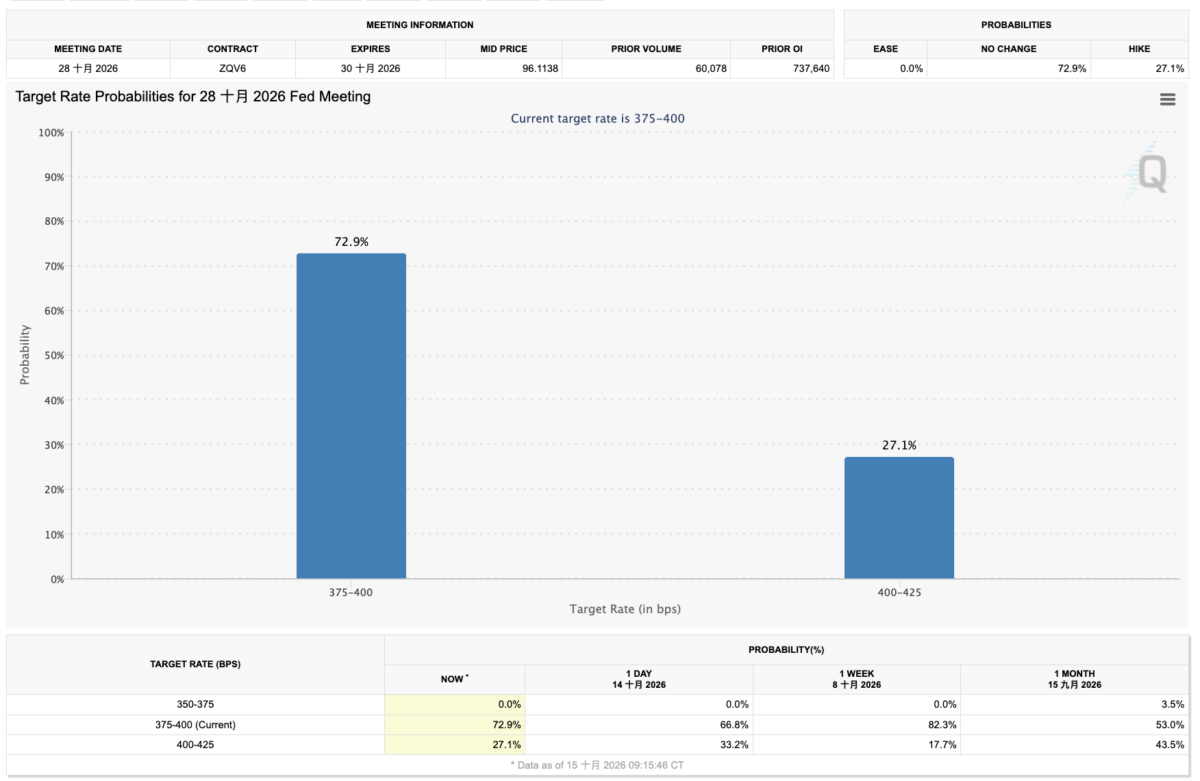
As for interest rate expectations, the CME FedWatch tool showed that markets put the probability of the Federal Reserve raising rates by 25 basis points at its October 28 meeting at 27%, down from a level that had briefly approached 45% the previous day. However, both PPI and core PPI came in above expectations, indicating that inflationary pressures at the production level remain significant and that the outlook for monetary policy remains uncertain.
Source