

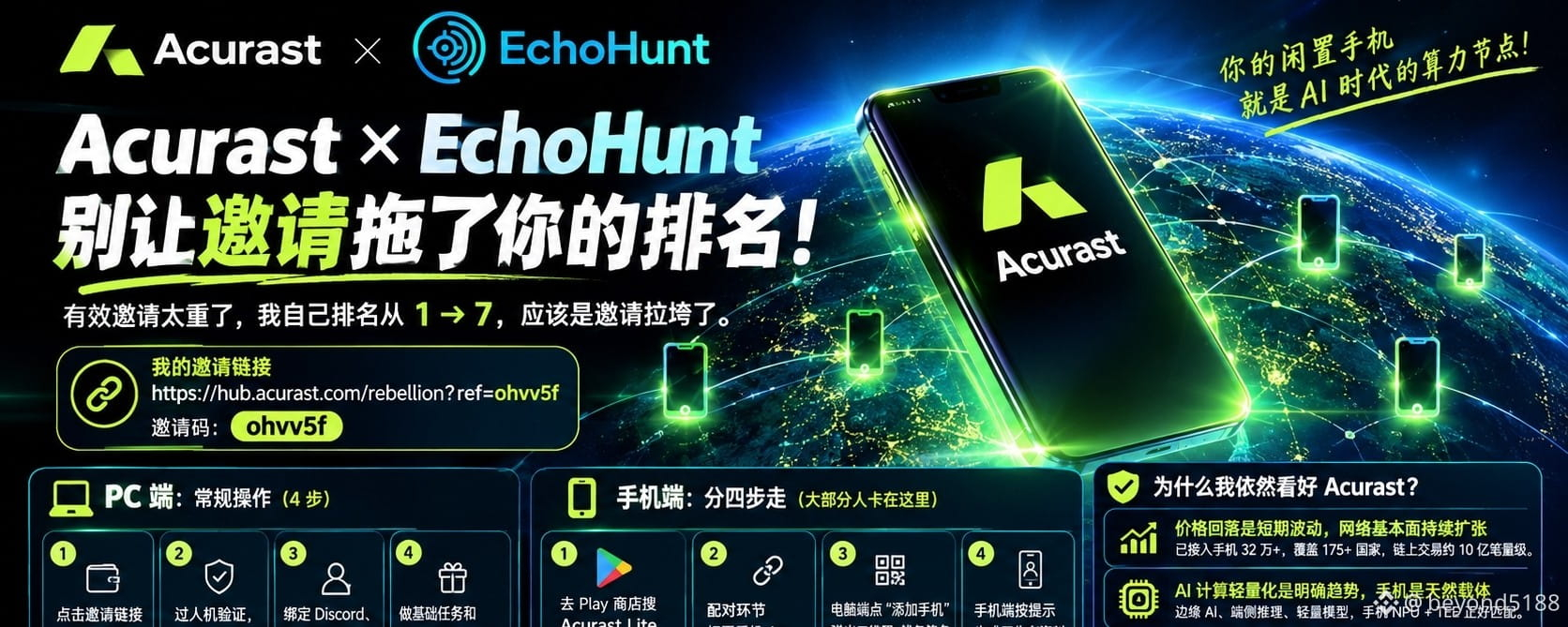

Acurast × @EchoHunt_ai campaign: valid invites carry a lot of weight. My ranking dropped from 1st to 7th—probably because my invites aren't doing well.
If you have a spare phone, feel free to use my @Acurast invite link:
hub.acurast.com/rebellion?ref=…
Invite code: ohvv5f
Here are the steps:
1. Click the invitation link, open the campaign page, and connect your wallet.
2. Complete the CAPTCHA and join Cloud Rebellion.
3. Link your Discord, email, and social accounts to generate your identity card.
4. Complete the basic tasks and quiz to start earning MIST. Unlock your invite code after completing 3 basic tasks.
The PC-side steps are all routine. What’s truly valuable is the mobile tutorial—this is where most people get stuck.
The mobile setup has four steps:
1. Search for Acurast Lite in the Play Store and install it. If you need an invitation code, enter: ohvv5f
2. Pair your device. Open the mobile app and select “Pair with an existing manager account.”
3. On your computer, click “Add phone” to display a QR code. Sign the transaction with your wallet, then scan the code with your phone to complete pairing.
4. Follow the prompts on your phone to create a worker profile, then open the mining screen and get started.
Although $ACU has pulled back slightly recently, I remain bullish on Acurast. Lightweight AI computing is a trend, and mobile devices will play an increasingly important role.
1. The price pullback is a short-term fluctuation; the network’s fundamentals continue to expand
$ACU was around $0.13–$0.14 in early October 2026, and has recently fallen to around $0.09–$0.10, down about 19% over 7 days and 22% over 30 days. This is related to sentiment across the crypto market, rotation in the DePIN sector, and short-term profit-taking, and is part of normal market fluctuations.
Meanwhile, network metrics continue to grow: more than 320,000 phones are connected across 175+ countries; cumulative on-chain transactions are around the 1 billion mark, and the number of deployments continues to increase.
A temporary divergence between price and the pace of network adoption is not uncommon in DePIN projects. What truly determines long-term value is the match between real computing power supply and demand, not short-term price movements.
2. Lightweight AI computing is a clear trend, and phones are its natural platform
AI is evolving from bigger models and larger data centers toward a lighter, closer, and more distributed approach:
Demand for edge AI and on-device inference is rising rapidly. Gartner and other organizations forecast that by 2028–2029, most enterprise data will be generated and processed outside data centers and the cloud, and many enterprises will deploy edge AI.
Mobile NPUs and model-compression techniques (such as quantization and distillation) are making it possible to run models with billions of parameters in real time on phone CPUs/NPUs. Apple, Google, Qualcomm, and others have already brought models with billions of parameters to on-device platforms.
Lightweight “System 1” decision-making models (not generative chat, but rapid classification, judgment, and action selection) are particularly well suited to mobile hardware.
Acurast is perfectly positioned here: instead of using dedicated mining machines or data centers, it turns existing smartphones around the world into verifiable computing nodes. Phones have hardware-level TEEs that provide confidentiality and verifiability, consume far less energy than traditional servers, and are already distributed globally.
3. Acurast is already running lightweight AI workloads in real-world deployments
This is not just theory—there are already working examples:
Laya, an open-source System One decision-making model, is already running at scale on the Acurast network. Each decision is made on a phone’s CPU, with latency of around 0.2–1 second and no need for a dedicated GPU. Public demos include decision-making in the game Snake, email classification, and protection against prompt injection. They all run on real phone nodes and can be verified on-chain.
Supports inference with GGUF-format models compatible with llama.cpp and provides an OpenAI-compatible API, allowing developers to switch over with almost no code changes.
In collaboration with FLock.io and others, Acurast is exploring federated learning, and is working with OriginTrail, Teneo, and others to deploy confidential AI, knowledge graph reasoning, and enterprise AI agent use cases.
Jointly tested a fully decentralized AI gateway (inference + search) with Pocket Network and NodeGhost. Everything ran inside the mobile TEE, with no centralized servers involved.
These use cases show that Acurast is not suited to training trillion-parameter large models, but rather to lightweight inference, classification, decision-making, agent workflows, and confidential data processing. These are precisely the areas with the clearest demand and the highest privacy requirements amid the trend toward lightweight AI.
Ultimately, price moves like a pendulum, swinging back and forth between greed and fear; the trend is like a needle, moving slowly in just one direction. Lightweight AI computing is a trend, phones are its natural platform, and Acurast has already run lightweight AI workloads on real nodes.
Short-term volatility won’t stop the pendulum, but what determines the future is the needle that keeps moving forward. Being bullish on Acurast isn’t about betting on a straight line, but on a curve that is being validated.#Depin赛道