
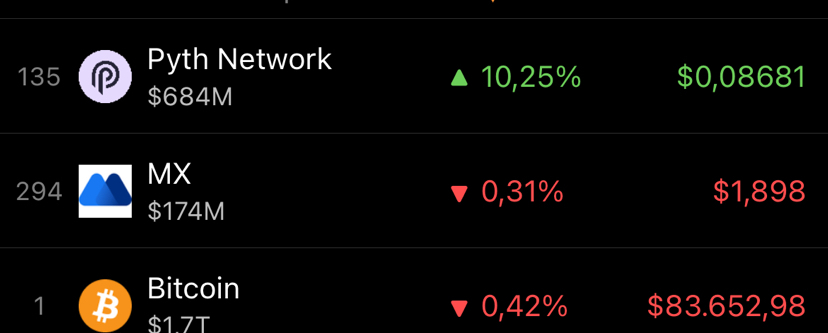

In my view, PYTH has considerable price appreciation potential compared with LINK, but it also carries greater risk that the project’s growth may not translate into value for the token. The most noteworthy development for Pyth in October 2026 is its newly announced revenue model and mechanism for using revenue to buy PYTH.
1. Is PYTH similar to LINK?
Pyth Network (PYTH)
An oracle network specializing in low-latency financial data sourced from exchanges, market makers, and financial institutions. Pyth targets DeFi, derivatives, and financial applications on the blockchain.
Chainlink (LINK) is an oracle network with a broad ecosystem, providing price data, connectivity between blockchains, and infrastructure for tokenized real-world assets (RWA).
Both address an important problem: bringing off-chain data onto blockchains for use in smart contracts. However, they differ in how they provide data, their ecosystems, and the mechanisms that create demand for their tokens.
Advantages
Fast financial data, direct data sources
A broad oracle and cross-chain connectivity ecosystem
Growth opportunities
Expansion of financial data services and institutional customers
Expansion of oracles, CCIP, and RWA
Key risks
Token supply; economic value may not fully reflect growth
Valuation and how effectively network demand translates into demand for LINK
Assessment
Could rise significantly if the new economic model succeeds
A more mature ecosystem foundation
Key point: PYTH is not simply a cheaper copy of LINK. Although the two projects are in the same sector, a lower market capitalization does not automatically mean PYTH will rise by more multiples.
2. The latest news making PYTH worth watching
October 8, 2026: 100% of DAO revenue to be used to buy PYTH
Pyth announced that all revenue from DAO-managed products will be used to accumulate PYTH. This is an important change because it creates token-buying demand from actual revenue.
Service revenue is growing
According to figures published by Pyth, annualized recurring revenue (ARR) reached $11.5 million in September 2026, up 86% from the previous quarter. This is a positive sign, though actual revenue collected and the ability to sustain growth should be monitored.
Expansion into traditional finance
Pyth is developing Pyth Pro, Data Marketplace, and Pyth Lazer to provide data to financial institutions, not just DeFi applications.
However, two things should be distinguished: network growth does not mean the token price will necessarily rise proportionally. Buybacks must be large enough relative to the circulating supply and the number of newly unlocked tokens.
3. How high could PYTH rise?
Based on the CoinMarketCap data I looked up, PYTH is trading around $0.08, with a market capitalization of about $634 million and a circulating supply of approximately 7.87 billion tokens. The actual price changes constantly.
A very optimistic scenario
$0.80 — 10x
If the circulating supply remains at 7.87 billion tokens, a price of $0.40 would imply a market capitalization of about $3.15 billion; a price of $0.80 would imply about $6.30 billion. An increase in supply could make the actual price lower than these estimates.
Factors that determine the potential for price appreciation
Bullish: Pyth Pro revenue grows, more institutional clients pay for services, and the buyback mechanism operates consistently.
Neutral: products are developing well, but most of the economic value is not yet directly reflected in the token.
Bearish: the altcoin market weakens, token unlocks create selling pressure, or competitors gain market share.
4. My conclusion
PYTH is a project worth watching in the oracle sector. Its main appeal right now is not just the technology, but also its efforts to connect product revenue with demand for the token. That said, I would not use its all-time high as a basis for assuming the token will definitely return to its peak.