

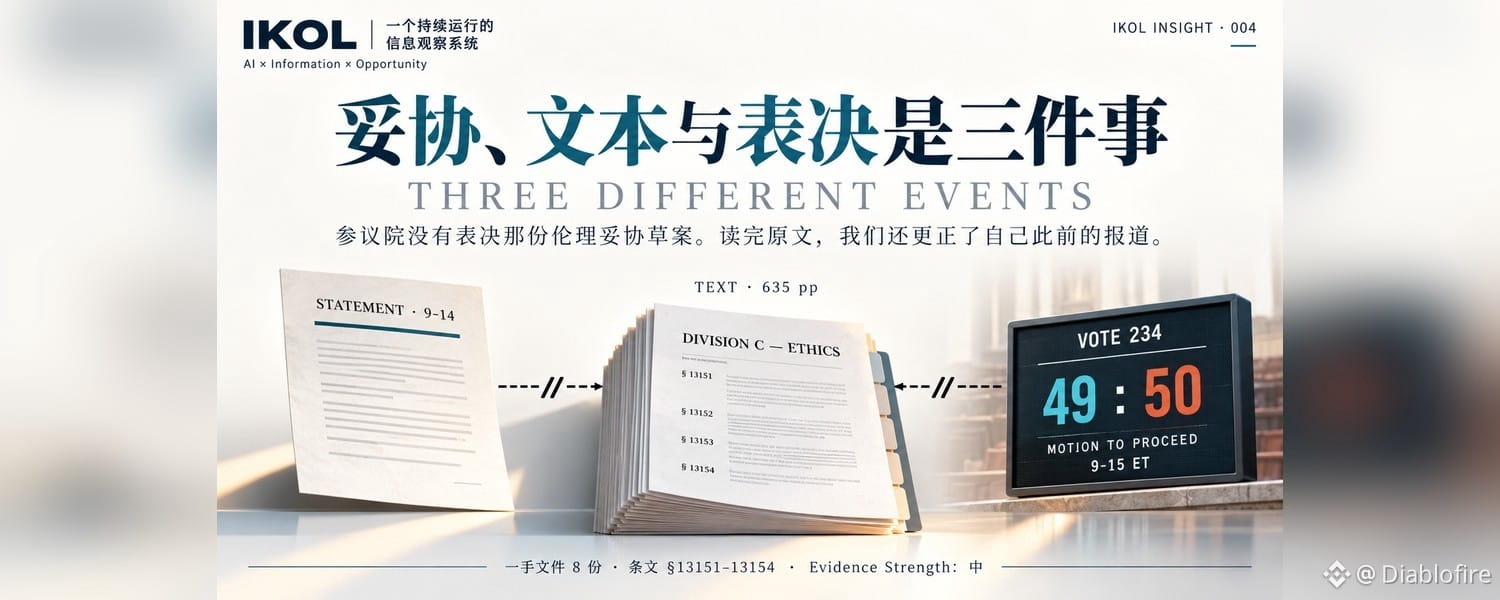

The Senate did not vote on that ethics compromise draft. After reading the original, we also corrected our earlier reporting.
【30-second takeaway】
In mid-September, “the president agrees to unprecedented ethics restrictions” and “the ethics provisions are unenforceable” described the same text.
We read the ethics section of the 635-page draft (pages 620–635) and found that it does establish substantive obligations. The disagreement was not about whether the provisions are binding, but about three specific mechanisms: whether they cover children, whether assets must be placed in a trust or sold, and what path state attorneys general can use to enforce them.
More importantly, what the Senate voted on September 15 was not this text, but whether to begin consideration of the House-passed H.R. 3633. The draft released on September 14 was not formally introduced as a substitute amendment and was not the subject of that day’s roll-call vote.
“Reaching a compromise,” “putting it into text,” and “getting it through a vote” were three different things in this episode. In 001, we conflated the first two ourselves; this article corrects that as well.
Evidence Strength: Medium. The procedure and bill text were verified against primary sources; most accounts of the parties’ positions come from secondhand reporting; the Democrats’ counterproposal was not made public.
—————
The facts below are labeled in three categories: 【Verified】 denotes information from primary documents (Senate records, bill text, official statements by lawmakers); 【Public positions】 denotes public statements by the parties involved and represents only their claims; 【Inference】 denotes this article’s research inferences. The source material consists of 133 reports archived from August 6 to October 10, 2026, of which 32 are directly relevant to this topic. The research also added 17 sources, including 8 primary documents. See the end of the article for sources.
—————
【One · One text, two descriptions】
On September 14, three Republican senators released the “final” text of the CLARITY Act.
【Public positions】 Sponsor Lummis’s press release said: “President Trump voluntarily agreed to unprecedented ethics restrictions.” White House digital assets adviser Witt said before the vote that the remaining disagreements were “just punctuation.”
【Public positions】 On the same day, Democrats publicly criticized the text, saying that state attorneys general could not sue the president directly and that a notice from the Office of Government Ethics could allow senior officials to retain ties to crypto businesses (as reported by CoinDesk on 9-15). Democratic Senator Warren put it more bluntly: enforcement is up to the Department of Justice, so the provisions are unenforceable against the president.
One side said “unprecedented”; the other said “unenforceable.”
Under our writing standards, both statements can only be recorded as public positions; neither side’s claim can be accepted at face value. To determine what the draft actually required, we must return to the text. Other evidence is needed to assess whether those requirements could be effectively enforced.
—————
【Two · What the text said: What did this compromise resolve?】
The ethics provisions are in Division C of the draft and would be added to Title 5, Chapter 131 of the U.S. Code. 【Verified】 Key points in the original text:
· Who is covered: Public officials as defined in Section 13103(f) (those required to file financial disclosures; the sponsors’ press release said this includes the president, vice president, judges, and federally elected officials); presidents, vice presidents, and members of Congress who have been elected but not yet sworn in; and the spouses of those individuals (§13151(1))
· What is prohibited: Issuing digital assets for consideration; sponsoring digital assets for consideration (including authorizing the use of one’s name, likeness, or position); holding a “substantial economic interest” (§13152(a))
· What counts as a “substantial economic interest”: Any class of equity in a company (or its subsidiary) that a person owns, controls, or holds, worth at least $15,000 (adjusted for inflation), where, in any one of the preceding three calendar years, a plurality of the company’s revenue (its largest share, not necessarily a majority) came from issuing or sponsoring digital assets (excluding tokenized traditional assets) (§13151(6))
· How interests may be disposed of: Divest before the effective date or place them in a qualified blind trust; notify the ethics office within 3 days, and the office must publish the notice within 3 days (§13152(c))
· Penalties: Knowing and willful violations. Issuance or sponsorship: disgorgement of all profits, plus a fine of 20% of the transaction consideration or $500,000, whichever is greater; holding a “substantial economic interest”: a fine of 20% of the value of that interest or $500,000, whichever is greater. Amounts are adjusted for inflation (§13153(a))
· Who enforces it: The U.S. Attorney General “shall” bring a civil action (§13153(c)); state attorneys general have a separate right to sue (see next section)
· Disclosure: Public financial disclosures would newly include digital assets with a market value exceeding $1,000 (§30102)
Thus, the sponsors’ claim of “unprecedented” restrictions has a basis in the text. 【Inference】 Compared with the absence of these provisions, the draft introduced new restrictions covering spouses, a duty to dispose of certain interests, penalties of at least $500,000, and new disclosure requirements. The sponsors also said these provisions incorporated “substantially all of the substance of the Tillis–Gallego ethics proposal,” and Gallego himself was one of the Democratic negotiators.
—————
【Three · What the text left unresolved: Three mechanisms】
Likewise, Democrats’ criticism of the enforcement mechanism also has specific provisions in the draft to which it can be linked. 【Verified】 The original text contains five details not found in the press releases:
1. Children are not covered. Coverage extends only to spouses (§13151(1)). Another provision says that actions by third parties whom the official has not authorized, directed, controlled, or coordinated with do not count as violations by the official (§13152(e)).
2. Attribution rules after placing assets in a blind trust. Once an interest is placed in a qualified blind trust, “the actions of the trustee and the actions of any entity in which the trust holds an interest—including the issuance or sponsorship of any digital asset—shall not be attributed to” the official who transferred the interest (§13152(i)).
3. State attorneys general sue the U.S. Attorney General. A state attorney general may sue if their state or its residents have been harmed, but the defendant is the U.S. Attorney General, and the relief sought is an injunction (§13153(d)(1)(A)).
4. An ethics office notice can bar state lawsuits. If the ethics office issues a legal opinion that an action is “not prohibited,” or publishes a notice of divestiture or a trust, state attorneys general cannot bring the above-mentioned actions concerning the matter in question (§13153(d)(4)).
5. The ban on issuance and sponsorship applies only prospectively. It covers only digital assets issued or sponsored on or after the effective date (§30104(b)). Note: This does not mean existing interests are exempt—the obligation to dispose of a “substantial economic interest” is a separate requirement.
【Inference】 Comparing these five points with Democrats’ public criticisms:
· State attorneys general cannot sue the president directly: §13153(d)(1)(A): the defendant is the U.S. Attorney General
· A notice can allow officials to retain business ties: §13153(d)(4) and §13152(i): after a public trust notice, state lawsuits are barred; the actions of entities in which the trust holds an interest are not attributed to the official
· Reports said the counterproposal sought to cover children and require divestiture rather than allow trusts: §13151(1); §13152(c)(1)(B)
The disagreement can be pinpointed in the provisions. The question was not “whether there should be restrictions,” but how these three mechanisms should work.
At the same time, the other side should also be fairly acknowledged: 【Verified】 Qualified blind trusts were not an arrangement newly created by this draft; they are one feature of the existing ethics framework for U.S. officials (the sponsors said they were consistent with the 1978 Ethics in Government Act). The text says the Attorney General “shall” bring suit, not “may.” Requiring divestiture means excluding trusts as a disposition option for the types of interests at issue here. These two designs differ in their legal effects and policy goals; this article does not judge which is more reasonable. How enforceable the provisions would be in practice is a matter of legal interpretation. There is no case law to rely on at present, and this article makes no judgment on that question either.
—————
【Four · This was not the text put to a vote】
【Verified】 Senate Roll Call Vote No. 234: At 2:19 p.m. on September 15, 2026 (U.S. Eastern Time), the question was “on the motion to invoke cloture on the motion to proceed to H.R. 3633.” The motion required 60 votes and failed, with 49 votes in favor, 50 against, and 1 not voting.
· All 49 votes in favor came from Republicans;
· 50 votes against: 46 Democrats and independents, and 4 Republicans (Collins, Hawley, Moran, Tillis);
· The Senate Floor Activity record contains no amendment or substitute text number.
【Verified】 The sponsors’ September 14 press release explicitly stated that the text would be introduced as a “complete substitute amendment” only if cloture was invoked successfully.
Therefore, the revised draft released on September 14—including all of its ethics provisions—was not formally introduced as a substitute amendment during that proceeding and was not the subject of the September 15 roll-call vote. The Senate did not vote on its contents. Democrats reportedly sent a counterproposal late on September 14, but its text was not made public. 【Public positions】 A Lummis spokesperson said it was the same as “the position from weeks earlier,” while Democratic Senator Warner said those demands had been on the table “for more than half a year.”
The “concession” remained at the level of statements and a draft; it never entered the legislative process to be tested.
—————
【Five · Disputes beyond ethics: They existed, but their impact is unclear】
During our research, we also tested another explanation: that there were independent disputes beyond ethics which would limit the coalition of support even if the ethics issues were resolved.
【Verified】 In an official statement on September 16, Collins said the bill was “still a moving target,” that its more than 600 pages required further study, and that she was concerned community banks and credit unions would lose deposits. 【Public positions】 Hawley told Newsweek that farmers in his state were worried they would not be able to get loans. Neither senator’s stated reasons concerned ethics.
This shows that ethics concerns were not the source of all opposition. But we cannot infer from a single procedural vote of 49 to 50 “how the coalition of support would have realigned if the ethics dispute had been resolved.” The vote margin tells us how many votes were missing this time; it does not tell us which kinds of disputes mattered more or less.
The available evidence therefore establishes only that independent disputes did exist; it cannot determine their actual role in this vote. This explanation is retained as a hypothesis to be tested and does not form part of this article’s main conclusion.
—————
【Six · Assessment】
Our view is that the September 14 ethics provisions created new substantive obligations, and the disagreement was not over “whether there would be restrictions,” but over a few specific mechanisms: whether children would be covered, whether interests could be placed in a trust or had to be sold, and how state attorneys general could enforce the provisions. Both “unprecedented” and “unenforceable” describe only part of the text. And this draft was never formally introduced as a substitute amendment or put to a roll-call vote on September 15; it was never tested on the Senate floor.
This assessment does not answer “Why did the bill fail?” It addresses a narrower question that can be verified against documents: What exactly was the “compromise” repeatedly reported on this occasion?
▍Two counterarguments
Counterargument one: Some opposition may have had nothing to do with the text’s details. 【Verified】 In an official statement on September 15, Gallego said he “will not support legislation that benefits him” and criticized Republican leadership for “ending negotiations and forcing a vote.” If some opposition was independent of the bill’s language, then even if all three mechanisms had been revised to meet Democrats’ demands, the vote’s outcome might not have changed. We cannot rule this out.
Counterargument two: The impasse can also be described as neither side moving from its position. 【Public positions】 Republicans said Democrats were “resubmitting the same demands,” while Democrats said Republicans had “never taken bipartisan negotiations seriously.” From this perspective, the problem was not the text, but the negotiations themselves. This article can only record what each side said; it cannot adjudicate between them.
—————
【Seven · Testable inferences】
Inference one: If CLARITY is revived, revisions to the ethics provisions will focus on three mechanisms. If the bill is revived during the remainder of this Congress or in the next Congress, the main revisions to the ethics provisions should address at least two of the following: coverage of children, trusts versus divestiture, and the enforcement pathway for state attorneys general. This prediction tests the direction of future revisions, not the reason the vote failed. If the prediction proves wrong, that would not invalidate this article’s factual verification of the September 2026 draft. Test date: June 2027.
Inference two: Cloture will not be invoked during the lame-duck session. In November–December 2026, the Senate will not secure the 60 votes needed to invoke cloture and advance consideration of H.R. 3633 (advancing the same content through a different bill vehicle is not covered by this inference). The basis is the 11-vote shortfall, the 46 votes uniformly opposed, and public statements by both sides after the vote that showed no shift in position. Test date: January 2027.
—————
【Eight · Corrections to 001】
In 001 (Three Days and Five Years), published on September 28, we wrote:
“Two days before the vote, Republicans released a 635-page ‘final’ revised proposal containing ethics provisions agreed to by Trump himself—requiring divestment from crypto businesses and granting state attorneys general the right to sue.”
After reading the original text, this statement presents two distinct problems:
1. “Requiring divestiture from crypto businesses”—materially inaccurate. The text offers a choice: “divest or place in a qualified blind trust.” It applies only to qualifying “substantial economic interests,” not to all assets in crypto, and does not require an outright sale in every case;
2. “Granting state attorneys general the right to sue”—omits a key limitation. The draft does establish a litigation mechanism for state attorneys general, but that particular route names the U.S. Attorney General as the defendant and seeks injunctive relief. The relevant lawsuit is also barred if the ethics office issues an opinion or publishes a notice. Without explaining these restrictions, readers could easily understand this as allowing state attorneys general to sue the president directly.
Also, 001 gave the vote date as September 16 in Beijing time. To avoid ambiguity, we clarify that the official Senate record gives the vote date as September 15, U.S. Eastern Time.
At the time, we wrote this passage based on media reports without further checking the specific provisions in the 635-page draft. The responsibility lies with us for insufficient verification. The original text of 001 remains unchanged, and a correction has been added at the end.
That is precisely what this article aims to show: we, too, failed to bridge the gap between statements, secondhand accounts, and the text itself.
—————
【Appendix One · Distinguishing facts, positions, and inferences in this article】
· Verified (primary sources): Subject, timing, vote count, and each senator’s vote; no substitute amendment number in the Floor Activity record; sponsors said the text would be introduced only if cloture passed; contents of Division C; official statements by Collins and Gallego
· Public positions: “unprecedented ethics restrictions” (Lummis); “just punctuation” (Witt); “unenforceable” (Warren); state attorneys general cannot sue the president directly, and notices may allow business ties to be retained (Democrats, as reported secondhand); “resubmitting the same demands” (Lummis spokesperson); Hawley’s concerns about credit access (secondhand)
· Research inference: The disagreements center on three mechanisms; both descriptions capture only part of the text; independent disputes beyond ethics existed, but their role in this vote cannot be determined (retained as a hypothesis to be tested)
· Unable to confirm: The specific language of the Democrats’ counterproposal (not made public); how enforceable the provisions would be in practice (no case law)
· Outside the scope of this article: A complete causal explanation of the bill’s failure; anyone’s motives; which party was right or wrong; prices and trading advice
【Appendix Two · Sources】
▍Research layer · Primary documents
· Facts: Subject of the vote, vote count, each senator’s vote; document: U.S. Senate Roll Call Vote 234 (119th Congress, 2nd Session); date: 2026-09-15
· Facts: No substitute amendment number; Tillis filed a motion to reconsider; documents: Senate Floor Activity record; Senate Daily Press; date: 2026-09-15
· Facts: The text would be introduced as a substitute amendment only if cloture passed; document: joint press release by Lummis, Boozman, and Scott; date: 2026-09-14
· Facts: Full text of Division C’s ethics provisions; document: Substitute Amendment Draft EHF26724, pages 620–635; date: 2026-09-14
· Facts: Divestiture or trusts, state attorneys general’s enforcement authority, effective-date rules (sponsors’ summary); document: “What’s New in the Final Clarity Act Text”; date: 2026-09-14
· Facts: Collins’s reasons for opposing the bill; document: official statement on Senator Collins’s website; date: 2026-09-16
· Facts: Gallego’s reasons for opposing the bill; document: official statement on Senator Gallego’s website; date: 2026-09-15
▍Research layer · Secondhand reporting
· Content: Democrats’ public criticism of the draft; counterproposal issued; source: CoinDesk; date: 2026-09-15
· Content: Lummis responds to the counterproposal; Warner and Warren state their positions; source: The Block; date: 2026-09-15
· Content: The 9-14 text covers spouses but not children; source: The Block; date: 2026-09-14
· Content: Hawley’s reasons for opposing the bill; Moran did not respond; source: Newsweek; date: 2026-09
· Content: Summary of the 9-14 revised draft; source: CoinDesk; date: 2026-09-14
▍Discovery layer · System archive
· Content: Bipartisan ethics proposal emerges; source: Cointelegraph (via Bloomberg); date: 08-07
· Content: Republicans’ “final” revised proposal; source: Cointelegraph; date: 09-14
· Content: Trump agrees to stricter ethics rules; source: CoinDesk (via AP); date: 09-14
· Content: White House adviser says he is giving up “historic” ethics authority; source: CoinDesk; date: 09-15
· Content: Each side’s explanation after the vote; source: CoinDesk; dates: 09-23, 09-24
【Appendix Three · Research and revision log】
· Topic selection: Cluster 3, “Trump,” in the weekly topic brief. Of the 133 items, only 32 were directly relevant to this topic; the rest covered Iran, tariffs, AI, and other subjects. A broad person-based category inflates the brief’s count.
· The question was revised twice:
- The system’s original question, “Why does the conflict-of-interest mechanism still allow him to participate in legislation?” presupposed a conclusion and misidentified the role (the president does not legislate), so it was not used;
- Q1, “Why did the bill still fail after the president agreed to divest?” presupposed a causal premise that “a concession should have led to legislation” and overlapped with 001, so it was dropped after review;
- Q2, “What did the ethics compromise resolve, and what did it leave unresolved?” was selected as the final research question.
· Premise verification (first in this article): Before beginning the research, we checked primary Senate records to verify “what exactly was being voted on.” This revealed that the September 14 draft was not formally introduced as a substitute amendment and was not the subject of a roll-call vote.
· Recovery of primary evidence: The web tool could not read the 635-page draft PDF, and sandbox downloads were blocked. The researcher downloaded the original file, cross-reviewed it to locate the ethics section, and then independently extracted and verified its provisions one by one.
· Claim toned down: The initial draft’s claim that “the concession was far less substantial in the text” was overturned by four counterarguments (new substantive obligations; provisions derived from a bipartisan proposal; blind trusts are an existing arrangement; and “unenforceable” is also one side’s claim), and was revised to “the disagreements center on a few mechanisms.”
· One possible explanation was not included in the main conclusion: “Independent disputes beyond ethics limited the coalition”—such disputes existed, but their impact is unclear; see Section Five. During review, we corrected an inference in the initial draft: the vote margin cannot be used to conclude that a particular kind of dispute was unimportant.
· Correction: The statements in 001 about “mandatory divestiture” and “state attorneys general’s right to sue” (see Section Eight).
· Post-publication addition (2026-10-11): While preparing the English version, we rechecked the text word for word and filled in two details in the table in Section Two: the threshold for a “substantial economic interest” is “at least” $15,000, and the revenue test is a “plurality.” We also added the calculation of the fine for holding a substantial economic interest. The conclusion is unchanged.
—————
This article is not investment advice and does not represent a position on any party or individual. All factual statements can be traced to the table above; all inferences are clearly labeled and open to challenge.