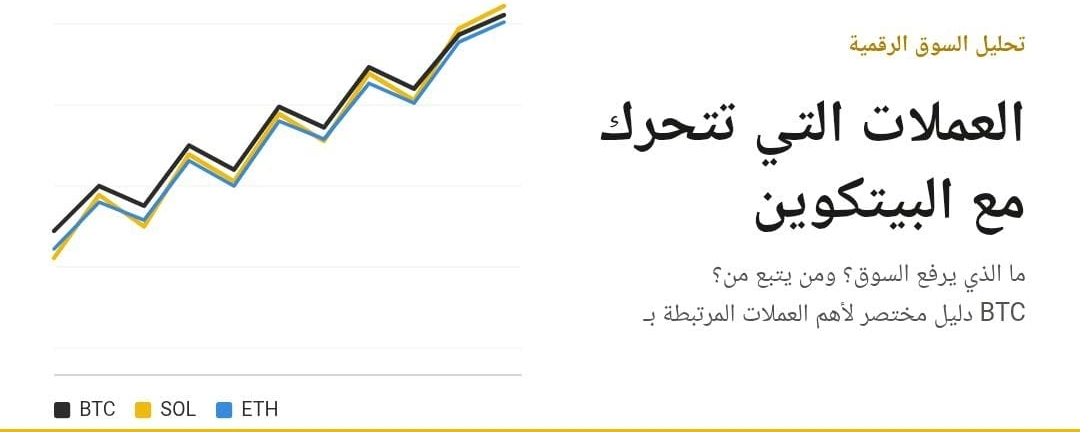

In the cryptocurrency market, not everything moves independently. Traders often see Bitcoin rise or fall, and most of the market follows within a few hours. This shared behavior is known as correlation, and understanding it is essential for anyone looking to build a balanced portfolio or manage risk wisely.
What does correlation with Bitcoin mean?
The correlation coefficient is a measure that ranges from -1 to +1:
Close to +1: The coin moves in roughly the same direction as Bitcoin, so if BTC rises, it rises, and if BTC falls, it falls.
Close to 0: There is no clear relationship between their movements.
Close to -1: The coin moves in the opposite direction from Bitcoin, which is very rare in the cryptocurrency market.
It is important to distinguish correlation from magnitude: a coin may be strongly correlated with Bitcoin but move with much greater volatility. Beta is also used to measure how much a coin moves relative to Bitcoin.
The main coins correlated with Bitcoin
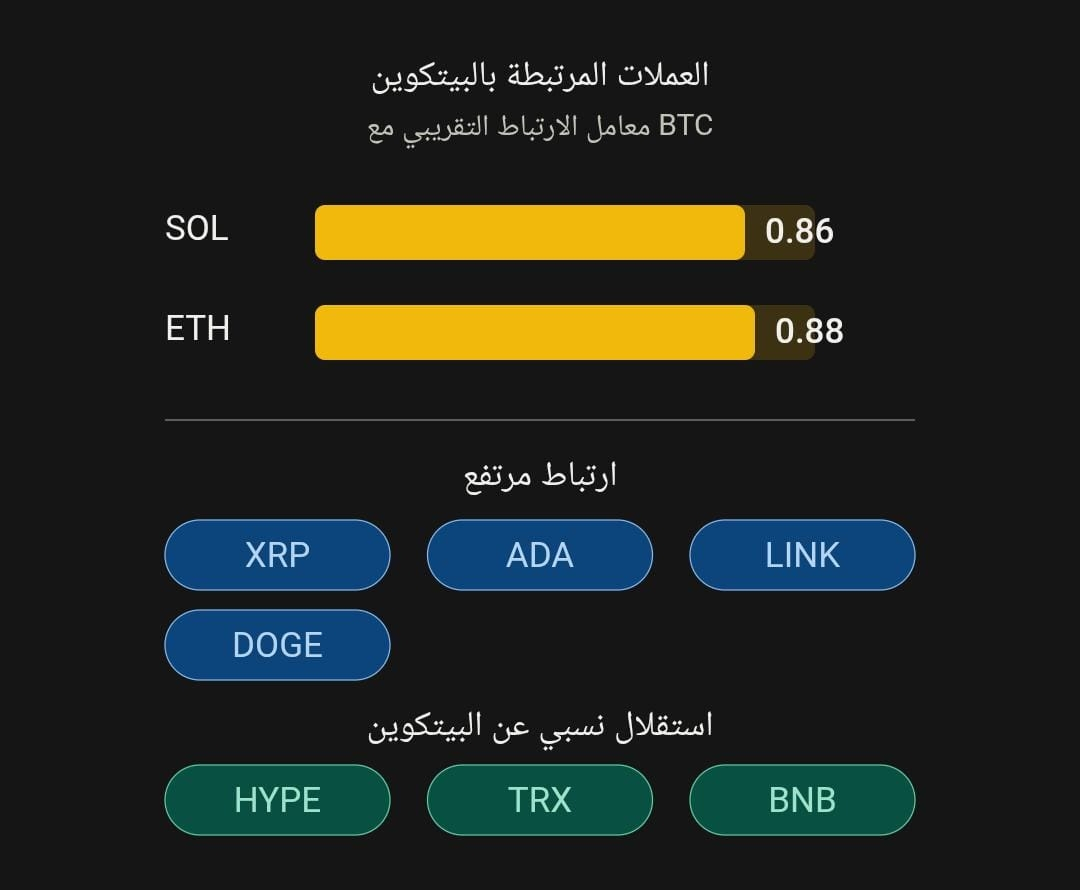
1. Solana (SOL): Currently the most closely tied to Bitcoin
Recent data shows that Solana is one of the major cryptocurrencies most closely aligned with Bitcoin’s movements, with its 90-day correlation coefficient exceeding 0.9 in some measurements. This means that any major move in BTC is often reflected in SOL with roughly the same intensity, making it a suitable asset for traders who anticipate the market’s general direction, though it carries higher risks.
2. Ethereum (ETH): The market’s second pillar
Historically, Ethereum has been the cryptocurrency most correlated with Bitcoin after Bitcoin itself, and recent measurements still show a high correlation. Ethereum nevertheless has independent drivers, such as network upgrades and institutional demand for tokenization and decentralized finance products. These can create periods when it outperforms Bitcoin, as well as periods when it underperforms.
3. Other major coins: XRP, ADA, and LINK
These coins usually move in the same general direction as Bitcoin, but to varying degrees. Some are also affected by news specific to them, such as legal developments for XRP, network upgrades for ADA, or partnerships and data services for LINK. Their correlation therefore remains high, but is less consistent than that of ETH and SOL.
4. Meme coins and high-liquidity coins: DOGE and BCH
These coins are strongly correlated with Bitcoin during periods of panic or widespread optimism, as traders often make similar decisions across the market. Their correlation sometimes weakens, however, when community interest or a media event overshadows broader market movements.
Coins that follow a different path
Not all coins necessarily follow Bitcoin. Reports have found that some assets performed independently during certain periods, including:
HYPE: Outperformed Bitcoin during several periods of the year, driven by growth in its platform and liquidity.
TRX: Recorded steadier growth with less volatility than Bitcoin.
BNB: Benefits from a quarterly token burn mechanism, which reduces supply regardless of market sentiment.
This independence is relative, however, and not guaranteed. Even coins that move independently often become affected by Bitcoin during major market shocks.
What does this mean for investors?
Beware of false diversification: holding SOL, ETH, and ADA together does not provide true diversification, as they move in roughly the same direction.
Regular monitoring is essential: correlation coefficients change with market conditions, so it is a good idea to review them, for example, every quarter.
Altcoin season has not started yet: the Altcoin Season Index remains low, meaning Bitcoin is currently leading the market.
Volatility is amplified: a coin correlated with Bitcoin gains more when prices rise and loses more when they fall.
Summary
Bitcoin is the main driver of the cryptocurrency market, and major coins such as Solana and Ethereum are currently the most closely tied to it, followed by coins such as XRP, ADA, and LINK. By contrast, coins like HYPE and TRX sometimes follow an independent path. Understanding these relationships can help you choose your strategy with greater awareness, whether you trade in the short term or build a long-term portfolio.
Disclaimer: This article is for educational and analytical purposes only and is not investment advice. Cryptocurrencies are high-risk assets and may lose all their value. Always do your own research (DYOR) and consult a licensed financial adviser before making any decisions.