

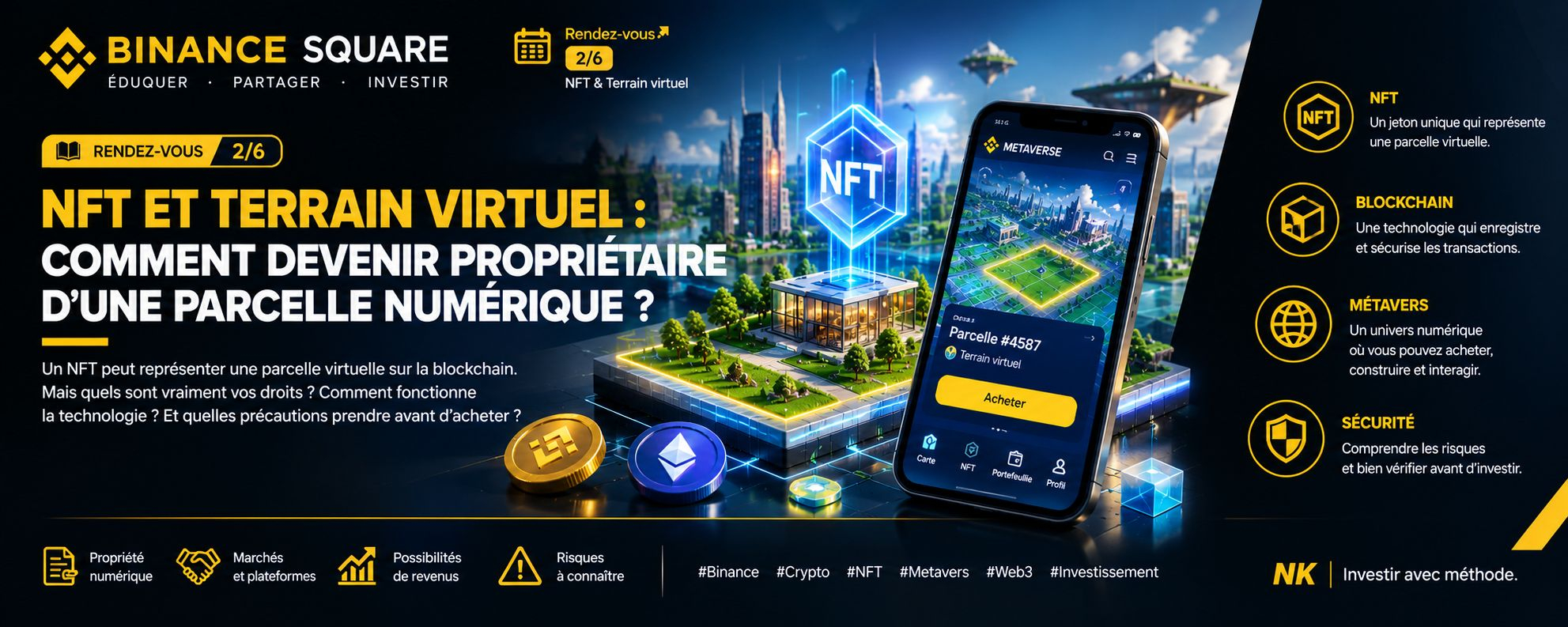

Imagine buying a plot of land without traveling, meeting a seller, or receiving a traditional title deed. Instead, you make a digital transaction recorded on a blockchain and receive an NFT representing a virtual plot of land.
Welcome to the world of virtual real estate!
But beware: owning an NFT representing virtual land does not automatically mean owning physical land or enjoying all the rights of a traditional property owner.
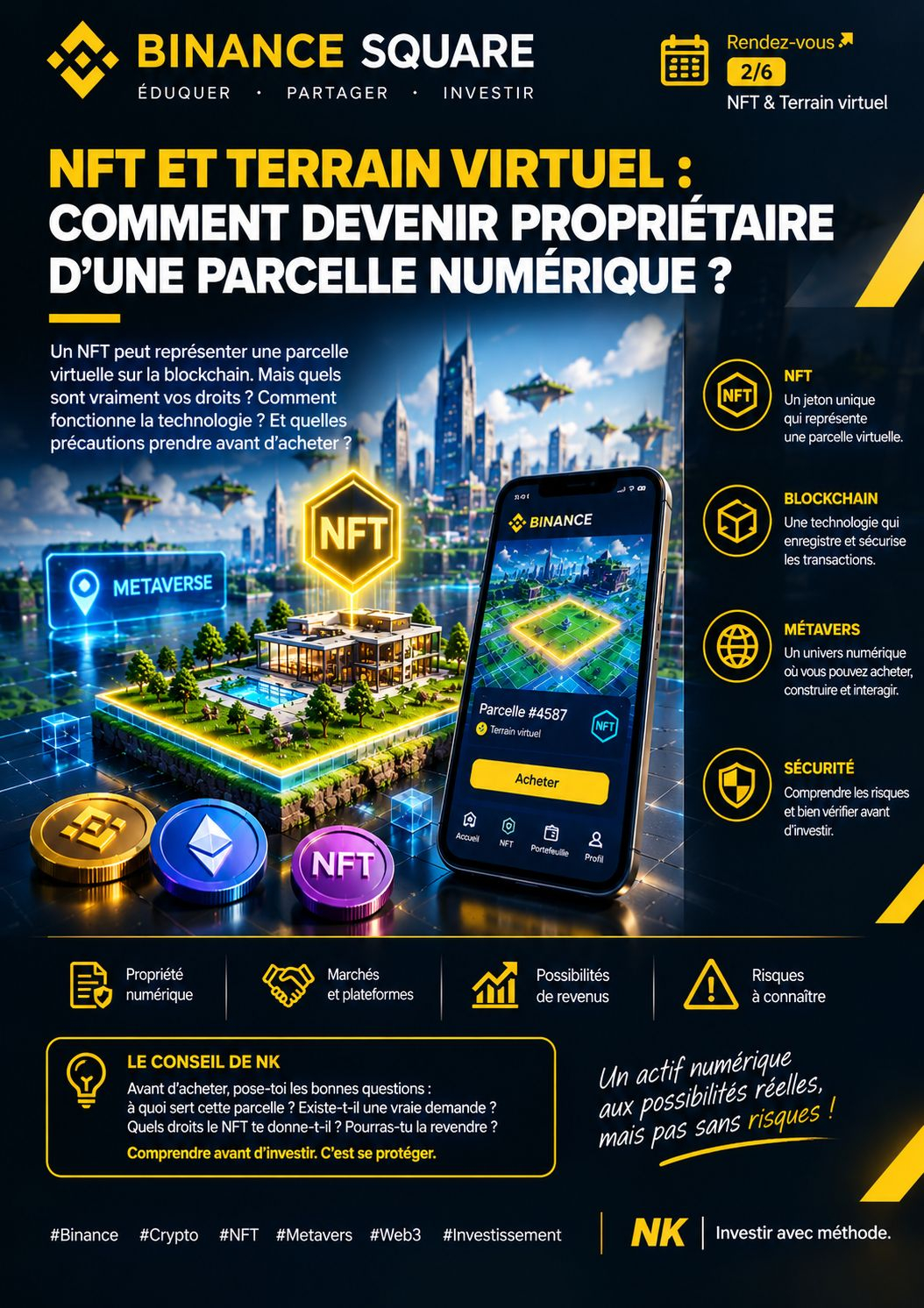
Today, let's explore the role of NFTs, how the blockchain works, and the precautions to take before buying a digital parcel.
1. What is an NFT?
An NFT (Non-Fungible Token) is a digital asset that can be uniquely identified on a blockchain.
Unlike two units of the same cryptocurrency, which are interchangeable, an NFT has its own unique identifier.
In virtual real estate, an NFT can represent a specific parcel within a digital world.
It may contain or reference:
A unique parcel identifier.
Information that makes it possible to locate the parcel in the virtual world.
Data related to the project or its smart contract.
Technical conditions relating to its transfer.
Key takeaway:
An NFT can represent and transfer a digital asset, but the exact rights associated with it depend on the project, its rules, and the applicable legal terms.
2. What is the role of the blockchain?
The blockchain is a technology that makes it possible to record transactions in a shared ledger among different network participants.
In a virtual real estate project, it can be used to record:
The creation of an NFT.
The transfer of the NFT from one wallet to another.
The address of the wallet that currently holds the token.
Certain rules automated by a smart contract.
Let's take an example.
You buy a virtual parcel represented by an NFT. After the transaction, the blockchain can make it possible to verify that the NFT was transferred to your wallet.
However, this technical proof alone does not guarantee that the project is trustworthy, that the land will retain its value, or that you will be able to use it forever.
The blockchain can prove ownership of a token without guaranteeing all the commercial promises associated with that token.
3. How do you buy a virtual parcel represented by an NFT?
Buying a virtual parcel requires preparation. Here are the main steps to know.
Step 1: Choose a reputable project
Research the platform offering the virtual land. Examine its utility, activity, team, community, and ownership terms.
Projects such as The Sandbox and Decentraland have offered digital land represented by NFTs.
Warning: the existence of a well-known project does not mean that every parcel offered for sale is a good investment.
Step 2: Set up a compatible wallet
Depending on the network and platform, you may need a compatible Web3 wallet, such as MetaMask.
This wallet allows you, among other things, to manage your compatible assets and sign transactions.
Security rule: never share your secret recovery phrase with a seller or anyone claiming they want to help you.
Step 3: Verify the NFT and the parcel
Before paying, check:
The official address of the smart contract.
The exact NFT identifier.
The location of the parcel in the virtual world.
The rights actually granted to the buyer.
The price, transaction fees, and any commissions.
Don't rely solely on a screenshot or a listing posted on social media.
Step 4: Complete the transaction
BIf your checks are satisfactory, you can buy the parcel on the project's official marketplace or from a verified source.
After the transaction, check that the NFT appears in your wallet and that the transfer is confirmed on the blockchain.
Keep in mind that buying an NFT guarantees neither the continued availability of the virtual world nor the ability to resell the land easily.
4. Can you make money from virtual real estate NFTs?
Yes, some strategies are possible, but none guarantees a profit.
Here are three options.
A. Buy to resell
BAn investor can buy a parcel and try to resell it at a higher price if demand increases.
Hypothetical example:
Transaction. Amount
Purchase price. €100
Resale price. €150
Gross profit. €50
This €50 profit is theoretical before fees. It only becomes real if the sale is completed at that price.
B. Develop a virtual business
BDepending on the project's features, you can develop a digital space to host a community, showcase products, or organize events.
C. Participate in a digital project
BA parcel can serve as a base for a business or community activity in a virtual world.
However, you need to check that the project is actually attracting users and that the necessary features are available.
Warning:
Buying an NFT does not automatically generate income. If someone promises you a fixed return simply because you own a virtual parcel, examine that promise with extreme caution.
5. What risks should you know about before buying?
A prudent investor should understand the risks before committing their money.
1. The risk of financial loss
The value of the NFT may fall sharply or even become almost worthless.
2. Lack of liquidity
Even if you own an NFT, you may not find a buyer when you want to resell it.
3. Dependence on the platform
If the virtual world shuts down or is no longer developed, your NFT may lose much of its utility.
4. Scams
Fake sellers may offer counterfeit NFTs, non-existent parcels, or links designed to steal your assets.
5. Transaction errors
An incorrect address, an incompatible network, or a malicious signature can result in a loss that is difficult or even impossible to recover.
6. Limited property rights
Owning an NFT does not automatically grant land rights recognized by the state. The associated rights depend in particular on the contracts, the project's rules, and applicable law.
6. Virtual real estate NFT and land title: what's the difference?
This distinction is fundamental, particularly for anyone accustomed to buying physical land.
Criteria. Virtual real estate NFT. Physical land
Nature. Digital asset. Real estate
Proof of ownership. Blockchain record and project rules. Applicable land documents and formalities
Use. Digital space. Residence, commerce, or real estate use
Income. Possible digital income Possible rental or operating income
Legal protection. Depends on the associated rights and applicable law
Depends on applicable land laws
Risks. Technology, speculation, and platforms
Disputes, maintenance, and the real estate market
Key lesson:
An NFT can represent a digital right to a virtual parcel, but it does not replace a land title for real property.
7. The five golden rules before buying a virtual real estate NFT
To invest methodically:
Understand the project before looking at the price.
Verify the NFT and its smart contract on the relevant network.
Read the ownership terms to find out exactly what rights you are buying.
Protect your wallet and never reveal your recovery phrase.
Be prepared for a potential total loss and do not invest money you need for essential expenses.
In Web3, technology opens up new possibilities, but the investor remains responsible for their decisions.
Conclusion:
Does owning an NFT really mean you own the property?
NFTs allow digital assets to be represented and ownership to be transferred using the blockchain. In some metaverses, they can represent virtual parcels.
But you need to distinguish between three things: owning a token, having rights to a digital parcel, and owning physical real estate. These three situations are not equivalent.
A good investor does not just ask how much an NFT is worth. They seek to understand what they are buying, what rights they have, and what risks they are accepting.
Question for the community
If you were to buy a virtual parcel represented by an NFT, what would you do first: check the project, examine the smart contract, or look into resale options?
Share your opinion in the comments. Let's learn together how to better understand Web3 investments.
NK | Invest methodically.
#Binance #Crypto #NFT #Metaverse #Blockchain #Web3 #Investment #BitcoinETFs #ledgertech