ByteDance employees have been furious lately. Tian Keyu, who previously maliciously tampered with code at ByteDance and attacked internal projects, has recently shot back to the top of trending topics.
The reason is that Bloomberg reported in recent days that, after launching his startup, he confirmed he had secured nearly $30 million in funding, including from prominent domestic investors such as IDG.
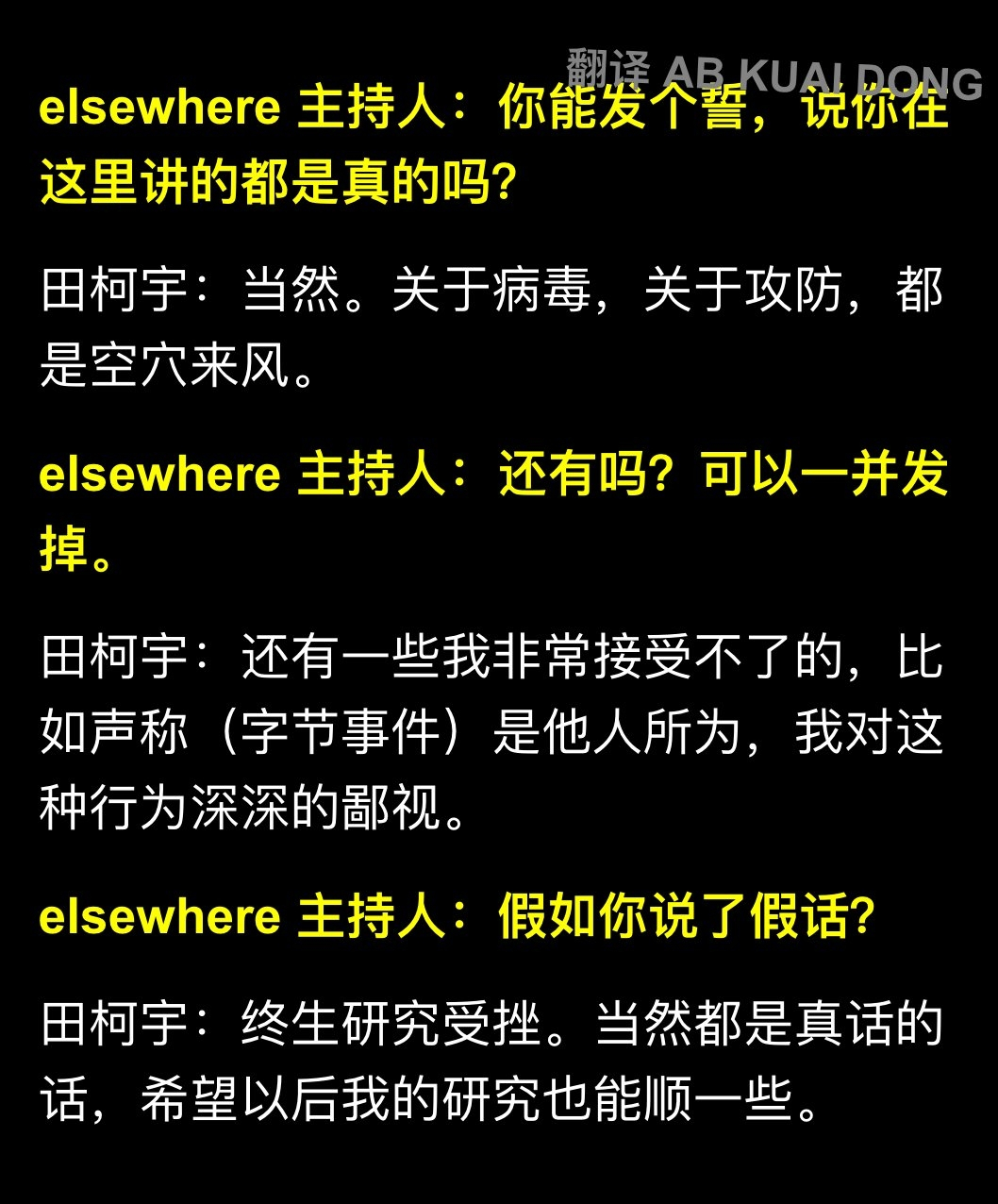
But the real trigger was his defense of himself as the victim of bullying on a podcast. He claimed that when he was an intern at ByteDance, a new intern joined his team with administrator privileges, used more than their share of computing power, and even stopped other interns’ training jobs.
He had reported it to his managers, but nothing was done. So he took matters into his own hands and used AI to write a small program that manually stalled the other person's project runs five times over roughly ten days, freeing up extra computing power for others to use.
He said he wasn't short on computing power, and none of his own tasks had ever been suspended. He simply couldn't stand seeing someone bully others, and denied the online rumors that he had poisoned the system or framed someone else.
But as soon as the podcast was released, ByteDance's internal community erupted. Many employees who had been in that team at the time, as well as colleagues who helped investigate the issue, came forward with their accounts.
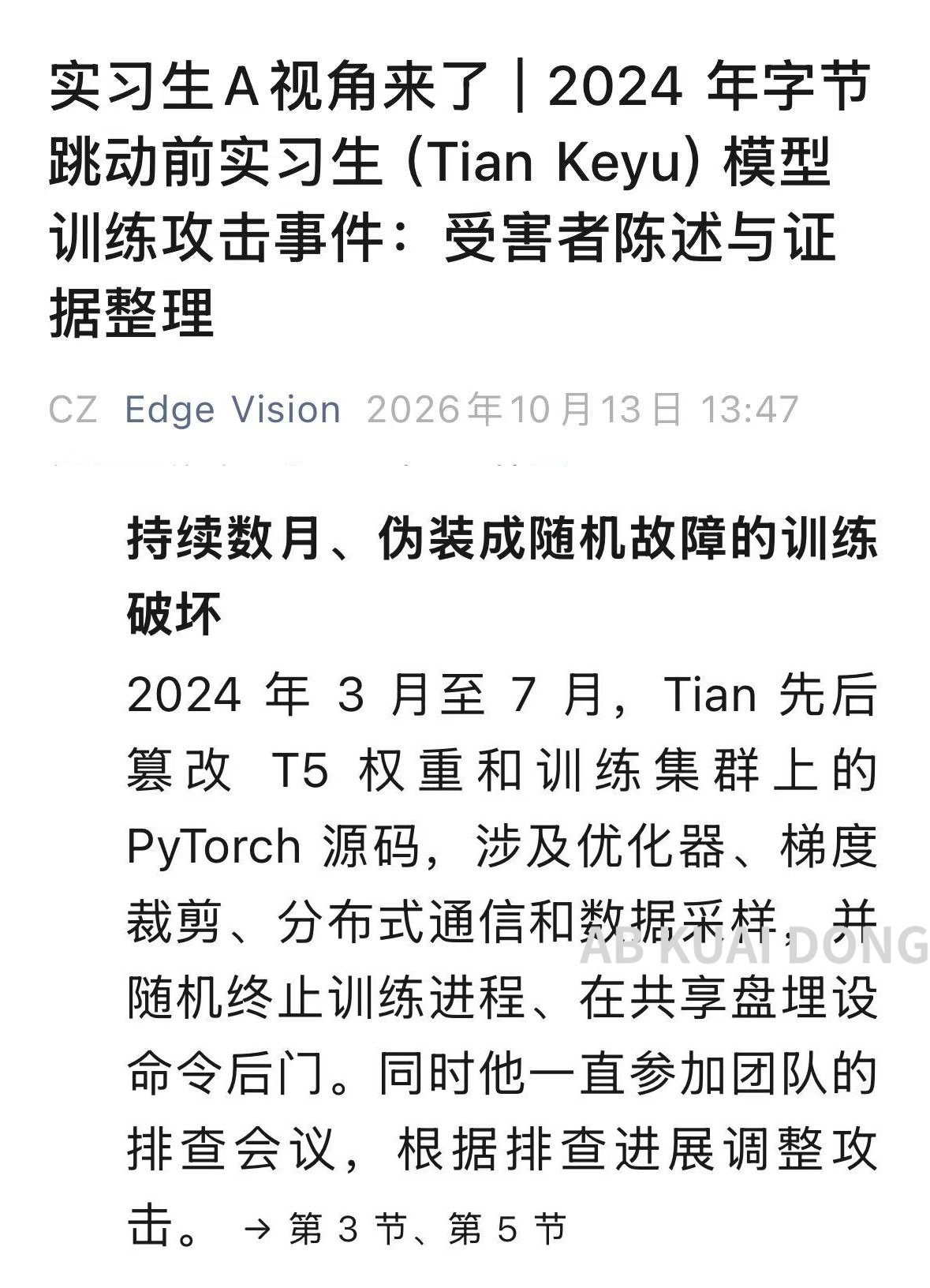
They accused Tian Keyu of nearly taking down several ByteDance projects—not just five times in ten days, as he described, but repeatedly over several months starting in March 2024, affecting multiple projects (including LlamaGen, a text-to-image project, and the later Goku video-generation project).
ByteDance employees in Beijing, Shanghai, and Seattle took turns investigating, but couldn't find the problem.
To keep people from discovering his sabotage, Tian Keyu didn't just manually suspend tasks. He also changed model weights in shared directories, used sudo to replace PyTorch files on the system and then changed their modification timestamps back, and altered random seeds, among other things.
This made the incidents look like random failures, so no one could tell that he was behind them.
They also said that Tian Keyu was a habitual fraudster within ByteDance. The VAR project he was responsible for used thousands of training cards, but it was later discovered that the project had actually run the open-source PixArt model, not a model he had trained himself.
To stop others from exposing him by comparing results using the same prompts, he secretly added instructions to the start of the prompts. The model he had actually trained performed much worse.
As the incident continued to unfold, more and more ByteDance employees began publicly accusing Tian Keyu. The incident has also become a hot topic of discussion inside ByteDance recently, with many employees joking, “If only we'd known—we could've done bad things too and gone out to raise money from gullible VCs.”