
The sensational international Bitcoin money-laundering case has recently reached a pivotal ruling.
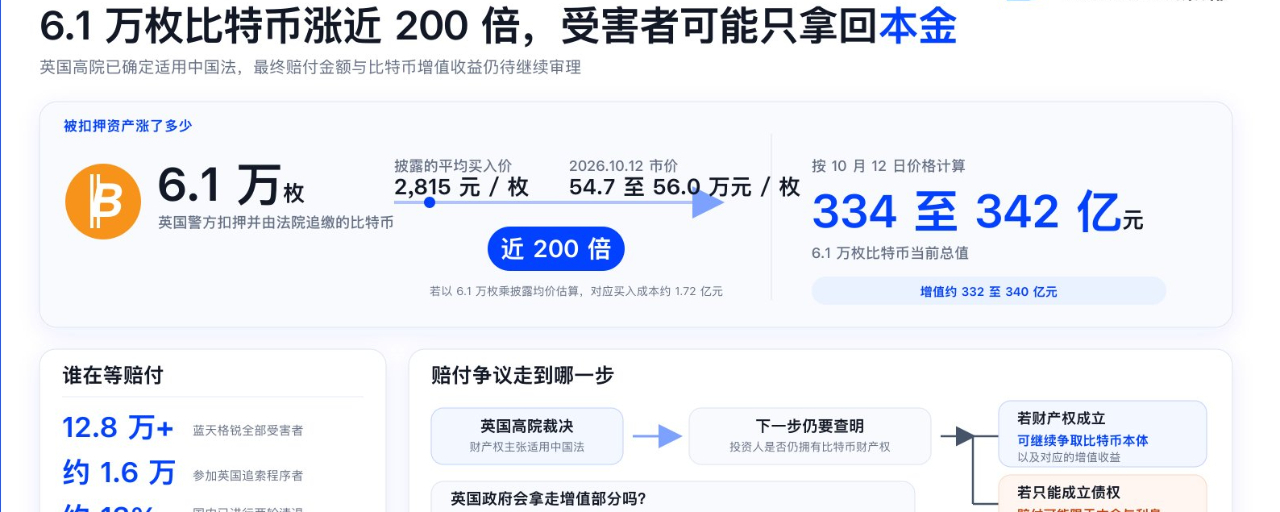
The UK High Court has formally ruled that Chinese law, rather than UK law, applies to property claims over the 61,000 bitcoins seized in this case.
This means the UK government may have emerged as the biggest winner in this landmark case, while the 128,000 victims in China may be left with no more than their original investments.
Because Chinese law applies, the victims will most likely be able to seek compensation only for the original amount they were defrauded of, plus interest. After Qian Zhimin absconded with 40 billion, she bought up Bitcoin at an average price of less than 3,000 yuan. Locked away for seven years, those bitcoins rose nearly 200-fold in value.
Now, after returning the victims’ principal, the tens of billions in windfall profits left over will likely go straight into the pockets of the British government, while the victims won’t get a penny.
More ironically still, this lengthy legal battle has also coincided with a massive market downturn.
When Qian Zhimin was sentenced in London last November, Bitcoin was still above $100,000, and the value of this stash of Bitcoin briefly approached $6.6 billion.
Now that the price of Bitcoin has fallen back to around $80,000, while all sides are still bitterly fighting over how to divide the spoils, more than a billion dollars in asset value has already evaporated amid the market’s volatility.
It all feels somehow destined.
The mastermind behind the money-laundering scheme, who once carried a fake passport and dreamed of buying a European castle and becoming its queen, ultimately met her end in an Airbnb bed.
And the more than 100,000 victims who truly paid the price for this frenzy have waited seven years, only to be mercilessly shut out of the crypto boom.