

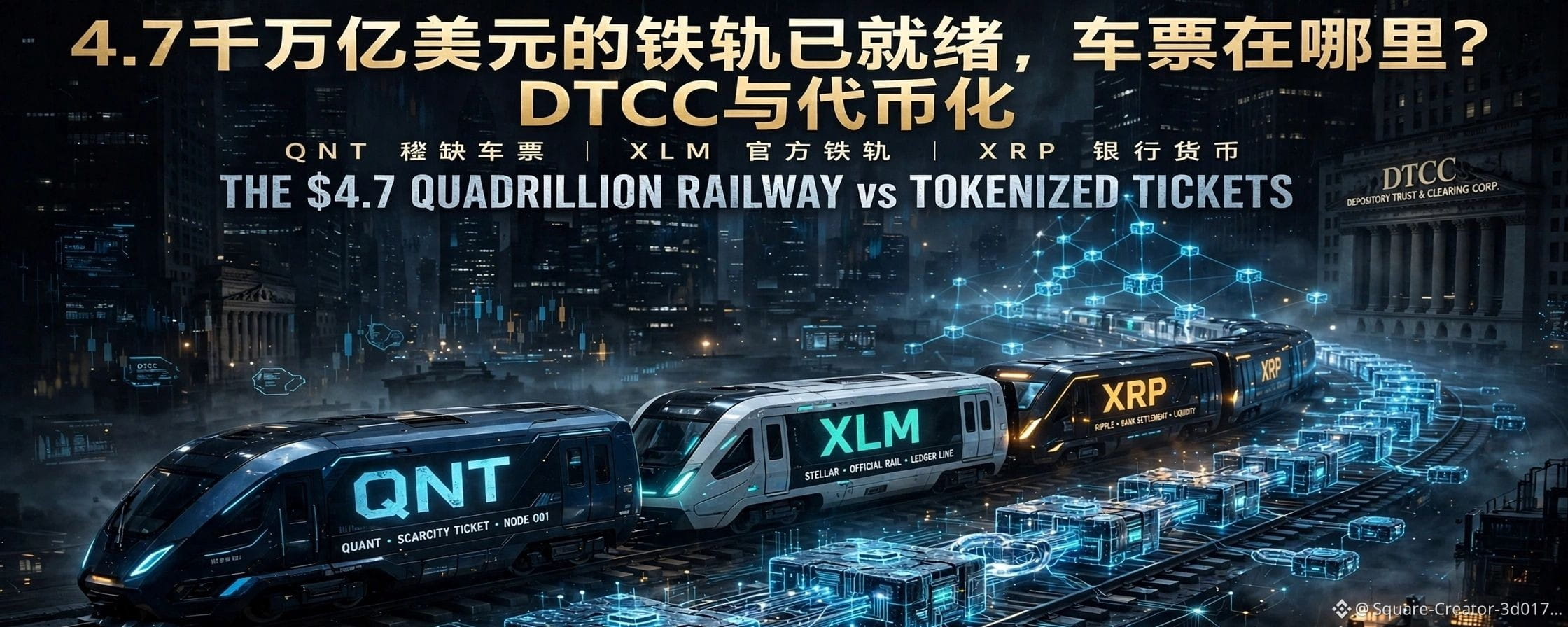

More and more people are paying attention to the tokenization of real-world assets (RWAs) and the trend of traditional financial infrastructure moving onto the blockchain.
But the most important question is not just how many assets will be tokenized. More crucially, how much of this activity can generate genuine economic demand for the native tokens of the networks involved?
In 2025, DTCC-affiliated entities processed securities transactions worth $4.7 quadrillion, while its depository arm provided custody and related services for securities assets valued at $114 trillion.
These figures are staggering, but they reflect the scale of traditional financial infrastructure. They do not mean that all these assets will migrate to the blockchain, let alone that they will translate into demand for any particular cryptocurrency.
Therefore, we need to distinguish among three different concepts: infrastructure development, growth in the value of tokenized assets, and the economic value these activities may bring to the network’s native token.
1. $QNT — Infrastructure for connecting different systems
In September 2026, The Clearing House announced that it had selected Quant to support its on-chain money initiative, which aims to connect blockchain-based financial activity with traditional payment systems and coordinate the settlement of transactions and tokenized bank deposits.
The Clearing House operates several payment networks and is owned by major U.S. banking institutions.
Why pay attention to QNT?
As financial institutions’ demand for interoperability solutions grows, Quant’s technology may have more opportunities for adoption. QNT is also used in Quant’s Overledger ecosystem, with its role in access to related services depending on the company’s business model.
However, a partnership announcement alone cannot answer a key investment question:
How much additional demand for QNT will actual institutional use of this technology create?
Without a clear operational mechanism or supporting commercial documents, we cannot claim that every bank must lock up a certain amount of QNT. The adoption of a technology also does not mean that the token’s price will necessarily rise.
Key risks: Even if the technology succeeds commercially, the economic benefits may not translate into the token’s price to the extent investors expect. Valuation, competition, and project execution also affect the outcome.
2. $XLM — A public blockchain with access to traditional finance
In May 2026, DTCC and the Stellar Development Foundation announced plans to bring certain assets from DTCC’s tokenization services onto the Stellar network in the first half of 2027.
Under the relevant plans, eligible assets may include constituents of the Russell 1000 Index, exchange-traded funds (ETFs), and U.S. Treasuries, among others. Specific arrangements remain subject to applicable regulatory requirements.
Stellar also announced that, as of September 1, 2026, the value of real-world assets tokenized on its network had reached $4 billion.
Why pay attention to XLM?
Because expanding Stellar’s use in payments and tokenized assets could strengthen its role as public financial infrastructure. XLM can be used to pay network transaction fees and meet the minimum balance requirements for some accounts.
However, extremely low transaction fees raise an important question: To what extent can increased network activity translate into demand for the native token?
Stellar’s base transaction fee is 0.00001 XLM per transaction. Assuming every transaction incurs only this minimum fee, the base fees for 1 billion transactions would total 10,000 XLM—not a fixed dollar amount.
Their value in U.S. dollars changes with XLM’s market price. Actual fees may also vary when the network is congested or smart contract resource fees apply.
This does not mean that growth in network usage has no value. Rather, it means that transaction counts alone cannot accurately measure economic demand for XLM.
Further research is needed into the nature of the transactions, account balance requirements, fee payment mechanisms, and whether this activity can be sustained.
Key risks: The value of tokenized assets on Stellar may continue to grow, but XLM’s price may not rise in proportion. Announcements of technology partnerships do not guarantee future levels of actual use, nor do they directly prove an impact on price.
3. $XRP — Payments and financial infrastructure
XRP is a digital asset associated with the Ripple ecosystem. It can be used for payments, liquidity, and cross-border value transfer in certain services and business contexts, depending on the design of the relevant products and how they are actually used.
XRP has a historical maximum supply of 100 billion tokens, and a portion of the fee is burned with each transaction.
However, burning transaction fees does not necessarily create a significant scarcity effect on the price. The impact depends on the amount burned relative to the circulating supply, as well as changes in market demand.
Why pay attention to XRP?
Developments in digital assets across payments, liquidity, and cross-border finance, as well as changes in the regulatory environment, may affect market interest in the Ripple ecosystem and XRP.
But one common misconception needs to be clarified: ISO 20022 is a standard for exchanging financial messages, not an official certification of any particular cryptocurrency.
Therefore, XRP cannot be described as the only cryptocurrency officially certified under this standard.
Additionally, discussions or market expectations around ETFs should be evaluated based on specific regulatory developments and reliable sources, not conclusions drawn solely from possibilities or market rumors.
Key risks: Market expectations for XRP may rise without translating into corresponding demand from actual use. Competition, overall market valuations, and regulatory developments can also affect its performance.
In summary: A successful network does not necessarily mean a successful token
Tokenization of real-world assets may create new opportunities for financial markets, but that does not mean every token associated with the relevant networks will deliver a certain investment return.
Before evaluating these projects, consider three questions:
1. Source of demand: Does using this technology create sustained demand for the token itself? Or can the services be used without holding substantial amounts of the token?
2. Value transmission: Is there a clear mechanism for translating growth in economic activity into demand for the token? Or does this relationship depend mainly on market expectations?
3. Valuation and risk: Does the current price already reflect the expected growth? What execution, competition, liquidity, and supply risks does the project face?
A technology may be adopted by institutions while its token sees only a limited impact. Conversely, a token’s price may be affected by factors beyond actual use, such as liquidity, market expectations, and broader market conditions.
Therefore, there is no simple formula that can guarantee an outcome.
Tokenized assets such as $BENJI or $USDY should be assessed separately based on their specific characteristics, holder rights, terms, and risks. They are not the same as a blockchain network’s native token, and growth in tokenization does not mean they will necessarily generate investment returns.
Investment perspective: Don’t focus only on which blockchain might be adopted. Understand how that adoption could affect the assets you plan to buy.
Which projects merit further research? The answer should not rest on promises of guaranteed price surges, but on reliable evidence, value transmission mechanisms, valuation analysis, and risk management.