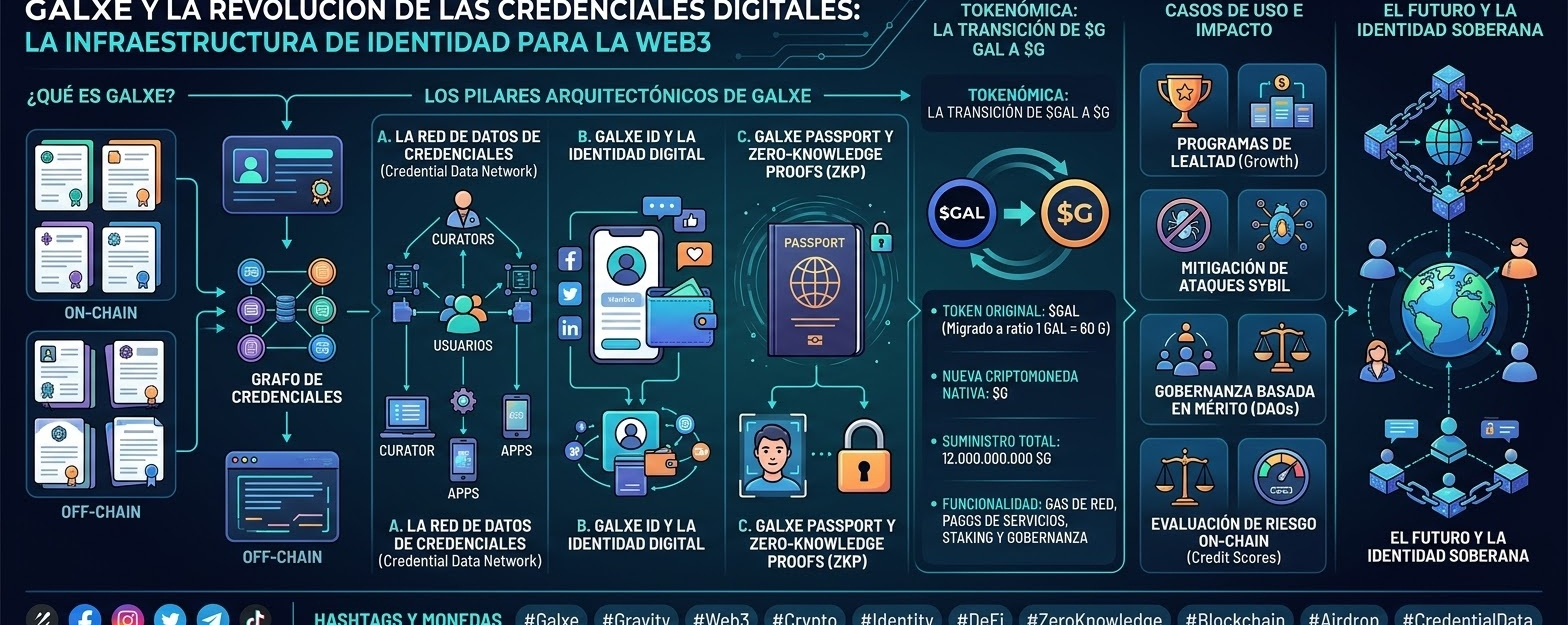

The growth of the Web3 ecosystem has brought significant advances in decentralized finance, governance, and digital ownership. However, one of the most complex and long-standing challenges in the blockchain space has been managing identity and reputation. In Web2, centralized platforms dominate digital identity by storing user data on proprietary servers, offering little or no privacy.
Galxe was created to solve this structural problem. Conceived as a collaborative, decentralized credential data network, Galxe provides the infrastructure developers, projects, and communities need to build, verify, and issue digital credentials in a secure, composable, privacy-focused environment.
1. What Is Galxe?
Galxe is an open digital credential infrastructure network that allows developers and creators to leverage on-chain and off-chain credential data to build better products and communities in Web3.
In simple terms, a digital credential is verifiable proof of an entity’s achievements, contributions, behavior, or status:
On-Chain Credentials: Providing liquidity to a specific DeFi protocol, participating in a DAO governance vote, interacting with a smart contract on a test network (testnet), or holding a tokenized asset.
Off-Chain Credentials: Participating in a Discord server, attending an in-person or virtual event, verifying identity through Proof of Humanity, or contributing to code repositories such as GitHub.
Galxe unifies both sources of information, turning them into a credential graph that can be used by any decentralized application (dApp).
2. The Architectural Pillars of Galxe
Galxe’s architecture consists of three fundamental modules that ensure data flow, security, and interoperability:
A. The Credential Data Network
It is the core of the protocol. It functions as an open infrastructure where data curators can provide information about on-chain and off-chain activities. When a curator contributes valid data to the network, they are rewarded when projects or developers use that data, incentivizing accuracy and continuous system updates.
B. Galxe ID and Digital Identity
Galxe ID acts as a digital passport in Web3. It unifies a user’s different wallet addresses, social media identities, and accumulated achievements within the ecosystem into a single sovereign entity. Through Galxe ID, users retain absolute control over which data they share.
C. Galxe Passport and Zero-Knowledge Proofs (ZKP)
To address the need for identity verification without compromising user privacy, the protocol integrated Galxe Passport. This system allows users to complete identity verification (KYC) and store the information in encrypted form. Using Zero-Knowledge Proofs, users can prove to any platform that they are real people or meet specific criteria without revealing their personal data.
3. Blockchain Architecture: Contracts and Infrastructure
To ensure scalable performance at low cost, the ecosystem evolved from a purely multichain solution into its own dedicated Layer 1 chain called Gravity.
Native Network: Gravity Alpha Mainnet.
Compatible ERC-20 / BEP-20 Networks: Ethereum, BNB Smart Chain, and Base.
Token Contract Address ($G on Ethereum, BSC, and Base): 0x9C7BEBa8F6eF6643aBd725e45a4E8387eF260649
Legacy Token Contract ($GAL on Ethereum): 0x5fAa989A7378D9875
4. Tokenomics: The Transition from GAL to G
The protocol’s economy underwent a structural upgrade, during which the original $GAL token completed its technical migration to the unified $G token.
Ecosystem Token Specifications
Native Cryptocurrency / Utility Token: $G (Gravity Token)
* Legacy Ticker: $GAL (Migrated at a ratio of 1 GAL = 60G)
* Total Supply: 12,000,000,000 $G
Decimals: 18
$G Token Functionality on the Network
Network Gas: $G serves as the native currency for paying transaction fees on the Gravity chain.
Web3 Service Payments: Developers use $G to pay for infrastructure queries, credential data API calls, and fees within Galxe Quest, Galxe Passport, and Galxe Score.
Staking and Governance: Network validation and active participation in DAO decisions require locking (staking) $G, which grants incentives and voting rights.
5. Use Cases and Ecosystem Impact
Galxe’s infrastructure is flexible enough to be applied across multiple key sectors of the blockchain ecosystem:
Loyalty and Growth Programs: Projects design structured incentive campaigns, rewarding users who demonstrate genuine behavior on the network.
Sybil Attack Mitigation: Credential verification allows protocols to filter automated bot traffic and direct incentives or token distributions to genuine users.
Merit-Based Governance: DAOs can give greater voting weight to members who have actively participated in previous proposals or hold specific technical credentials.
On-Chain Risk Assessment: Transparent histories of financial interactions allow lending platforms to assess decentralized credit risk profiles.
6. The Future of Galxe and Sovereign Identity
Galxe’s evolution is moving toward full cross-chain interoperability and enhanced privacy through advanced cryptographic technologies. As global regulations demand higher compliance standards without sacrificing decentralization, solutions such as Galxe Passport and the integration of advanced identities are emerging as a bridge between traditional finance and decentralized infrastructure.
Galxe represents a paradigm shift in digital information management: moving from a model where platforms own users’ data to one where users have full ownership of their digital reputation and can carry it freely, securely, and privately across Web3.
#Galxe , #Gravity , #Web3 , #DeFi , #ZeroKnowledge ,