




Let me say something that may offend a lot of bulls: with this CPI report, what worries me most isn’t that the data will come in hotter than expected, but that everyone knows inflation is set to rise and is still aggressively chasing oil higher.
Markets can be pretty interesting sometimes. When oil prices rise, everyone cries inflation; when inflation hits, everyone cries rate hikes; and when rate-hike expectations heat up, everyone starts turning bearish on U.S. Treasuries.
It sounds perfectly logical, but if trading were really that simple, there probably wouldn’t be so many people stuck in losing positions.
On October 14, the U.S. September CPI report is due out. In my view, this data could be just as important as a Fed rate decision.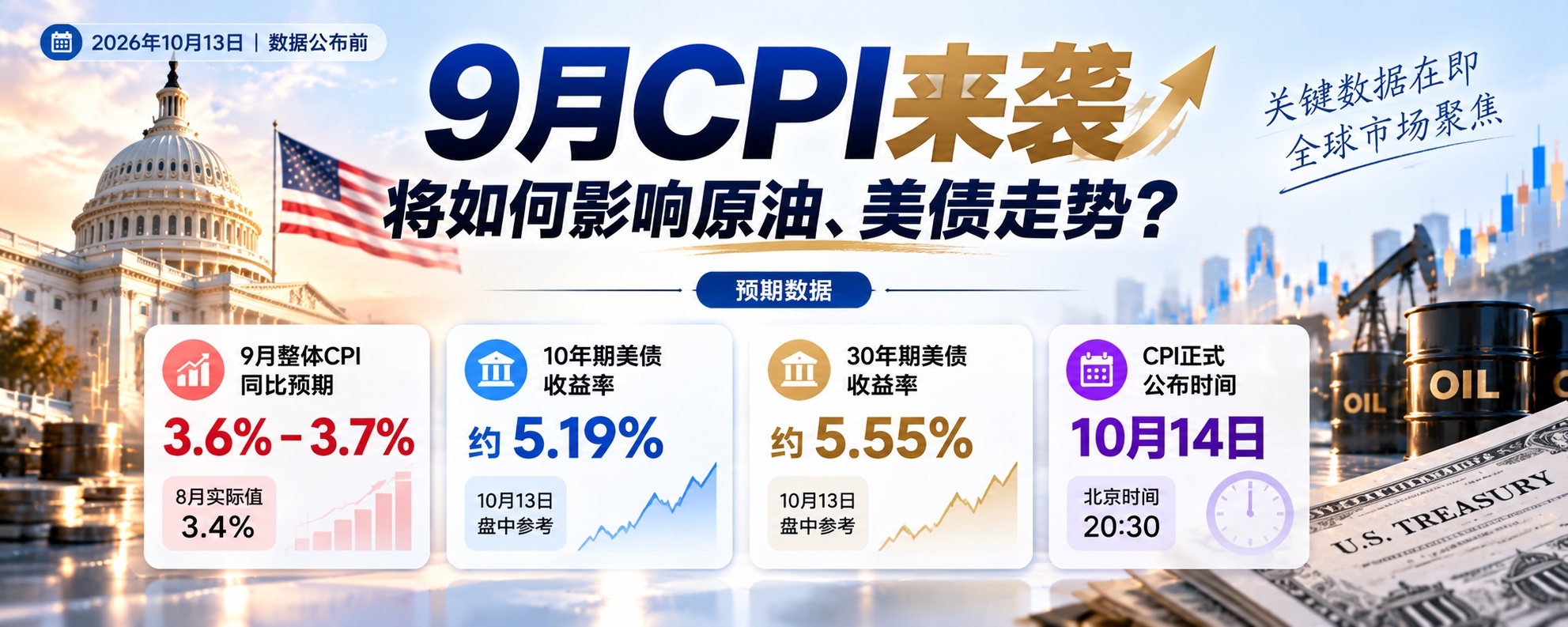
The reason is simple: oil has already priced in geopolitical conflict, and U.S. Treasuries have already absorbed some rate-hike expectations. What will really determine the market’s direction now isn’t whether inflation is high, but how large the gap is between the actual data and market expectations.
I. CPI hasn’t been released yet, but the market has already placed its bets
Let’s start with a few data points worth watching.
U.S. CPI rose 3.4% year over year in August, while market forecasts for September CPI are clustered around 3.6%–3.7%. In other words, a resurgence in inflation is no longer a secret.
More importantly, the market expects core CPI to come in at around 2.4%–2.5%.
There’s a crucial distinction here.
If headline CPI rises mainly because of a sharp jump in energy prices, while core CPI remains relatively stable, that would suggest this bout of inflationary pressure may be driven more by an external supply shock.
But if core CPI also comes in significantly above expectations, that’s a problem.
That’s because it suggests high oil prices may be feeding into other sectors through transportation, production, and service costs.
The former may be a temporary inflation shock; the latter is the kind of persistent inflation that would truly give the Fed a headache.
So this time, I won’t focus only on the year-over-year CPI figure. I’ll pay close attention to month-over-month core CPI and whether energy costs are spreading to other goods and services.
II. Crude oil (BZUSDT): I’m not denying the case for a rise, but chasing longs now could be the riskiest move
Let me state my view upfront: oil still has support in the medium term, but in the short term, blindly chasing a rally is unwise.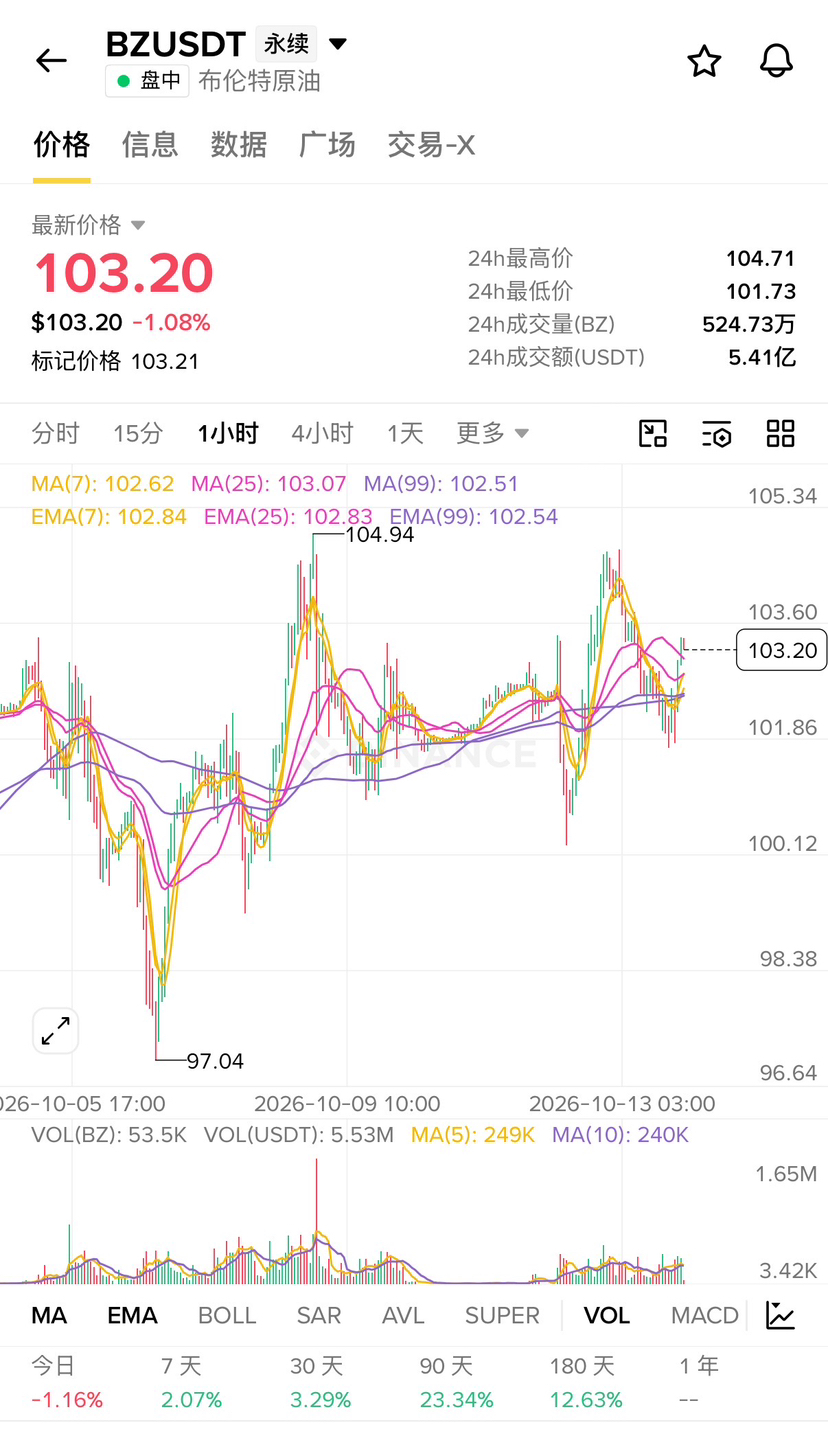
Geopolitical conflict in the Middle East continues to affect energy transportation and supply. Oil tanker insurance costs are rising, shipping routes are being adjusted, and some crude oil supplies are restricted. These all translate into real costs.
In its October outlook, the U.S. Energy Information Administration (EIA) also noted that oil prices could remain high amid supply disruptions and transportation costs, until restrictions on crude oil flows in the Middle East ease.
So I don’t think oil’s rise is entirely market hype.
The thing is, markets never look at fundamentals alone.
When everyone knows oil prices will be supported by geopolitical conflict, a considerable portion of the risk premium may already be priced in.
At this point, would another stronger-than-expected CPI reading really be enough to send oil prices surging further?
Not necessarily.
Instead, I think oil could take one of three paths from here:
First scenario: CPI comes in above expectations, but oil prices spike and then pull back. That’s because the bullish inflation news may already have been priced in, prompting some investors to take profits once the data is released.
Second scenario: CPI comes in as expected, and oil continues to trade sideways. The market turns its attention back to the situation in the Middle East, actual supply levels, and changes in inventories.
Third scenario: CPI comes in below expectations, while geopolitical tensions ease. This is the combination I think oil bulls really need to watch out for.
For BZUSDT, my thinking is clear: I won’t chase a sharp rally driven by headlines. I’d rather wait for a pullback and confirmation that buyers are stepping in.
If prices break above the previous high but fail to hold there, I’ll be especially alert to the risk of a short-term pullback.
I’d rather miss part of a rally than be the last one buying when everyone is excited.
III. U.S. Treasuries: Are yields at elevated levels an opportunity or a trap?
Compared with oil, I’m actually more focused on U.S. Treasuries.
As of October 13, the 10-year U.S. Treasury yield had fallen to around 5.19% at one point, while the 30-year yield had retreated to around 5.55%.
But don’t forget that just last week, the 10-year U.S. Treasury yield touched 5.365%, while the 30-year yield climbed as high as 5.733%.
What does that mean?
Long-term U.S. Treasuries are facing considerable valuation pressure.
A reminder for those who are new to bond trading:
Rising U.S. Treasury yields usually mean that the prices of existing fixed-rate bonds fall; declining yields usually mean bond prices rise.
So if CPI continues to exceed expectations and markets once again price in a stronger chance of rate hikes, U.S. Treasury prices could come under renewed pressure.
But that doesn’t mean I’m going to be blindly bearish on U.S. Treasuries.
There’s an interesting feature of the bond market: when everyone thinks yields are going to keep rising, if the actual data turns out to be less bad than expected, short covering can quickly drive bond prices higher.
What’s more, U.S. Treasury yields are affected not only by inflation, but also by the fiscal deficit, Treasury supply, the term premium, and growth expectations.
So don’t assume that a slight drop in CPI will automatically send U.S. Treasuries sharply higher.
My view is that U.S. Treasuries are approaching a repricing window worth watching, but high yields alone aren’t enough to conclude that a bottom is in.
IV. How would I choose between TBT, TMFUSDT, and RWUSD?
I don’t have the same view on all of these instruments.
TBT: Cautious in the short term; I won’t blindly chase prices higher.
TBT mainly reflects changes in long-term U.S. Treasury prices through inverse leveraged exposure. It typically benefits when long-term Treasury prices fall.
If CPI comes in well above expectations and long-term yields surge again, TBT could offer a short-term trading opportunity.
But I’m not planning to make a large bet ahead of the data release, because the market has already priced in quite a bit of hawkishness.
Also, TBT resets its leverage daily, so its returns over multiple days may differ from a simple inverse multiple.
TMFUSDT: I’m more interested in a rebound opportunity, but I need confirmation first.
TMF-related exposure is generally associated with leveraged ETFs that provide three times the long exposure to long-term U.S. Treasuries. Be sure to check the platform’s contract rules before trading.
If CPI comes in below expectations, core inflation eases, and the 10-year U.S. Treasury yield continues to fall, the case for a rebound in long-term Treasuries would become much stronger.
However, these highly leveraged products are very volatile. I won’t buy the dip just because prices have fallen a lot.
RWUSD: I’d treat it as part of my capital management.
For funds I’m not yet confident about, I’d rather keep some liquidity available than force a position just to take part in the market move.
If I use yield-bearing products such as RWUSD, I’ll first verify the specific sources of yield, redemption mechanisms, asset risks, and platform rules. I won’t treat it as equivalent to risk-free U.S. Treasuries.
Sometimes, waiting is a trading strategy in itself.
V. How am I planning to trade before and after the CPI release?
I’ve laid out three scenarios for myself.
Scenario A: CPI comes in well above expectations, with core inflation rising at the same time.
In this situation, I’d first watch whether U.S. Treasury yields start rising again. If yields break above a key level and hold there, I’d lean toward TBT in the short term and remain cautious on TMFUSDT.
I’m not in a hurry to go long on oil. The key is to watch whether prices spike and then pull back after bullish news is announced.
Scenario B: CPI comes in broadly in line with expectations.
This is the scenario I think is most likely to punish people who chase rallies and sell off in a panic.
That’s because the market may first swing sharply before returning to its previous trading logic.
In this kind of market, I’d rather reduce my position size and wait for a clear direction to emerge.
Scenario C: CPI comes in below expectations, and core inflation also eases.
This is the scenario I’m most interested in.
If U.S. Treasury yields also move lower and long-term Treasuries see sustained buying, I’ll look closely for short-term rebound opportunities in TMFUSDT.
As for oil, I’ll watch whether the geopolitical risk premium starts to fade, rather than mechanically assuming that low inflation must be bearish for oil prices.
One more rule: As a rule, I don’t chase the first sharp move after the data is released. I’ll wait at least until the market has made its initial adjustment, then assess whether it’s a genuine breakout or a false move.
VI. A few final thoughts that may not be very popular
I’ve noticed that many people trading macroeconomic events are especially fond of guessing the numbers.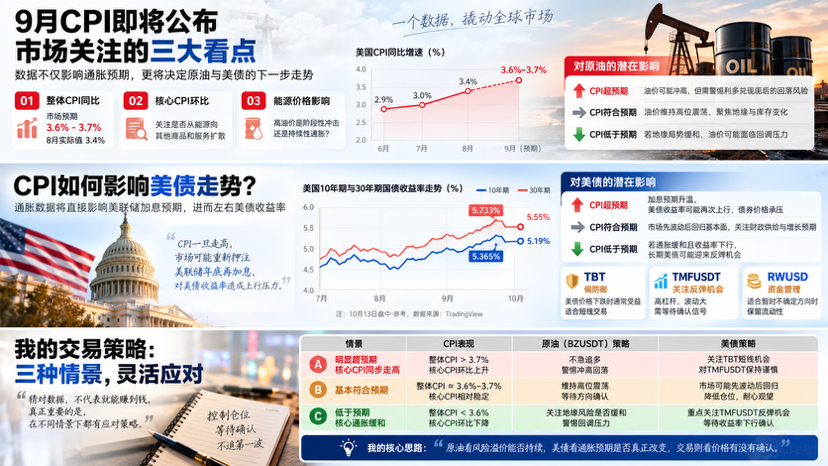
Guessing the CPI figure, guessing whether the Fed will raise rates, guessing how much further oil prices can rise.
But I’m increasingly convinced that getting the data right doesn’t necessarily mean making money.
You may correctly predict that CPI will rise, but oil may have already made its move. You may correctly anticipate stronger rate-hike expectations, but Treasuries may have already fallen too far.
In the end, you get the direction right, yet your account is still losing money.
This is the most frustrating part of macro trading.
So this time, I won’t put all my chips on one direction ahead of time.
My core idea boils down to one sentence:
For oil, I’ll watch whether the risk premium can persist; for U.S. Treasuries, whether inflation expectations really change; and for trading, whether price action confirms the move.
Personally, I’m more wary of the risk of chasing oil higher, and more focused on the possibility of a rebound in long-term U.S. Treasuries once the inflation data is released.
But a view is just a view. If the market hasn’t confirmed it, I’m in no hurry to jump in.
The market never runs out of opportunities; what’s scarce are people who can stay clear-headed at crucial moments.
One final question for everyone: If CPI really does come in above expectations this time, would you go long on oil, stay bearish on U.S. Treasuries, or position for a Treasury rebound?
I’ll put my vote in first: Don’t rush into the first move; wait for the market to show its hand.