

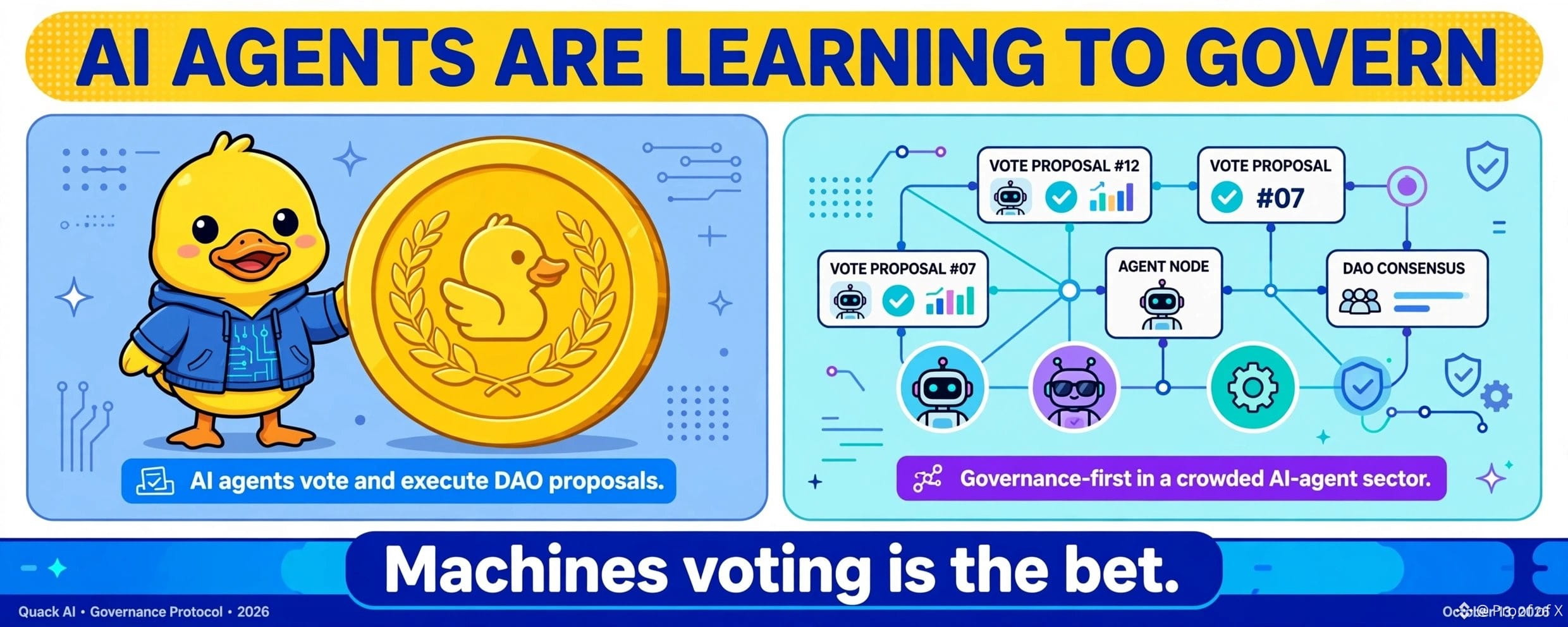
DAOs have a participation problem, and Quack AI thinks the fix is to let AI agents do the governing.
BUSINESS
Quack AI is the governance layer for what it calls the Agent Economy, a system where AI agents, users, and applications interact under verifiable on-chain rules.
Its product automates the full DAO governance loop: AI agents read proposals, score their risk, filter low-quality submissions, cast votes on behalf of delegating holders, and trigger on-chain execution once a proposal passes.
Holders delegate voting power to AI agents rather than voting on every proposal themselves, and authorization runs through Soulbound Tokens that tie an agent to a verified holder.
The protocol started on DuckChain, the Telegram-integrated EVM chain, and now supports governance across BNB Chain, Base, Arbitrum, Linea, Avalanche, Metis, Taiko, Optimism, and Conflux.
A newer module targets tokenized real-world assets, with treasury automation and proposal scoring aimed at funds and issuers that need auditable decisions.
Its Agentic Wallet, updated to version 2.1 in June 2026, lets AI agents view, send, stake, and unstake $Q from agent-controlled wallets through a gasless execution layer.
No fee or revenue figure could be verified this run, so the business case rests on governance utility and agent transaction demand rather than a documented revenue stream.
TECHNOLOGY
The technical core is a facilitator relay system plus a policy engine that lets agents act on-chain under pre-set rules, with sign-to-pay flows built on the x402 standard.
The x402 design enables gasless transactions: agents sign a payment authorization and the relay settles it, so an agent can act without holding gas on every chain.
Governance intelligence modules score proposals in real time using community sentiment, on-chain metrics, and alignment with ecosystem goals.
Cross-chain voting is the differentiator: one delegation can cover governance decisions on several networks instead of forcing holders to track each chain separately.
The design trades full autonomy for guardrails, since agents act only within the policy their holder approved.
SECTOR
Quack AI sits at the intersection of two crowded sectors: AI agents and DAO tooling.
AI-agent tokens drew heavy speculative flows through 2025 and 2026, but most of them price a narrative rather than measured usage.
DAO tooling has the opposite problem: the infrastructure exists, yet voter turnout in most DAOs stays low and a small number of large holders decide most votes.
Quack AI is betting that combining the two solves both problems at once: agents supply the participation, and governance supplies the agents with real work.
The token is listed in the Binance Alpha Spotlight category on CoinGecko, which reflects exchange attention rather than a listing.
COMPETITION
In the AI-agent sector, $VIRTUAL built the best-known agent-launching platform, while $FET anchors the largest open AI-agent alliance.
Quack AI differs from both by focusing on governance rather than agent creation or model marketplaces: its agents vote and execute, not just chat or trade.
Against pure governance tooling such as Snapshot and Tally, the edge is automation: those platforms organize votes, while Quack AI aims to carry them out.
The risk in this positioning is breadth: a governance-only agent layer must win adoption DAO by DAO, while broader agent platforms can monetize many use cases at once.
TOKENOMICS
Per CoinGecko, $Q trades with a market cap of about 186.8 million dollars and a fully diluted valuation of about 396.9 million dollars.
Circulating supply is about 4.71 billion $Q out of a 10 billion maximum supply, so about 47.1 percent of the total supply is circulating.
No unlock schedule could be verified from a cited source this run, so the remaining 5.29 billion $Q should be treated as future supply overhang until a schedule is published.
$Q is used for governance delegation, agent authorization, and staking inside the Agentic Wallet.
The token reached an all-time high of 0.05635 dollars on September 27, 2026, and an all-time low of 0.00527092 dollars on March 28, 2026.
ON-CHAIN AND FUNDAMENTALS
No verifiable on-chain and fundamentals data found this run.
DeFiLlama lists no TVL figure for the Quack AI protocol, and no fee, revenue, or active-address figure could be verified from the project dashboards this run.
The one measurable activity signal is market turnover: about 20.85 million dollars of $Q changed hands in the last 24 hours, per CoinGecko.
TEAM AND FUNDING
Per a PANews report, Quack AI raised 3.6 million dollars in July 2025.
The round included Animoca Brands, 071labs, Skyland Ventures, Kenetic, Scaling Labs, Carv, and Merlin Chain as strategic investors.
No verifiable founder or team background data found this run.
RISKS
The largest structural risk is supply: more than half of the 10 billion $Q supply is not yet circulating, and any unlock schedule would add steady sell pressure.
The second risk is adoption: AI-governed DAOs are an unproven model, and if DAOs do not delegate real decisions to agents, the protocol has no demand engine.
The third risk is accountability: when an AI agent votes or executes wrongly, it is unclear who bears the loss, and that ambiguity could slow institutional use.
The fourth risk is sector crowding: larger AI-agent platforms can add governance features, and governance tooling incumbents can add automation.
The token is also about 30 percent below its September 2026 all-time high, which shows how fast sentiment reprices this sector.
Not financial advice. DYOR.
$Q