


Ripple’s RLUSD stablecoin is getting closer to the banking and trading services that financial institutions already use. The latest development could make it easier for large firms to work with digital dollars, although the implications for XRP price need a careful explanation.
Santiment’s SanSights explores this development in an analysis of RLUSD’s growing institutional role. The analysis examines how banking access and trading infrastructure could support Ripple’s stablecoin business, then considers whether that growth can translate into demand for XRP.
Standard Chartered’s RLUSD Custody Gives Institutions a Banking Connection
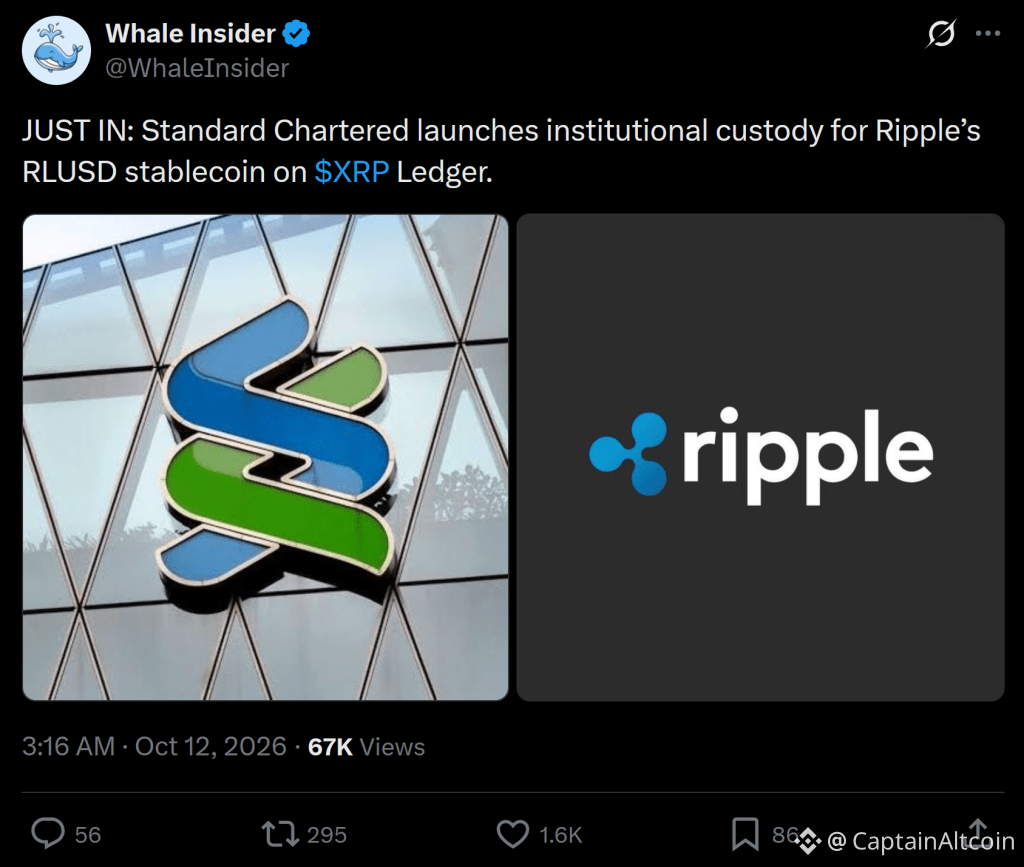
Standard Chartered announced institutional custody for RLUSD on October 12, 2026. Eligible clients can now hold RLUSD issued on the XRP Ledger through the bank’s DIFC branch in Dubai, which is regulated by the Dubai Financial Services Authority.
Custody involves safeguarding a client’s assets and controlling access to them. Institutional clients need reliable procedures for authorising transfers, recording ownership, checking balances, and assigning responsibility when problems occur.
Consider an investment firm that owns $20 million in RLUSD. Its requirements go beyond access to a cryptocurrency wallet. The firm needs arrangements that fit its accounting, security, and internal approval processes.
 https://app.santiment.net/
A banking custody relationship can help meet those requirements. This makes RLUSD more practical for institutions whose policies restrict where they can hold digital assets.
However, the announcement does not establish that Standard Chartered bought RLUSD for its own balance sheet. The service concerns clients’ tokens, which also differs from custody of the reserve assets backing RLUSD. Ripple identifies BNY as the primary custodian of those reserves.
RLUSD and XRP Have Different Roles Within Ripple’s Ecosystem
RLUSD is a dollar-backed stablecoin designed to maintain a value close to $1. Its backing consists of cash deposits, US Treasuries, and cash equivalents.
XRP serves a different purpose as the native cryptocurrency of the XRP Ledger. Its price depends on market supply and demand, and its functions include network fees and potential use as an intermediary asset.
That distinction matters for institutions that want predictable settlement values. A firm with a $10 million obligation may choose RLUSD because it wants the payment asset to remain close to $10 million until settlement.
The firm does not automatically need to purchase an equivalent amount of XRP. Greater RLUSD adoption therefore needs a separate explanation before it can support an argument about XRP price.
The Planned LMAX Arrangement Could Turn RLUSD Holdings Into Trading Collateral
Standard Chartered is also working with Ripple and LMAX Group on a proposed collateral service. The arrangement would allow eligible RLUSD held at the bank to support trading at LMAX without transferring the underlying tokens directly to the trading venue.
Collateral is an asset committed to support a financial obligation. A trading firm may need to provide it before opening positions because the venue requires protection against possible losses.
The proposed collateral mirroring model would recognise the value of eligible RLUSD held under custody. A hypothetical example helps explain the process:
A firm holds $10 million in RLUSD with Standard Chartered.
An agreed portion becomes eligible collateral for LMAX trading.
LMAX recognises that value under applicable margin rules.
Withdrawal restrictions and default procedures govern the committed balance.
These figures explain the concept and do not represent published commercial terms. The firm would also face controls that prevent unrestricted use of the same committed collateral elsewhere.
The arrangement could reduce repeated transfers between a custodian and a trading platform. It would not eliminate trading losses or every counterparty risk.
Custody is already live, but the collateral integration remains planned. Documentation, testing, regulatory requirements, and internal approvals still need to be completed.
Reads Also: XRP Price May Not Fall to $1 Again Unless Bitcoin Does This
Ripple’s $150 Million LMAX Financing Supports RLUSD’s Wider Expansion
The custody development follows Ripple and LMAX Group’s broader partnership announced on January 15, 2026. Ripple committed $150 million in financing to support LMAX’s expansion.
The partnership targeted RLUSD use across institutional trading infrastructure, including spot crypto, perpetual futures, and contracts for difference.
That $150 million should not be confused with RLUSD trading volume or investment in XRP. Its relevance concerns the infrastructure where institutions could acquire, hold, and deploy Ripple’s stablecoin.
OKX provides another connection within this wider picture. The exchange confirmed on October 6 that Circle, Qube Research & Technologies, Ripple, and SC Ventures participated in a strategic investment at a $25 billion pre money valuation.
That valuation describes the company’s assessed value before the investment. It does not mean the investors supplied $25 billion in fresh capital.
The overlapping relationships connect stablecoin issuance, liquidity, trading, and custody. They do not establish that every participant operates through a single system or that all resulting activity will use XRP.
RLUSD Market Capitalisation Does Not Explain Every Token’s Usage
Santiment’s analysis places RLUSD’s market capitalisation around $2.4 billion to $2.5 billion. That figure represents the reported snapshot in the analysis.
Since RLUSD targets $1, a market capitalisation near $2.5 billion would generally imply approximately 2.5 billion circulating tokens.
However, circulating supply does not establish that every token is actively used. Some balances could remain in wallets, exchange inventories, or institutional treasury accounts.
A fuller assessment would examine transfer volume, active users, trading liquidity, redemption activity, and collateral balances after implementation. The share of activity occurring on each supported blockchain also matters.
RLUSD operates on networks that include the XRP Ledger and Ethereum. Total stablecoin growth therefore cannot automatically be counted as additional XRP Ledger activity.
Read Also: Tron Founder Justin Sun Warns Crypto Has Two Years to Prove Itself
XRP Price Benefits Depend on Actual Network and Liquidity Demand
RLUSD activity on the XRP Ledger provides a direct connection to XRP through transaction fees. Those fees consume small amounts of XRP, which are destroyed.
A large stablecoin payment can still require only a small XRP fee. The payment’s dollar value does not determine an equivalent XRP purchase.
Another possible connection comes through liquidity. XRP can act as an intermediary when that route offers a better exchange price than a direct trade between tokens. Every RLUSD transfer or trade does not need to pass through XRP.
Santiment’s broader argument is that institutional adoption becomes more meaningful for XRP when it produces actual token demand. Deeper liquidity, intermediary trades, and operational holdings would provide clearer evidence than partnership announcements alone.
MRCΛULIMΛN’s Commentary Adds Context to the Supporting XRP News
MRCΛULIMΛN’s supplied commentary reinforces the distinction between institutional developments and direct XRP ownership. The commentator reports that Evernorth began Nasdaq trading under XRPN with about 473 million XRP and approximately $300 million in gross cash proceeds.
$XRP RUMOR CHECK Evernorth finally started trading on Nasdaq under XRPN. We’ve been following this one through the shareholder vote, merger and closing, and now it’s actually trading. The company holds about 473 million $XRP and raised about $300 million in gross cash proceeds. That’s a public company holding a massive amount of $XRP. It doesn’t mean all 473 million $XRP were bought on the open market today. Buying XRPN shares doesn’t mean you own the $XRP in the company’s treasury either. Standard Chartered is now providing institutional custody for RLUSD on XRPL through its Dubai branch. Institutions can hold RLUSD with the bank, and there’s also a plan involving Ripple and LMAX that would let clients use their RLUSD holdings as collateral without moving the tokens. That second part is still being worked on. What wasn’t announced was Standard Chartered settling payments in $XRP. RLUSD is the stablecoin. $XRP is the native asset. A major bank is now offering RLUSD custody on XRPL. Why the fuck do people need to turn that into something else? The XRPL payment engine vulnerability is serious, and I want people to understand what happened. A researcher found a bug that could have allowed someone to create $XRP beyond the intended supply. One scenario put that number near 18 trillion $XRP. Yes, trillion. The bug had been in the code since 2015. The fix was released in xrpld 3.4.1 on Sept. 25, before the public disclosure on Oct. 9. The official report says there’s no evidence it was exploited on a public network, and the researcher received a $250,000 bounty. That’s a massive vulnerability to find in something handling real value. I’m glad it was caught. The bug was real, the risk was serious, and the fix was released. Calling it an active exploit today is wrong. Now BlackRock supposedly has a $32.91 price target for $XRP. No, it doesn’t. That number comes from a 2018 academic paper by Robert Mitchnick and Susan Athey exploring possible $XRP adoption scenarios. Mitchnick later joined BlackRock. That doesn’t make the paper an official BlackRock forecast. It wasn’t a new price target then, and it certainly isn’t one today. U.S. spot $XRP ETFs also recorded about $11 million in net inflows for the week ending Oct. 9, with reported holdings near 1.19 billion $XRP. What I’m most interested in is seeing how XRPN performs now that it’s trading and what comes from Standard Chartered offering RLUSD custody. Those are developments we can actually follow. I’m not interested in pretending a research paper from 2018 is BlackRock telling everyone where $XRP is going.
— MRCΛULIMΛN (@mrcauliman) October 13, 2026
Those holdings do not mean every token was purchased on the open market that day. Buying XRPN shares also does not give shareholders direct ownership of the company’s treasury XRP.
The commentary discusses a payment engine vulnerability fixed in xrpld 3.4.1 on September 25 before public disclosure on October 9. The supplied information states that no evidence of exploitation was found on a public network.
MRCΛULIMΛN also rejects the claimed BlackRock XRP price target of $32.91. The figure came from a 2018 academic paper by Robert Mitchnick and Susan Athey, rather than an official BlackRock forecast.
FAQs
Does XRP have any future?
XRP has a future centered on institutional cross-border settlement and financial infrastructure, though its long-term token value remains heavily debated.
Is XRP the new Bitcoin?
No, XRP is not the new Bitcoin; they serve fundamentally different purposes and have distinct economic models.
Subscribe to our YouTube channel for daily crypto updates, market insights, and expert analysis.
The post Ripple News: RLUSD Just Took a Big Step Into Institutional Finance appeared first on CaptainAltcoin.