



Pearl ($PRL) aims to answer a very specific question: GPUs already perform matrix multiplication—could the same computation serve AI and secure a blockchain at the same time?
AI model training and inference rely primarily on matrix multiplication, while traditional PoW has miners repeatedly compute hashes with almost no practical use beyond mining. Until now, the two have largely operated separately: data centers run models, while miners burn electricity to mine coins. Pearl Research Labs is building an independent Layer 1 that aims to bring the two together.
The mainnet launched on April 27, 2026. Its core mechanism is called Proof of Useful Work (PoUW): instead of focusing on meaningless hashes, miners perform matrix multiplication. In theory, the same computation can serve real AI inference or training while also generating proof of work for a block—one computation, two purposes.
1. Where the technology comes from
This approach is grounded in published research. In 2025, Ilan Komargodski and Omri Weinstein published (Proofs of Useful Work from Arbitrary Matrix Multiplication). The central conclusion is that it is possible to construct proofs of work over arbitrary matrix multiplication that meet blockchain security requirements, with additional overhead approaching 1 + o(1)—that is, the larger the computation, the lower the relative additional cost.
The two authors are also Pearl’s principal founders. Weinstein holds a PhD in computer science from Princeton, previously taught at Columbia University, and is now an associate professor at the Hebrew University of Jerusalem; he has also worked at NVIDIA and VAST Data. Komargodski is an associate professor specializing in cryptography at the Hebrew University of Jerusalem. The team’s roots are in theoretical computer science and cryptography—not in building a product first and coming up with a story later.
At the base layer, Pearl is a fork of Bitcoin’s Go implementation (btcd). It retains UTXO and the longest-chain rule, and currently does not support general-purpose smart contracts. Structurally, it is closer to Bitcoin than to Ethereum.
2. How the token is issued
The native token is $PRL, with a maximum supply of 2.1 billion (100 times Bitcoin’s 21 million). The official position is that there was no premine, no founder allocation, and no public VC unlocks; all tokens are issued through mining. Rewards do not undergo a hard halving every four years, but decline along a smooth curve: issuance is high early on and gradually decreases over time.
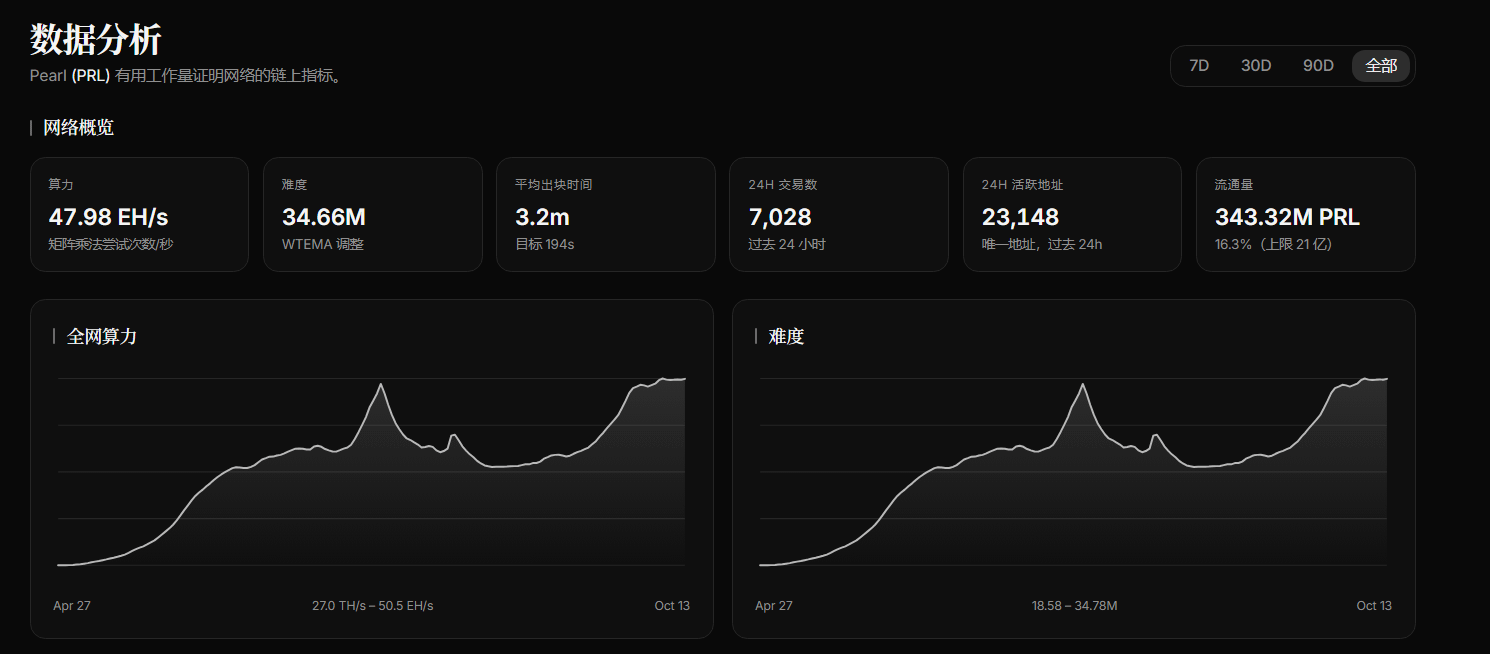
About five months after mainnet launch, roughly 16% of the supply had been mined (with around 340 million tokens in circulation). Current daily issuance is on the order of a million tokens and will change as block rewards decline. The target block time is about 194 seconds (close to three minutes), though actual operation fluctuates.
3. Progress to date
Public reports indicate that the network’s total computing power has grown from a low level shortly after mainnet launch to an amount equivalent to hundreds of thousands of high-end consumer- or data-center-grade GPUs, suggesting that a substantial amount of hardware is participating.
There is an early commercial use case: Together AI partnered with Pearl to launch a PoUW-based Gemma inference service, priced more than 20% below comparable conventional services, with the difference subsidized by mining rewards. Pearl has also built an inference platform compatible with the OpenAI API, supporting some open-source models and charging per token. In July 2026, Pearl Research Labs joined NVIDIA Inception.
The technology is still evolving: early versions focused on integer matrix multiplication, with subsequent work advancing floating-point (FP) approaches to better support mainstream large models. Pearl is also exploring verifiable inference, privacy proofs, and related areas with third parties. Most of this work is still at an early or testing stage. The goal is to increase the share of “useful work,” rather than perform only pure mining computations.
4. What problem is it trying to solve, and what are its advantages?
Traditional PoW is often criticized for “wasting computing power on useless calculations.” Pearl’s response is that GPUs already need to perform matrix multiplication, so this computation can also help secure the chain and reduce pure waste. For AI service providers, if mining rewards can subsidize costs, they may theoretically be able to offer lower inference prices.

It retains several Bitcoin-like features: a fixed total supply, no centralized allocation, and block production through competition for computing power. If substantial real AI workloads join in the future, chain security could become tied to the scale of global AI computing power—not just to people buying dedicated mining hardware.
The paper provides a feasibility argument; the Together AI partnership is the first public commercial validation—at least one AI cloud provider is willing to try using mining subsidies in a real service.
5. Reality and limitations (equally important)
Objectively, not all mining power is performing paid AI work. A considerable share of miners are running matrix multiplication specifically to mine coins, which provides no direct value to AI customers. The share of “useful work” depends on how many AI service providers connect production workloads to the protocol. That share remains low for now, making it a key point the project must prove going forward.
Issuance is continuous. The new $PRL produced each day needs to be absorbed by the market. There is no concentrated selling pressure from VC unlocks, but miners selling their rewards creates ongoing supply. If the price rises quickly without real usage keeping pace, selling pressure can become significant. A large gap between circulating market cap and fully diluted valuation is also common among early-stage projects.
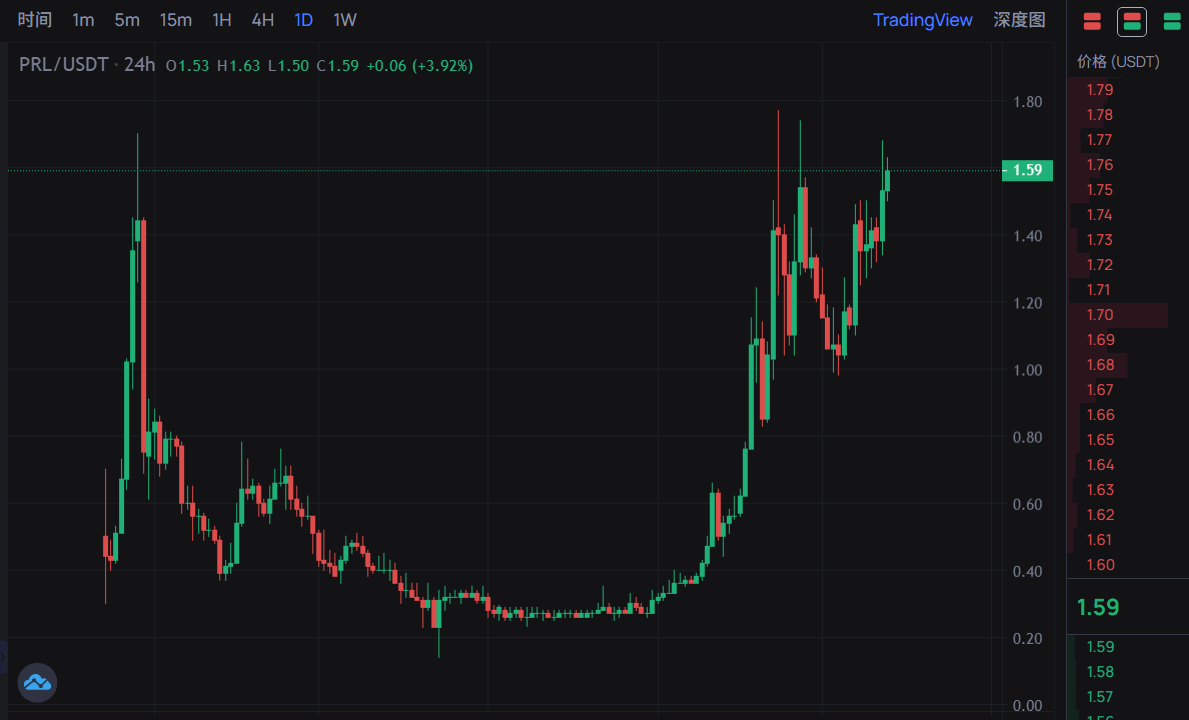
The network is currently closer to Bitcoin in its positioning and does not support complex smart contracts or on-chain applications. Whether it expands to include a computing marketplace, settlement for verifiable inference, and other features depends on future development. Security, fairness, and miner concentration also need to be observed over time. The price is volatile—it rose rapidly after mainnet launch, fell back, and then rebounded as interest grew. This is not unusual for new public chains and AI narratives, but it does not mean the fundamentals have been proven.
6. How to assess it
Pearl is a concrete attempt to incorporate “useful computation” into proof of work. It has a peer-reviewed paper, an academically grounded team, a running mainnet, and an initial commercial partnership. Its advantage is that, in theory, GPUs can serve both AI workloads and chain security, improving computing-power utilization and potentially subsidizing inference costs.
The challenges are also clear: the share of real AI workloads, the market’s ability to absorb ongoing issuance, and whether additional overhead can be reliably reduced in production environments. All of these will take time to verify.
If you want to follow this project, focus first on official technical progress, changes in the makeup of computing power, and how many paid AI services are actually using this mechanism. These indicators often say more about whether the project is progressing as described than short-term prices do.
(Compiled from public information: the project website, papers, mainnet operating data, and media reports. This is not investment advice. Crypto projects are high-risk; please make your own judgment.)
#Pearl #PRL #AI #Crypto #PoUW