

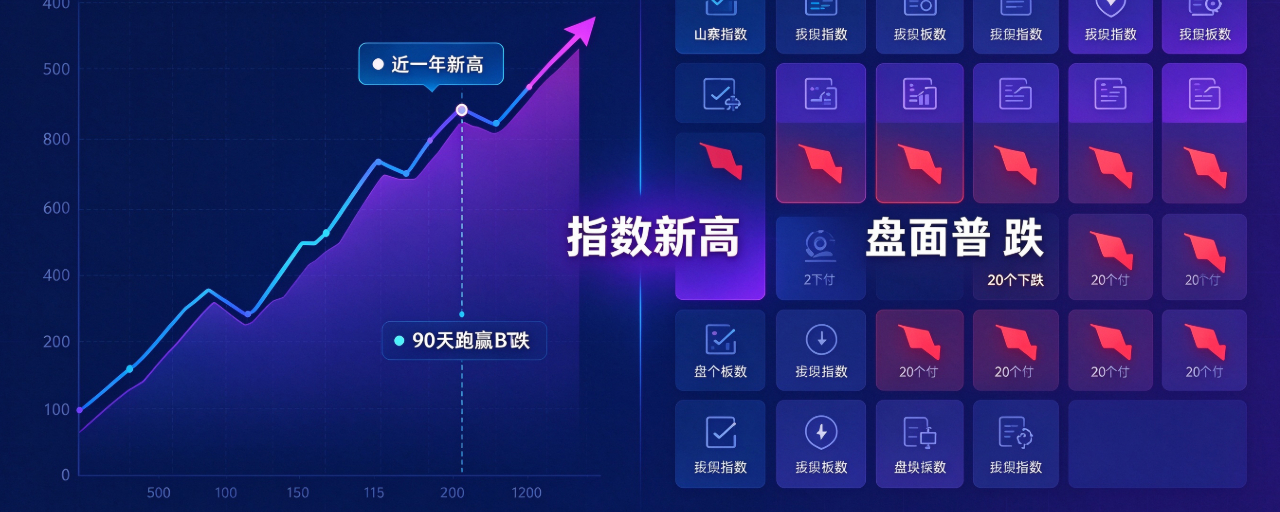

Recently, a set of highly contradictory figures has emerged in the altcoin market, leaving many people puzzled: the Altcoin Season Index has hit a new one-year high, while at the same time, 20 market sectors are down on the day.
On one hand, long-term data points to strong bullish momentum; on the other, the short-term market is broadly weakening. What does this really mean? Today, I’ll break it down in plain English—and especially offer a word of caution to anyone watching the index and rushing in.
1. First, let’s clarify what these two data points are actually saying.
90-day view: Many altcoins have outperformed BTC, and the index has hit a new high. Over a three-month period, the returns of many altcoins have indeed significantly outpaced Bitcoin, as market capital continues to flow into small- and mid-cap coins. When this data came out, many people started declaring, "Altcoin season is in full swing."
But on an intraday basis, 20 of the 26 sectors are down. Zoom in on the day’s action, and altcoins are broadly weakening. A few sectors are holding up, but the vast majority are falling. This is a classic divergence between the index and market action.
The problem is that many people see only “a one-year high” and miss the “broad short-term sell-off,” making it easy to get the timing wrong.
II. What’s behind this divergence? Three key explanations
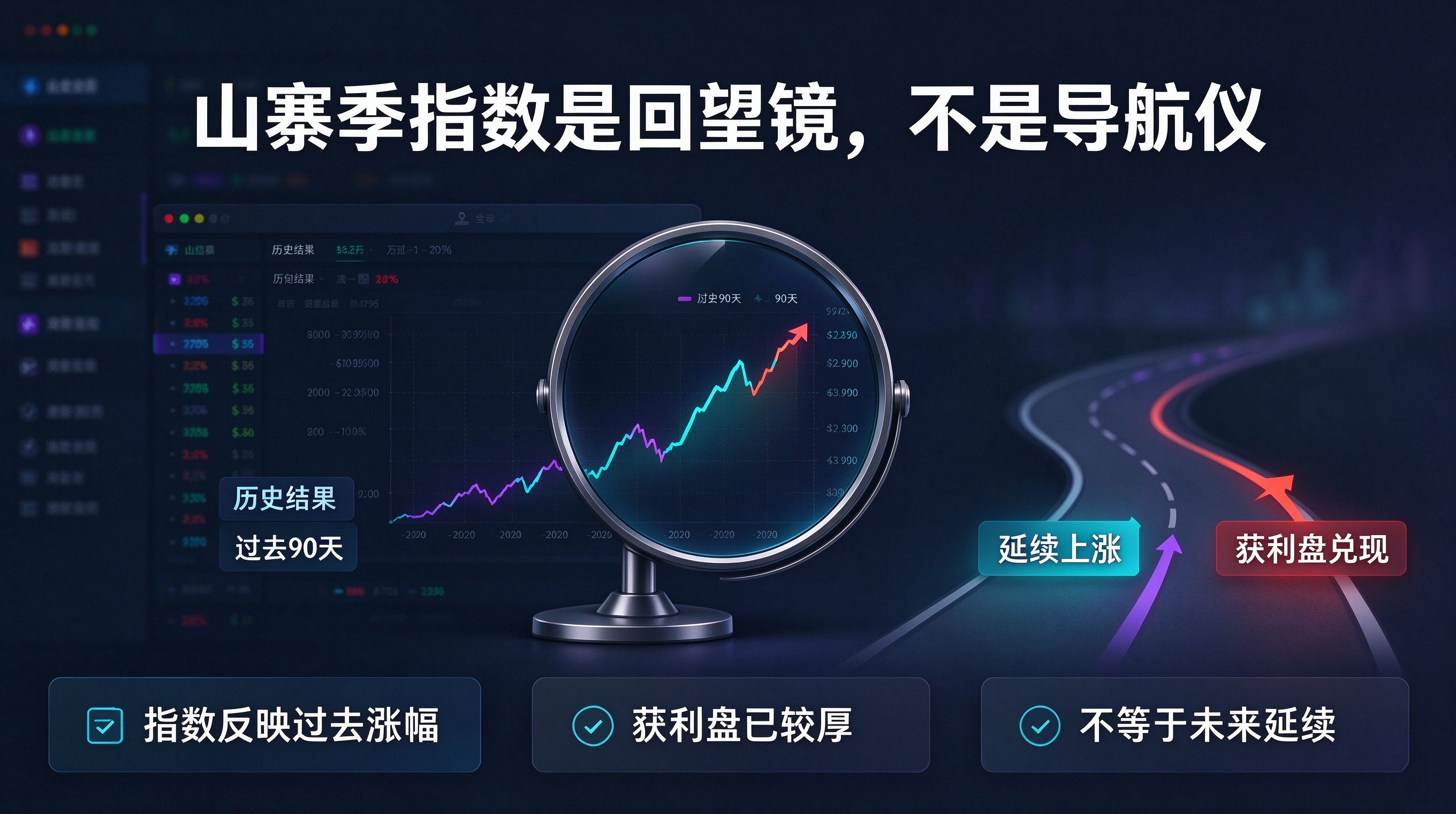
First, the Altcoin Season Index is a “rearview mirror,” not a “navigation system.” The Altcoin Season Index is essentially a lagging indicator—hitting a 90-day high means altcoins have made substantial gains over the past three months, with a large amount of capital already positioned in the market. That’s a historical result; it doesn’t mean the rally will continue. Many projects have already had a major run, and holders have substantial unrealized profits. If the broader market so much as wobbles, selling pressure on altcoins will be far greater than on Bitcoin.
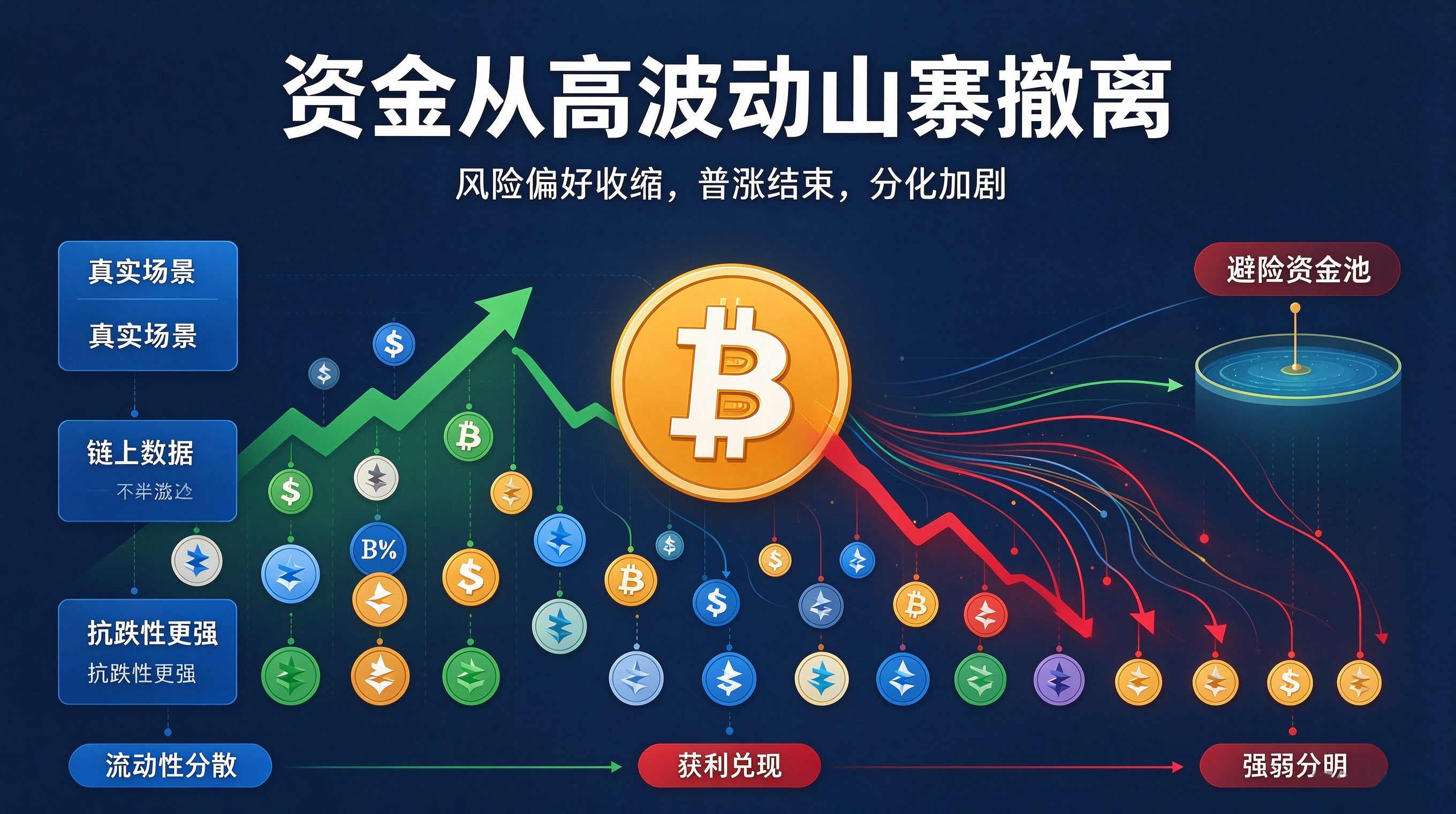
Second, broad intraday losses suggest short-term capital is moving to safety and exiting. When BTC becomes volatile to the downside, the market’s risk appetite contracts rapidly. Investors’ first instinct isn’t to add to their positions, but to take profits on altcoins. Altcoins are highly volatile and have fragmented liquidity, so they are inherently less resilient. Once the tide turns, small- and mid-cap coins are the first to be sold, and they fall further. Sectors begin to diverge sharply instead of rising across the board.
Third, the essence of the divergence: the market has shifted from “broad-based gains” to a “selective market.” The period when you could “buy any altcoin with your eyes closed and make money” over the past 90 days is basically over. From here on, not all altcoins will rise together; the gap between sectors and projects will keep widening. Projects with real businesses, genuine on-chain data, and real-world use cases may still hold up, while tokens built purely on hype and empty narratives will be the first to be abandoned by investors.
In short, this signal means that a new high in the index doesn’t mean the altcoin bull market will continue. The short-term market action has already told you: capital is pulling out, and divergence is intensifying.
III. What does this mean for project teams and traders, respectively?
For project teams—don’t treat hype around the index as a basis for marketing. If you see the Altcoin Season Index hit a new high and rush to ramp up marketing, increase incentive emissions, or grow your community, that’s dangerous. Market sentiment is already divided, and capital preferences are shifting rapidly. Projects driven purely by narrative hype can see their liquidity collapse overnight. At this stage, the projects best able to withstand a downturn are those with real-world use cases, on-chain data, and operational businesses. Rather than spending money to buy hype, strengthen your product, data, and real-world case studies so your project can stand firm when the market cools.
For traders—beware of concentrated profit-taking at elevated levels. A new high in the index is not a signal to buy in. Altcoin holders at these levels have substantial profits, and if the broader market pulls back, concentrated profit-taking can create intense selling pressure. In a diverging market, reducing leverage and avoiding tokens with no fundamentals and only empty narratives is the more prudent approach. Don’t chase the market just because the index has hit a new high; the short-term market action is already warning you of the risks.
IV. Conclusion
This divergence is essentially a warning that a long-term indicator is bullish while short-term market action is weakening: the altcoin market has shifted from “broad-based gains” to a phase of “sharp divergence.”
For project teams, the test is whose fundamentals are more solid; for traders, it’s who can avoid more pitfalls. The index reflects the past; the market action shows what’s happening now. Understanding this signal matters far more than chasing new highs.