


There’s a simple calculation that shows what your personal answer depends on.
The most important thing is to calculate your living expenses.
A formula you can work out on a napkin
The capital you need equals your annual expenses divided by the rate. The rest is arithmetic.
Calculate one year of living expenses. Monthly spending × 12: housing, food, transport, family, leisure.
Choose a rate. This is the share of your capital you're willing to withdraw each year. If you live off the growth, the rate equals the return you expect.
Divide. This gives you the capital amount in dollars. Divide that by the BTC price to get the number of coins.

Example. Expenses of $5,000 per month amount to $60,000 per year. At a 10% rate, you need $60,000 ÷ 0.10 = $600,000. At a BTC price of $83,000, that's about 7.2 BTC.
The rate is the main lever here. We'll use two benchmarks:
25%. The optimistic scenario: BTC grows by a quarter every year. That's the assumption used in popular versions of this calculation.
10%. Approximately the long-term return on U.S. stocks (nominal, including dividends).
Three lifestyles: $2,000, $5,000, and $10,000 per month
The same lifestyle costs anywhere from 1.2 to 36 BTC. The difference comes not from the amount you spend, but from one assumption: the rate.
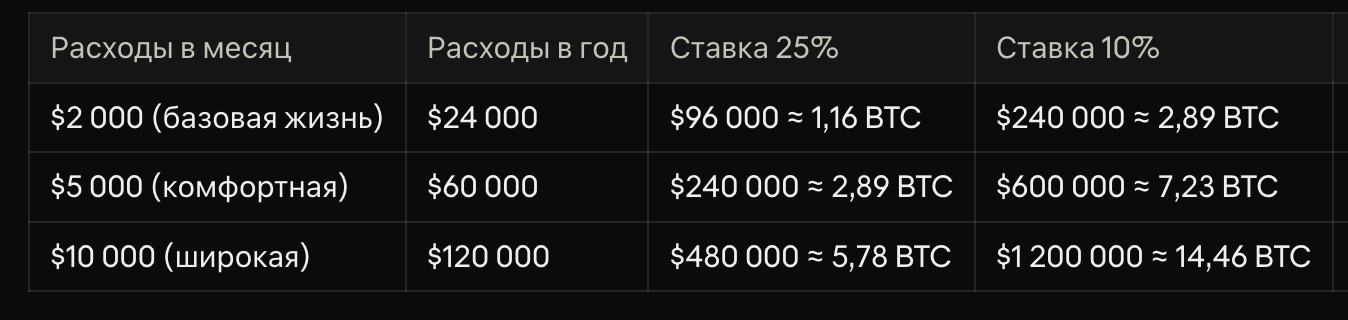
BTC price used in the calculation: about $83,000 as of October 12, 2026. The price changes every day, so recalculate using the formula above.
Note: living on $5,000 at a 25% rate requires the same amount as living on $2,000 at a 10% rate—that is, $240,000. The return assumption carries as much weight as your entire lifestyle.
Checking the 25% column. Popular versions of this calculation use the “average BTC return over the past 5 years.” That figure doesn't hold up today. In October 2021, BTC averaged around $58,000 at close; now it's around $83,000. That's about 7.5% per year: the constant annual growth rate that would have taken the price from the first figure to the second over five years.
At a 7.5% rate, the picture looks like this:
$2,000 per month: about 3.9 BTC.
$5,000 per month: about 9.6 BTC.
$10,000 per month: about 19.3 BTC.
Where the elegant formula breaks down
The formula calculates an average, but you have to live through specific years. This leads to four problems.
1. Averages can be misleading. Suppose BTC rose 100% in the first year and fell 50% in the second. The average comes out to +25% per year. But $100 became $200 and then fell back to $100: the total growth was zero.
This isn't just theoretical. On October 6, 2025, BTC rose above $126,000, and on February 6, 2026, it fell to around $60,000. That's a 52% drop in four months. The price is now roughly a third below its record high.
2. The order of the years matters more than the average. Let's take capital of $240,000 and expenses of $60,000 per year, exactly 25% (as in the original model). Two years: −50% and +100%, with the same average of +25%. Expenses are withdrawn at the end of each year.
First, a decline: $240,000 → $120,000 − $60,000 = $60,000 → $120,000 − $60,000 = $60,000.
First, growth: $240,000 → $480,000 − $60,000 = $420,000 → $210,000 − $60,000 = $150,000.
The same two years in a different order, and the outcome differs by a factor of 2.5. In neither case did the capital remain intact.
3. Expenses increase. With 3% annual inflation, a lifestyle costing $5,000 today will cost about $10,500 per month in 25 years. An amount that seems “enough for life” today will no longer cover the same lifestyle over time.
4. Taxes and fees. In many countries, selling BTC is a taxable event, and each sale incurs fees. They're not included in the calculation, which means you need more capital in reality.
What follows from this
A 25% rate works as a dream, a 4% rate as a plan, and the difference between them is a factor of 6.25.
The formula doesn't tell you how much BTC you need. It shows how much the answer depends on what you believe about future returns.
But one number in the formula is entirely yours: your expenses. Every $1,000 per month, or $12,000 per year, requires $48,000 in capital at a 25% rate and $300,000 at a 4% rate. Cutting expenses by $1,000 is cheaper than chasing returns that may never materialize.
How much do you spend each month?
Disclaimer
Important: This information is for informational purposes only and is not financial advice or a recommendation to buy. This material was prepared for educational purposes and does not take into account your goals, financial situation, tax status, or risk tolerance. All calculations are based on hypothetical assumptions (withdrawal rate, returns, inflation, and the BTC price as of October 12, 2026) and are not a forecast or a promise of results. Past performance does not guarantee future results. Cryptocurrencies are extremely volatile: their price can fall sharply, and you could lose all the money you invest. The model does not account for taxes, fees, custody risks, loss of access to keys, actions by issuers and regulators, or changes in legislation, which depends on your jurisdiction. The author is not a licensed financial, tax, or legal adviser. Do your own research before making any decisions and consult a qualified professional if needed.