

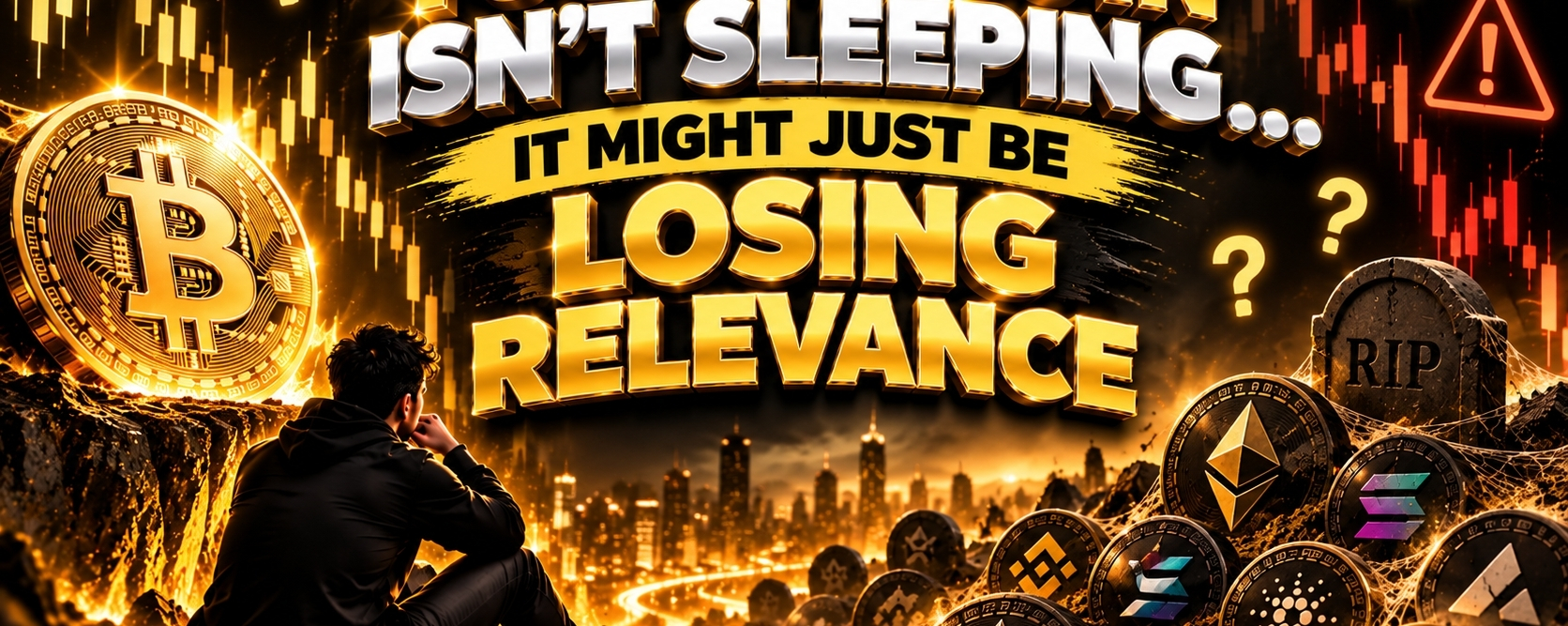


Crypto fam, we need to talk about something nobody wants to hear. Your favorite altcoin has been sitting at the same price for months, Bitcoin is making moves, new projects are stealing the spotlight, and you're still telling yourself, "Just wait, my coin will pump soon."
But hold up. What if your altcoin isn't preparing for a massive comeback? What if the market has simply moved on?
That's the uncomfortable reality of crypto. Not every coin that's down is secretly getting ready for its next 10x. Some projects might actually be losing relevance.
Remember When Every Altcoin Had Its Main Character Moment?
Back in the 2021 bull market, almost every corner of crypto seemed full of excitement. DeFi tokens, gaming projects, meme coins, and NFTs were dominating conversations.
People believed their favorite projects would keep growing forever.
But crypto trends change faster than social media algorithms. A project that dominated headlines during one cycle can struggle to attract attention during the next.
The market doesn't reward nostalgia. It responds to demand, innovation, and investor expectations.
Your Coin's Old ATH Isn't a Promise
Let's be real. Some investors are still looking at their altcoin's 2021 all-time high and expecting the price to return there eventually.
But here's the plot twist.
A cryptocurrency reaching $10 in the past doesn't mean it must trade at $10 again.
Token supply may have increased, competition may have intensified, and investor interest may have shifted elsewhere.
Even if a project is still operating, its token might never recover its previous valuation.
An old all-time high is historical data, not a guaranteed future destination.
New Narratives Are Stealing the Spotlight
Crypto is constantly reinventing itself.
During different market cycles, investors have focused on decentralized finance, NFTs, blockchain gaming, meme coins, artificial intelligence, and real-world asset tokenization.
When new narratives attract attention, older projects can struggle to maintain momentum.
But this doesn't mean every old project is worthless or every new project is valuable.
A trending narrative can generate excitement without producing sustainable adoption.
The important question is whether a project continues solving meaningful problems as the industry evolves.
A Strong Community Doesn't Always Mean Strong Demand
Every crypto project claims to have the most loyal community.
Telegram groups are active, influencers keep posting, and holders constantly encourage each other to stay bullish.
But social media engagement doesn't automatically create demand for a token.
A project might have thousands of enthusiastic followers while struggling to attract actual users, developers, or meaningful economic activity.
Community support can be valuable, but it needs to be considered alongside fundamentals.
Because likes and reposts don't guarantee sustainable token value.
Tokenomics Might Be Working Against Your Altcoin
Here's something many holders overlook.
Some cryptocurrencies have large amounts of tokens scheduled to enter circulation over time.
When previously locked tokens become available, circulating supply can increase.
If demand doesn't grow enough to absorb that additional supply, prices may face pressure.
That's why understanding token unlocks, inflation schedules, and token utility matters.
A project can announce exciting developments while its token continues underperforming because supply and demand aren't moving in the same direction.
Developers Might Have Moved On, and Nobody Noticed
One important sign to investigate is whether a project continues making meaningful progress.
Is the development team releasing updates? Are applications being built? Are users actively interacting with the network?
A project that stops improving can lose ground to competitors.
However, development activity alone doesn't guarantee success. Some projects publish frequent updates without attracting meaningful adoption.
The bigger picture matters.
Technology, users, economic activity, and token demand all deserve attention.
Bitcoin Pumping Doesn't Mean Your Altcoin Deserves a Rally
Here's where many investors get confused.
Bitcoin starts climbing, and suddenly everyone expects their altcoins to follow.
But Bitcoin and smaller cryptocurrencies can respond differently to market conditions.
Institutional demand may concentrate on Bitcoin, while smaller projects struggle with weaker liquidity or declining interest.
Even during bullish periods, some altcoins can continue underperforming.
A strong crypto market doesn't guarantee that every cryptocurrency will succeed.
The 2021 Mindset Might Be Holding Investors Back
One of the biggest mistakes is assuming the next bull run must look exactly like the previous one.
The cryptocurrency market has changed.
There are more tokens, more competing blockchains, more institutional products, and different narratives attracting capital.
Projects that were popular five years ago now face a very different environment.
Some may adapt and grow. Others may remain active but struggle to regain their former influence.
Holding a cryptocurrency for years doesn't automatically improve its chances of recovery.
So, How Can You Tell Whether a Project Is Still Relevant?
Instead of focusing only on price, look at what is happening behind the chart.
Consider whether the project has active users, meaningful development, sustainable economic activity, and a clear reason for its token to exist.
Compare its progress with competing projects.
Pay attention to circulating supply, future token unlocks, and whether adoption is growing or declining.
No single metric tells the complete story, but examining several factors can help distinguish temporary market weakness from deeper project-specific challenges.
And remember, even fundamentally strong projects can experience substantial losses.
Final Thoughts: Sometimes the Market Has Already Moved On
Crypto fam, nobody enjoys watching a favorite altcoin struggle while newer projects dominate the conversation.
It's tempting to believe every quiet coin is simply waiting for its comeback moment.
But crypto doesn't work that way.
Some projects recover because they continue building, attracting users, and creating demand. Others gradually lose relevance as technology, competition, and investor preferences change.
The biggest mistake isn't holding an altcoin through a correction. It's assuming that time alone guarantees a comeback.
Your altcoin might be temporarily overlooked.
Or it might be losing its place in a rapidly changing industry.
Understanding the difference matters more than hoping for another 2021-style rally.
Now tell me, crypto fam: Is your favorite altcoin still building something valuable, or are you holding it mainly because you remember its old all-time high?
Educational content only. Not financial advice.