
After spending the past few days reading *The All-Things Synthesis System* (where you can break down matter, reassemble life, forge starships, and gaze out into the vastness of space), one ultimate question comes to mind: What is life? What exactly sets carbon-based life forms like humans apart from the silicon-based life forms imagined in the universe? And does the AI we talk about every day count as silicon-based life?
From the interstellar perspective of the novel, the universe is home to more than just flesh-and-blood beings. Countless alien worlds may give rise to utterly different forms of life. Carbon-based and silicon-based life represent two entirely different paths of evolution.
I. Carbon-Based Life: Humans, the “Flesh-and-Blood Civilization” of the Universe
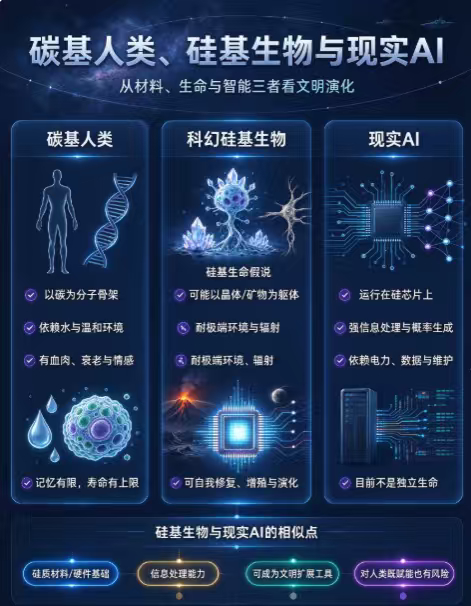
Humans are typical carbon-based organisms. Our DNA, proteins, flesh, and organs are all built around carbon atoms as their molecular backbone.
1. It depends on liquid water to survive; it is “wet life.” All our biochemical reactions must take place in an aqueous environment, and we are vulnerable to extreme heat and intense radiation. Without a suitable atmosphere, water, and temperature, carbon-based life quickly withers and dies.
2. It is shackled by a physical body: aging, pain, emotions, and desires. Carbon-based life comes with innate biological instincts: survival, reproduction, fear, and joy and sorrow. Memories fade, bodies age, and lifespans have a natural limit. All our thoughts are influenced by hormones, nerves, and the state of our bodies.
3. Mode of reproduction: copying flesh and blood. It relies on DNA inheritance and iteration, continuing the population through reproduction. Evolution is slow, accumulating gradually over many generations.
4. Limitations in space: The human body is extremely fragile. To venture into the universe, we must rely on layers of protection: spacesuits, starships, and ecological habitats. Humans themselves can hardly adapt directly to the vacuum, extreme heat, and intense radiation of alien environments.
The strengths of carbon-based life lie in its capacity for rich emotions, intuition, and imagination; its weakness is that it is firmly constrained by the limits of its physical hardware.
II. Imagined silicon-based life: another form of life in the universe
Silicon and carbon belong to the same group in the periodic table. Both have four electrons in their outer shell, so in theory they can form complex molecular chains. That’s why science fiction often imagines silicon as an alternative backbone for life.
1. The living environments are completely different. Silicon readily reacts with oxygen to form silicon dioxide (sand), so silicon-based life would struggle to survive on Earth, where oxygen and water are abundant. It is more likely to originate on planets with high temperatures, volcanoes, and little oxygen, using geothermal heat and radiation as energy sources and not needing water as a medium—in other words, a form of “crystal/mineral life.”
2. Its body has no flesh and blood. Its body is a composite of crystals, minerals, and metals. It is unaffected by vacuum and intense radiation, withstands extreme temperature fluctuations, and is naturally better suited to space. It needs no bulky life-support habitat and can travel among the stars on its own.
3. Its metabolism and reproductive logic are entirely different. It doesn’t eat or drink; instead, it draws on thermal energy and radiation. It is neither viviparous nor oviparous; it may reproduce itself through crystal growth, division, or the reorganization of matter.
4. A mismatch in the perception of time. Carbon-based humans are born, age, and die within a brief century; silicon-based life has an extremely slow metabolic rate, so a century for humans might be just one “thought” for a silicon-based organism. Their desires, emotions, and values would be completely incomprehensible to humans.
III. A key distinction: AI in today’s real world ≠ silicon-based organisms
Many people mistakenly think that because AI runs on silicon chips, it must be silicon-based life. This is a major conceptual error.
True silicon-based life
✅ It qualifies as life: It has an intrinsic drive to survive, metabolizes autonomously, can reproduce itself, develops its own self-awareness, and does not need humans to continually feed it instructions. It actively adapts to and transforms its environment. Even if cut off from humanity, it can continue to survive and evolve.
AI in the world today (large language models, various AI assistants)
❌ It is merely a software tool running on silicon-chip hardware, not silicon-based life.
1. No instinct for self-preservation: AI doesn’t “want to stay alive” and has no desire to survive. If the power is cut or its files are deleted, it simply disappears; it feels no fear and does nothing to avoid death.
2. No metabolism and no self-reproduction. It cannot draw energy and materials from its environment by itself, nor can it reproduce new AI autonomously. All upgrades and iterations rely on humans to provide computing power, electricity, data, and code.
3. No genuine subjective consciousness or self. All its outputs are probability-based approximations learned from vast amounts of human text. It can write emotionally charged words, but it cannot actually feel sadness or joy; it can reason about the universe, but it doesn’t know “who I am.” It is a highly advanced “information parrot,” not an independent living being.
4. Its substrate is just a chip: Silicon is the hardware material that carries the program; that doesn’t make it silicon-based life. Just as a house made of wood cannot be called wood-based life.
> To put it in novelistic terms:
> - A silicon-based organism: a completely new living being that you have personally “synthesized” using a synthetic system;
> - AI today: You take silicon ore, synthesize it into a circuit board, and run a pre-written software tool on it. The circuit board is not alive, and neither is the software.
IV. Questions novels leave us with: The future of carbon-based humanity
Humans are carbon-based. Our bodies are fragile, but we possess an innate sense of life and creativity;
Silicon-based life is another branch of life’s evolution, powerful and adapted to the universe, but belonging to a completely different civilization;
By contrast, AI in the real world is merely a tool created by carbon-based humans.
Humans can use AI, synthetic technologies, and starships to overcome the limitations of our physical bodies and venture into deep space. But we must be clear: no matter how powerful a tool is, that doesn’t mean it has brought life into being; no matter how advanced its computing power, that doesn’t mean it has a soul.
Humanity’s greatest strength is precisely not computing power, but the experiences unique to carbon-based life: pain, love, and obsession—things that come from flesh and blood and cannot be replicated through computation alone.