

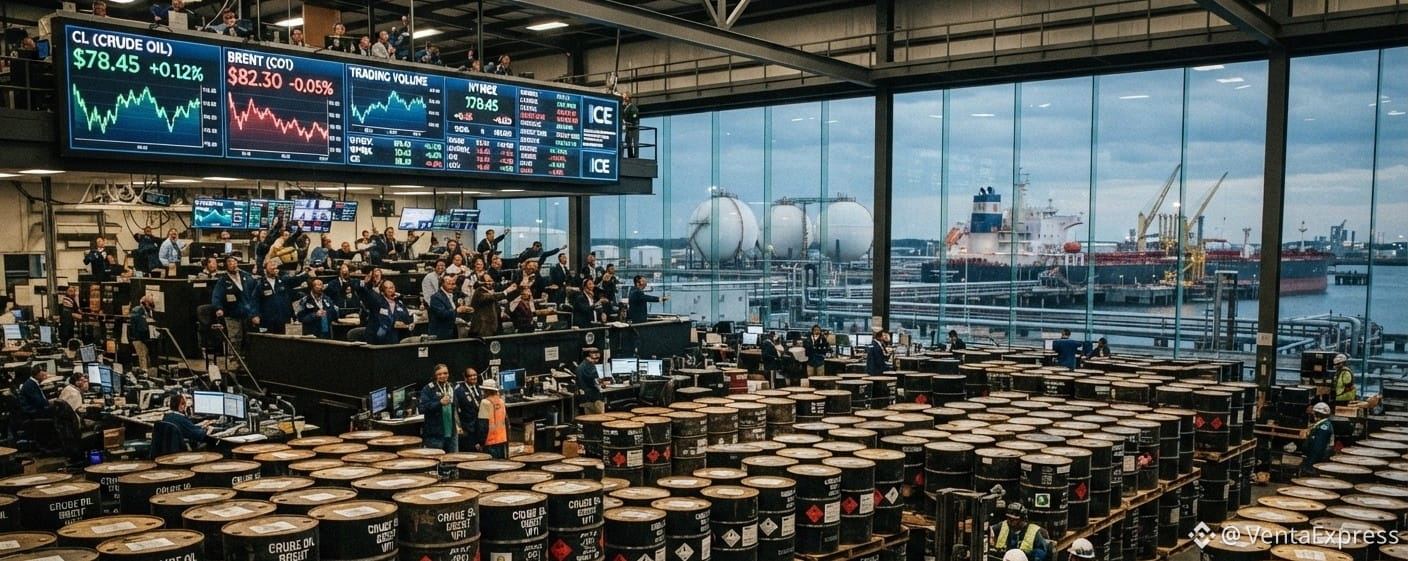

The global oil market is experiencing sharp volatility, with barrel prices hovering around $100, driven by a combination of critical geopolitical tensions in the Middle East, climate disasters in the Gulf of Mexico, and major strategic moves in Venezuela.
📈 Global Market Prices and Conditions
WTI crude recently closed at $91.67 per barrel after a highly volatile trading session, while Brent is trading near $100 to $105.
The conflict in the Strait of Hormuz: Seven months after this key maritime route was closed, attacks on oil tankers have reached an all-time high. In response to the crisis, Saudi Arabia announced plans to develop new pipelines to secure alternative export routes to the Red Sea.
Massive release of reserves: To ease the global fuel shortage and curb rising prices, the International Energy Agency (IEA) confirmed that 32 member countries are continuing to release their strategic reserves. So far, 325 million barrels have been distributed.
Climate impact in the U.S.: Production in the Gulf of Mexico was dealt a severe blow by hurricanes, forcing oil companies such as Shell, Chevron, and BP to evacuate platforms and suspend production of nearly 1.3 million barrels per day (62.9% of the area's output).
🇻🇪 The Situation in Venezuela: Historic Agreements and Investment
Venezuela has moved to the center of the international energy equation due to its rapid opening to foreign investment:
Strategic agreement with the U.S.: A historic memorandum of understanding between state-owned PDVSA and U.S.-based Continental Resources was finalized. Former President Donald Trump said the agreement gives the United States operational control and access to around 65 billion barrels of Venezuela's proven reserves. The country's acting president, Delcy Rodríguez, led official meetings with Washington's energy commissions.
Multibillion-dollar investment in the west and east: U.S. company Pacific Coast Energy Company (PCEC) officially announced a $3.5 billion investment to reactivate mature fields in the Cabimas (Zulia) and Delta (Monagas) blocks. The California-based company's goal is to increase extraction from these fields from 19,300 to 160,000 barrels per day over the next decade by installing new drilling rigs.
Production rebound: With the arrival of global operators and companies such as TotalEnergies, Repsol, and Baker Hughes, national production stabilized above 1.2 million barrels per day, consolidating the country's highest extraction volume since early 2019.
If you'd like to explore the economic impact of these events in more depth, let me know which you'd prefer:
Follow analysts' forecasts on whether oil will soon hit $130 per barrel.
Learn more about the operations of European and U.S. companies in the Orinoco Belt.
Additionally, if you'd like to stay up to date on upcoming OPEC monthly reports or newly signed contracts, I can set up a task to send you timely alerts. Would you like that?
The AI Mode response is ready
Ask a question, prompted by a combination of critical geopolitical tensions in the Middle East, climate disasters in the Gulf of Mexico, and major strategic moves in Venezuela.
📈 Prices and the Global Market Situation
WTI crude recently closed at $91.67 per barrel after a highly volatile session, while Brent is trading near $100–$105.
The conflict in the Strait of Hormuz: Seven months after this key maritime route was closed, attacks on oil tankers have reached an all-time high. In response to the crisis, Saudi Arabia announced plans to develop new pipelines to secure alternative export routes to the Red Sea.
Massive release of reserves: To ease the global fuel shortage and curb rising prices, the International Energy Agency (IEA) confirmed that 32 member countries are continuing to release their strategic reserves. So far, 325 million barrels have been distributed.
Climate impact in the U.S.: Production in the Gulf of Mexico was dealt a severe blow by hurricanes, forcing oil companies such as Shell, Chevron, and BP to evacuate platforms and suspend production of nearly 1.3 million barrels per day (62.9% of the area's output).
🇻🇪 The Situation in Venezuela: Historic Agreements and Investment
Venezuela has moved to the center of the international energy equation due to its rapid opening to foreign investment:
Strategic agreement with the U.S.: A historic memorandum of understanding between state-owned PDVSA and U.S.-based Continental Resources was finalized. Former President Donald Trump said the agreement gives the United States operational control and access to around 65 billion barrels of Venezuela's proven reserves. The country's acting president, Delcy Rodríguez, led official meetings with Washington's energy commissions.
Multibillion-dollar investment in the west and east: U.S. company Pacific Coast Energy Company (PCEC) officially announced a $3.5 billion investment to reactivate mature fields in the Cabimas (Zulia) and Delta (Monagas) blocks. The California-based company's goal is to increase extraction from these fields from 19,300 to 160,000 barrels per day over the next decade by installing new drilling rigs.
Production rebound: With the arrival of global operators and companies such as TotalEnergies, Repsol, and Baker Hughes, national production stabilized above 1.2 million barrels per day, consolidating the country's highest extraction volume since early 2019.
If you'd like to explore the economic impact of these events in more depth, let me know which you'd prefer:
Follow analysts' forecasts on whether oil will soon hit $130 per barrel.
Learn more about the operations of European and U.S. companies in the Orinoco Belt.
Additionally, if you'd like to stay up to date on upcoming monthly reports