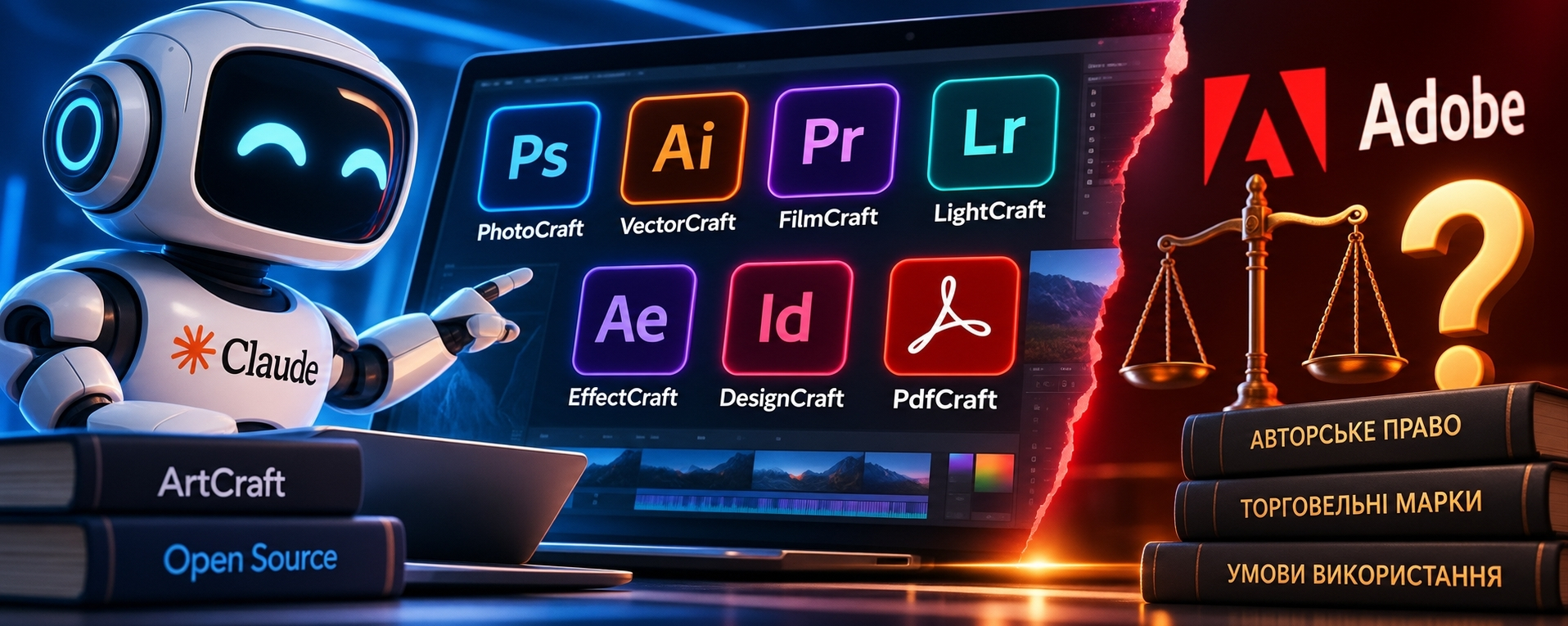

In late September and early October 2026, developer Brandon Thomas introduced ArtCraft — a suite of 7 free alternatives to Adobe programs, created using Claude Opus 5.5.
🛠️ What did they recreate?
PhotoCraft — Photoshop, VectorCraft — Illustrator, FilmCraft — Premiere Pro, LightCraft — Lightroom, EffectCraft — After Effects, DesignCraft — InDesign, and PdfCraft — Acrobat Pro.
The projects are written in Rust and are open source. But they are early alpha versions, not full-fledged replacements for Adobe. By the developers’ own estimate, they currently offer only 25–35% of Photoshop’s features suitable for everyday professional work.
⚖️ Is it legal to create such alternatives?
This is where things get interesting.
▪️ Copyright. It protects specific code and other protected elements, but not necessarily the idea behind a program or its functionality. Independently implementing similar functions may be lawful, provided protected elements are not copied.
▪️ Clean-room approach. The developers say they used publicly available specifications and observable software behavior, rather than Adobe’s code. This method can help demonstrate independent development, but the claim itself is not independent confirmation that all requirements have been met.
▪️ Interface similarity. Even without copying code, claims could arise over trademarks, visual design, and the possibility of misleading users about an affiliation with Adobe. The scope of legal protection for interfaces depends on the circumstances and applicable law.
▪️ Terms of use. Adobe explicitly restricts reverse engineering and attempts to recreate its products in its own terms of use. However, contractual restrictions and statutory exceptions must be assessed separately.
Questions arise: Was the code truly created independently? Were any protected materials used? Are particular methods of studying the program permissible? There is no definitive court ruling on this project.
💡 Why does this matter for the technology market?
AI lowers the cost of creating software that previously required large teams and lengthy development. This intensifies competition and could change the economics of software.
But there is a difference between the technical ability to create an alternative and the right to develop and distribute it.
ArtCraft is an interesting experiment, not proof that Adobe has already lost its edge. The key question is whether projects like these can combine AI capabilities, professional quality, and legally independent development.
What do you think: where is the line between fair competition and copying someone else’s product?