
Starknet’s Move to an Independent L1: A Repricing of the Quantum-Resistance Narrative, or Still Just a Discussion?
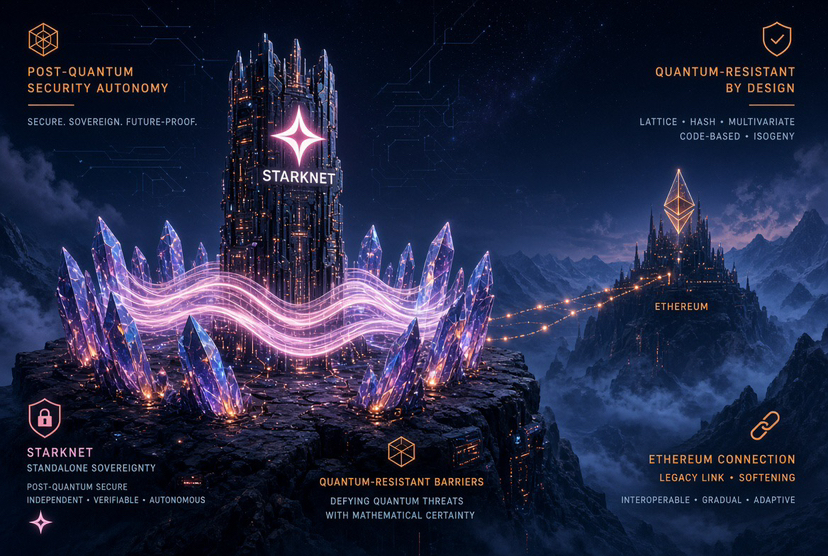
On October 8, StarkWare CEO Eli Ben-Sasson raised the question at Token2049 and on Twitter: Should Starknet move from being an Ethereum L2 to an independent L1 to achieve faster post-quantum security?
The official account promptly responded that it was “seriously considering becoming an L1,” with the goal of becoming the first fully quantum-resistant network by 2027!
On October 10, StarkWare went further, calling an independent L1 “the clearest path.”
However, the project team, including Starknet’s official account, emphasized that this is still “a question, not a decision.” No transition proposal, timeline, migration plan, bridge design, or tokenomics changes have been announced. The network is still an Ethereum-settled Rollup.
The timing gap is key
Ethereum’s goal of becoming fully quantum-resistant is around the end of 2029, while Bitcoin has made no clear commitment. As an L2, Starknet’s security ceiling is constrained by the underlying layer, so it cannot accelerate the upgrade independently. Moving to L1 would let it control consensus and the pace of its security transition, with a goal of completing the move by 2027.
The technical foundations are a relatively good fit
STARK proof systems rely mainly on hash functions (which are relatively quantum-resistant), while native account abstraction also makes it easier to gradually switch to post-quantum signatures without a hard fork of the entire network.
Need to reshape the narrative
L2 revenue fell sharply in 2026 (the sector has generally been under pressure since EIP-4844), and the company had already taken steps to restructure. The shift from “Ethereum scaling tool” to “independent future-proof chain” is an effort to find a new point of differentiation.
Practical constraints
Moving to L1 means giving up Ethereum’s proven security budget and having to build its own validator set, data availability, and security infrastructure; bridging and asset migration are major challenges. For now, everything remains at the public discussion stage, and any protocol-level changes would still require governance approval.
The market is currently pricing possibility as certainty. STRK’s sharp short-term rally is fundamentally driven by sentiment and narrative, not by realized fundamentals.
STRK broke above $0.10, gaining around 40%+ in 24 hours and reaching a new high for the year. It is currently trading around $0.10–$0.11, after briefly reaching around $0.12. Trading volume has risen significantly, and sentiment is running hot.
Support: $0.090–$0.095 (recent breakout zone), $0.080, and $0.070 (pullback buffer)
Resistance: $0.120–$0.125 (recent highs), $0.150 (the next target if the narrative continues to gain traction)
A routine unlock is scheduled for mid-October (around 127 million STRK). Prices have often come under pressure on past unlock dates, and given the token’s purely narrative-driven appeal, there is a risk of a short-term pullback.
If the idea is ultimately implemented, the network could control its own security upgrades, giving the quantum-resistance narrative room to stand out. However, changes to the security model, validator incentives, ecosystem compatibility, and bridging solutions all remain unproven, making the outcome highly uncertain.
The current price has already priced in some of the expectations around these discussions. Don’t chase the rally!