
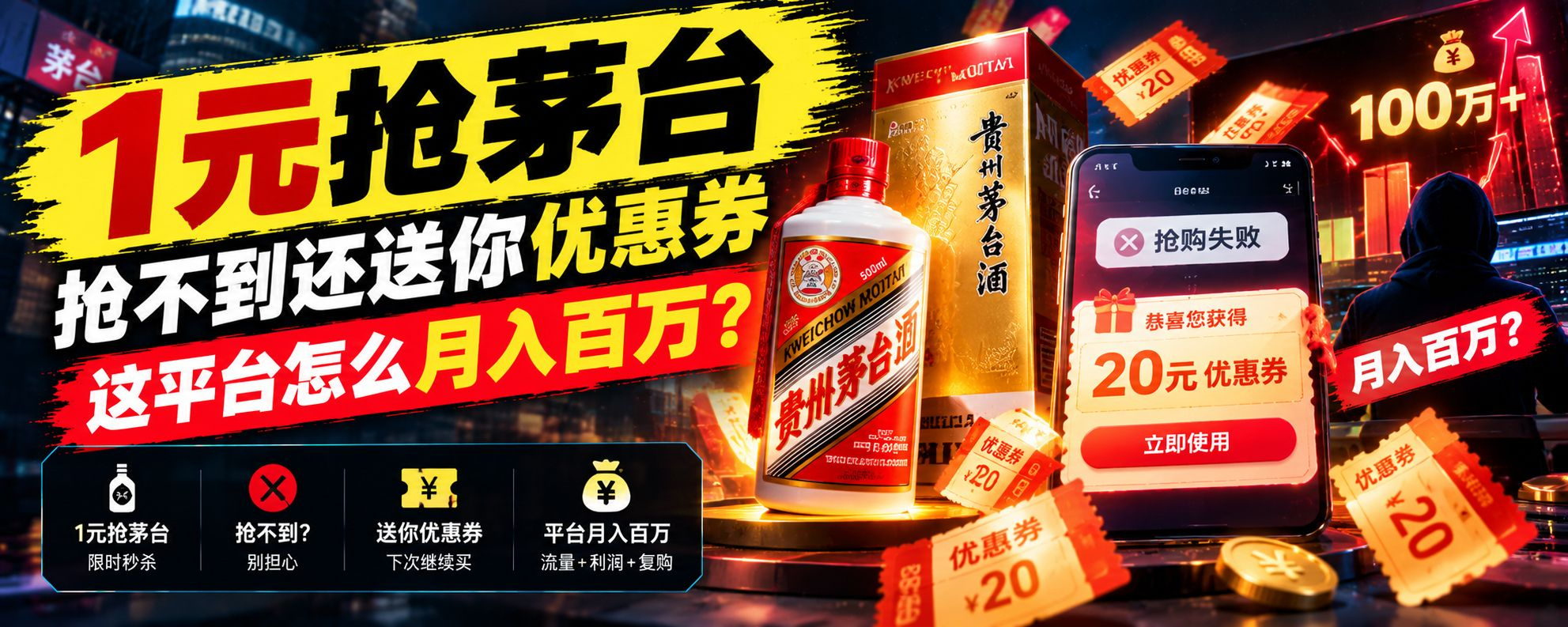

Two million in 15 days. An obscure shopping site you’ve probably never heard of, with a website that looks like a college student’s homework and an app store rating of 2.8. The reviews are full of complaints. And yet, without spending a cent on advertising, this thing brought in two million in sales in just 15 days with a one-yuan raffle for Moutai. The rules are simple: pay one yuan for a chance to buy it. If you don’t win, you get your yuan back, plus a free 50-yuan coupon. What’s your first reaction? Has this platform lost its mind? Win, and you can resell it for two or three thousand. Lose, and you don’t lose a cent—in fact, you still get a coupon. Isn’t that basically giving money away?
Today, I’ll break down the odds behind all this so you can see who’s actually sending money to whom in this two-million-yuan scheme. First, look at the promotion page. Right in the middle is a bottle of Feitian Moutai, with the market price clearly marked: 2,999 yuan! Below it, a countdown ticks away, making your heart race. Next to it, a line of tiny text says, “187,632 people have participated.” You think, “180,000 people competing for one bottle? Those odds are worse than winning the lottery.” But then you think, “It’s only one yuan—I can’t lose. If I don’t win, I still get a coupon. There’s no way this is a bad deal.” So you pay without hesitation.
The second your payment went through, a spinning wheel popped up. The pointer wobbled around twice and landed on “Thanks for participating.” Your one yuan was refunded, and at the same time, a 50-yuan coupon appeared in your account: 50 yuan off orders of 299 yuan or more, valid for 72 hours. You were about to close the page, but then you thought, “Might as well use the 50-yuan coupon.” You browsed the store and saw a case of liquor listed at 299 yuan. With the coupon, it came to 249, so you placed the order.
Did you come out ahead? Let’s do the math. First, the cost of that bottle of Moutai was real: among 180,000 people, one person really did pay one yuan and get the bottle. The platform paid 2,999 yuan for a genuine bottle of Moutai and shipped it to them, then pinned a screenshot of the winner. Everyone saw it and thought, “Whoa, someone actually won!” So they’d come back and try again next time. But who paid for that 2,999-yuan bottle? Not the platform. It was paid for by the 180,000 people who didn’t win. Technically, you got your one yuan refunded, but the path to claiming it was hidden better than anything. Want to withdraw it? You need at least 100 yuan. Most people glanced at the one yuan in their balance and thought, “Forget it.” One yuan left behind by each of 180,000 people means the platform pockets 180,000 yuan for free. That’s not a liability. That’s pure profit.
The second part of the math: the cost of that 50-yuan coupon. You used it to pick a bottle of liquor listed at 299 yuan, and paid 249. But how much was that bottle actually worth? The liquor itself cost no more than 30 yuan, and packaging and shipping bring the total cost of an order to, at most, 60 yuan. You used the coupon and paid 249 minus 60, so the platform netted 189 yuan on that order. You thought you’d scored a 50-yuan bargain. In reality, you spent 249 yuan on a bottle that cost 60 yuan—and spent the whole day feeling like you’d struck gold. And here’s the kicker: the coupon was only valid for 72 hours. Worried it would expire and you’d miss out on a bargain, you rushed to place an order. You had no time to compare prices or even think about whether the liquor was worth 249 yuan. A countdown coupon hijacked your decision-making.
The third part of the math: look at how the whole chain fits together. The one-yuan Moutai is bait. The goal isn’t to let you win; it’s to make 180,000 people believe the promotion is real. Those 180,000 people each pay one yuan, and the refund gets stuck in a balance they can’t withdraw. The platform gets to keep that idle money. Then the 50-yuan coupon they give you nudges you into spending in the store, where you buy 60-yuan liquor for 249 yuan. Did the platform lose money anywhere along the way? Not a bit. A bottle of Moutai costs 3,000 yuan, but the 180,000 yuan left sitting in people’s balances covers that, and the store’s liquor sales bring in double the cost. You think you’re getting one over on them, but the moment you paid that one yuan, you were already caught in their trap.
They’re not selling liquor. They’re playing the odds. That one yuan isn’t an entry fee; it’s a screening fee. It screens for people who think one yuan is no big deal, people who can’t resist using a coupon, and people who don’t compare prices before placing an order. You spend your time helping them build up the participant count, use your social network to bring in new customers, and spend 249 yuan helping them hit their sales targets—all while thinking you’ve scored a huge bargain. If you sell liquor the old-fashioned way, you worry about location, foot traffic, and unsold stock. They put up a single promotion page, dangle a one-yuan hook, and 180,000 people come pouring in on their own—rushing to pay, rushing to place orders, rushing to leave behind spare change in their balances that they can’t withdraw.
From the one-yuan temptation to 180,000 participants, from money sitting in balances to coupons locking people in to store profits—the people who designed this whole chain never had to touch a single bottle of Moutai. You’re not getting one over on them; you’re stepping into a bear trap. What you thought was bait was actually your own greed. “Direction matters more than effort”—take your time and think about that. This business makes quick money by betting on human nature. But human nature has never been able to withstand a test.#骗局