

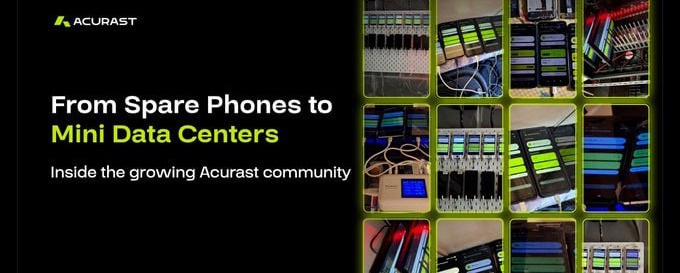

Those old phones in the drawer used to just gather dust or serve as backups. Their screens still light up, and their batteries aren’t swollen, but nobody uses them. Now there’s a project called @Acurast that connects them to a decentralized computing network, letting their idle processors run lightweight tasks when they’re not in use in exchange for $ACU.
These tasks don’t need a server farm full of graphics cards costing tens of thousands. Data classification, content moderation, simple inference, or small scheduled jobs can all be handled by a phone’s chip. The key is that the phone’s built-in secure chip isolates the computation: the results can be verified, but you can’t see what’s running inside, and neither can anyone else tamper with it. In other words, you provide the hardware without having to worry about your data being snooped on.
The barrier to entry really is low. If you don’t want to fuss with it, just install a lightweight version on a phone you use every day and let it run in the background for a while as you charge it at night—there’s no need to factory-reset your phone. If you have a spare Android phone that’s genuinely unused, you can set it up as a dedicated node. Factory-resetting it and leaving it running long-term may make it more stable. Linking multiple devices to the same wallet also makes them easier to manage, and the $ACU you earn will all go to the same address.
Don’t think of the rewards as a fixed salary. $ACU rewards mainly depend on your device’s score (hardware specs such as processor, memory, and storage), whether you actually complete tasks, and whether you stake tokens as a “commitment.” The network periodically checks whether devices are really doing the work. If you make a commitment but don’t deliver, the stake corresponding to the unfinished portion will be slashed, while you can still earn rewards for the portion you completed. Most of the slashed amount is burned rather than redistributed to others. In other words, simply locking up tokens isn’t enough—it only makes sense when it’s tied to actual computing power.
The network already seems to have reached a substantial scale, with hundreds of thousands of devices across more than a hundred countries and on-chain transaction volume in the hundreds of millions. $ACU has a fixed annual inflation rate, with the bulk going to those who provide both computing power and staking. For developers, if AI agents eventually need to call on computing power themselves, payments could be more direct, settled when tasks are performed instead of waiting for manual confirmation each time.
But these figures ultimately depend on real demand. Whether developers are willing to keep paying for this distributed mobile computing power, and whether task volume can keep pace with the number of devices, will determine whether the network can truly get off the ground. Even with lots of mobile computing power, its long-term value will be limited if it just circulates within the network without any external tasks coming in. Whether $ACU can become more than just an infrastructure token also depends on whether real-world usage can grow steadily.
Take an old phone out of the drawer and try it on @Acurast. It costs almost nothing, and gives your unused hardware a purpose. Just don’t treat it as a stable source of income: your hardware, network stability, and the number of actual tasks will all affect how much $ACU you ultimately earn. The network is already at scale; what remains to be seen is whether real-world usage can catch up.