



Data as of around 07:15 Beijing time on October 10.
1. The preliminary reading of the University of Michigan’s U.S. consumer sentiment index for October fell to 46.3, below expectations of 47.6. The current conditions index hit a record low of 44.7, while one-year inflation expectations remained elevated at 4.7%. Meanwhile, a New York Fed model showed the U.S. 10-year Treasury term premium rising to 0.98%, its highest level since 2014. The 10-year yield remains around 5.24%, and Brent crude is around $104.7. The current macro mix is still one of weakening growth expectations alongside elevated inflation and long-term interest rates—not a favorable backdrop for crypto valuations.

2. Global funds are continuing to seek shelter in cash-like assets. In the week through October 7, global money market funds saw net inflows of around $153.8 billion, U.S. equity funds saw net outflows of around $5.1 billion, and global bond funds saw net inflows of around $26 billion. In a high-interest-rate environment, cash and short-term bonds remain highly attractive. The rebound in U.S. stocks has not sparked a broad-based risk-on mood, and what the crypto market needs most right now is fresh inflows.
3. After rebounding from its low of $80,400, BTC was stable near $82,500 this morning, but has yet to reclaim $83,500. The market has moved from the continuous deleveraging of the past two days into a choppy recovery phase. ETH/BTC remains around just 0.0301, showing that capital still prefers to stay in BTC and that alts as a whole have not regained the initiative. The short-term rebound will strengthen noticeably only after BTC reclaims and holds above $83,500. If it falls below $80,400 again, the next key level to watch is around $78,000.
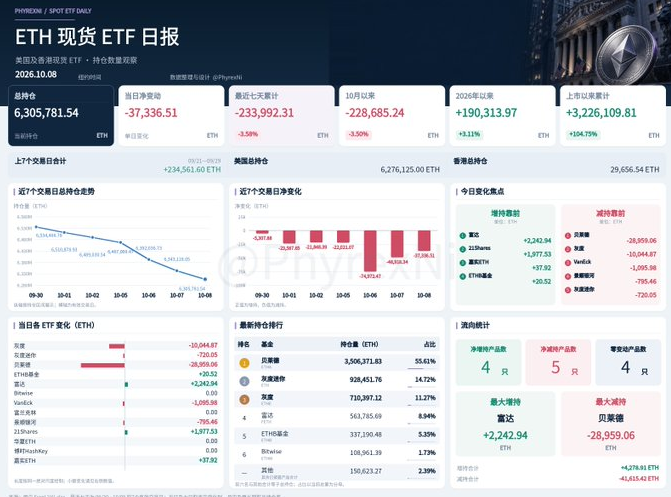
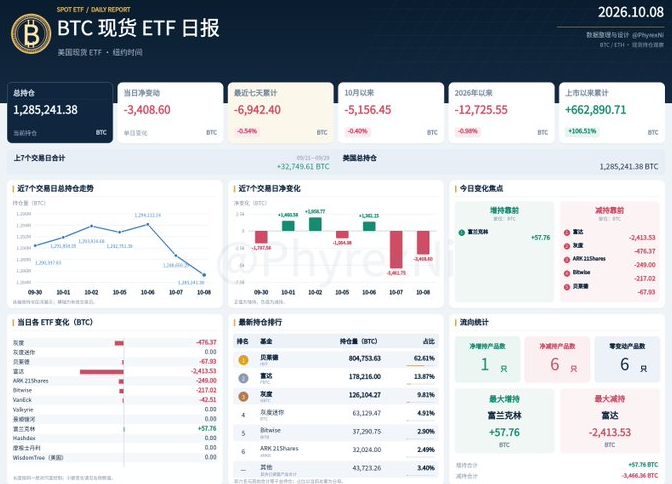
4. ETFs and stablecoins are sending weak signals at the same time. On October 7, spot BTC and ETH ETFs saw combined net outflows of about $646 million, followed by another $317 million in outflows on October 8, bringing the two-day total to nearly $962 million. Meanwhile, the total stablecoin supply across the market is about $306.5 billion, having increased by only around $12 million over the past seven days—essentially flat. Institutional ETFs are selling, and there is no meaningful increase in new on-chain dollars, so there is still no capital basis for broadly raising altcoin exposure.
5. The amount stolen in the incident linked to CryptoBilis, a Ledger distributor in Southeast Asia, has risen to about $86–90 million, and Tether has begun freezing some of the USDT involved. At this stage, there is still no evidence that Ledger hardware itself or its core infrastructure was compromised; public information points more toward the distributor or supply-chain level. Users who bought devices through this channel in the past 90 days should treat this as a supply-chain security incident. This is the hardware wallet sector’s most significant incident in recent times.
6. The post-quantum narrative has officially moved from discussion to capital flows. STRK rose as much as about 25% over the past 24 hours and is up nearly 68% over seven days; the Zcash development team announced an engineering target of introducing post-quantum signature capabilities in January 2027; and StarkWare has validated an emergency post-quantum solution on Bitcoin mainnet that requires no soft fork. ZEC and STRK now both have clear technical catalysts, but prices have already begun to reflect expectations, so continue waiting for a pullback.
7. QTC, meanwhile, serves as a warning for this sector. QTC fell as much as about 30% over the past 24 hours. Its circulating market cap is only about $32 million, but its FDV is nearly $670 million, with current circulation accounting for only about 4.8% of issued supply. Technical partnerships, post-quantum security, and institutional custody are all stories worth researching, but a low-float, high-FDV token structure is not suitable for a large position. Continue to avoid chasing QTC, and don’t buy the dip just because it has fallen 30%.

8. KAIA rose as much as about 56% over the past 24 hours after Upbit added KRW, BTC, and USDT trading pairs, with spot volume exceeding $100 million. But perpetuals open interest has reached about $205 million—roughly 55% of its circulating market cap—and 8-hour funding has even approached -1%. This is an extremely stretched event-driven derivatives setup: a further short squeeze is entirely possible, but so is a rapid pullback from the highs. Only watch for support around $0.052–$0.055; don’t chase with leverage.
9. Thailand’s SEC has officially established a local regulatory framework for crypto ETFs, with the rules taking effect on October 16. Initially, only BTC and ETH will be allowed, funds must maintain net exposure to a single crypto asset of at least 80% of NAV, and licensed custody is required. In terms of capital size alone, it will be difficult to rival U.S. ETFs in the short term. But its significance is that Asia now has another regulated gateway for securitized BTC and ETH, further expanding their global institutional distribution.
10. Telegram 13.0 is rolling out its built-in Money wallet to more than 1 billion users. Its trading feature, powered by Walt, supports over 300 assets, while internal transfers arrive instantly with no network fees. The value of this entry point lies in user distribution: users don’t first need to be taught how to install a wallet or pay Gas. What’s more worth watching next is the actual number of activated wallets, stablecoin transfer volume, and trading revenue—not assigning value to related tokens just because of the “1 billion users” figure.
11. Tokenized stocks continue to expand. Tokenized stock supply on Base has grown from about $400 million to $3.3 billion over the past 12 months; Binance has begun rolling out bStocks in the UAE, Bitget has launched perpetuals on stocks, and Robinhood is studying tokenized actively managed ETFs with T. Rowe Price. After Securitize brought real securities entitlements to Solana two days ago, the direction is increasingly clear: the next round of competition will shift from “who can issue stock tokens” to liquidity, collateralized lending, oracles, cross-chain settlement, and 24/7 trading.
12. Robinhood Chain has not seen capital outflows, but spot activity continues to cool. TVL is about $1.037 billion, with net bridge inflows of around $20 million over 24 hours, while Morpho TVL is about $610 million. At the same time, weekly DEX volume is down about 20%, while weekly perpetuals volume is up about 26%. Capital remains on-chain, but usage continues to shift away from Meme and Spot toward lending, perpetuals, and financial applications. This thesis has been largely confirmed over the past few days, so there’s no need to raise the rating again today.

13. Tempo has produced another set of data that’s easy to misread. TVL surged more than 30% in a single day to about $106 million, but 24-hour DEX volume was only about $34,000, and fees across the entire chain totaled just $6.48. Capital has indeed flowed in, but economic activity and revenue have not kept up at all. Continue researching Tempo, but don’t interpret a TVL spike as an ecosystem boom, and don’t buy unconfirmed so-called ecosystem tokens because of this data.
14. The trading calendar for the coming week is now clear: U.S. September CPI on October 14 is the highest-priority macro event; Thailand’s Crypto ETF rules take effect on October 16; CME plans to launch UNI and BCH futures on October 19; and at 08:00 Beijing time on October 22, Aero plans to expand to seven networks in one go: Base, Ethereum, Robinhood Chain, Arc, OP, Arbitrum, and Ink. AERO and UNI both have clear catalysts, but the current market environment still favors waiting for prices rather than FOMOing in early.
【Bitcoin Market Analysis】
BTC was around $82,500 this morning. It has temporarily halted its consecutive decline after rebounding from $80,400, but for now this still counts only as a choppy recovery. On the positive side, the nearly 100,000 BTC in open interest from earlier has been largely flushed out, leaving leverage conditions much cleaner than when BTC was at $87,000. On the negative side, ETFs have seen nearly $1 billion in net outflows for two consecutive days, and stablecoin supply has yet to resume growing. Spot buyers have therefore not yet proven that they have taken control of the market again.
$80,400–$81,500 remains the first zone to watch. If the price revisits this range but quickly recovers, a small position is reasonable. A genuine return to strength would be signaled by reclaiming $83,500; if it holds, first look for $84,500–$86,000. If BTC loses $80,400 again and cannot quickly recover, the next level is around $78,000. A renewed break above 5.30% in the U.S. 10-year yield, or Brent continuing toward $105–$110, would further lower the odds of a successful BTC breakout.
CEX priorities today: BTC, HYPE, AAVE, LINK, SOL, AERO, UNI, RAY.
Continue waiting for HYPE at $81–$83; AAVE becomes attractive again at $158–$163; watch LINK at $12.1–$12.5 and SOL at $105–$108. AERO moves onto the key event watchlist ahead of its seven-chain deployment on October 22. For UNI, continue waiting for stability around $7–$7.2; watch RAY at $2.2–$2.3. KAIA, STRK, and ZEC have entered a high-volatility event zone; continue to avoid QTC.
On-chain, focus on just three things today: neither ETFs nor stablecoins are providing additional liquidity; post-quantum is beginning to form its own distinct capital sector; and new financial chains such as Robinhood and Tempo have reached the stage where real revenue and capital utilization need to be assessed. Projects with no revenue, no users, and only rising TVL should continue to be discounted.
Keep risk assets at 20%–25% and stablecoins at 75%–80%. Until BTC regains and holds above $83,500, don’t proactively increase total exposure, and don’t add leverage over the weekend.
The three most important numbers today:
BTC: $83,500.
U.S. 10-year Treasury yield: 5.30%.