

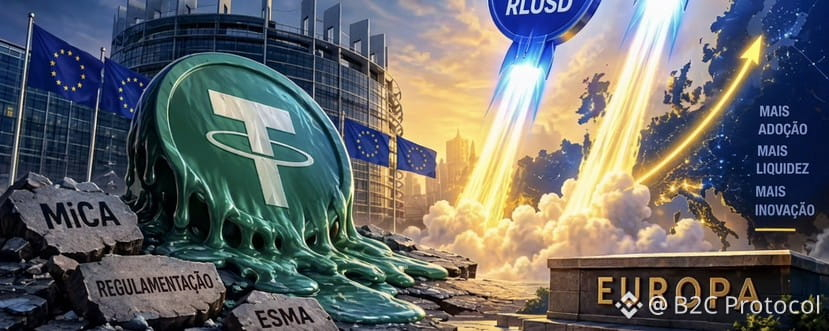

The scope is extremely broad: trading platforms, exchange services, order execution, transfers, custody, investment advice, and portfolio management. This is not a simple “delisting,” but a systematic exclusion from the entire regulated financial system.
USDT is the main target. It has around $184 billion in circulation, but Tether has never applied for MiCA authorization, arguing that MiCA requires stablecoin issuers to hold 60% of their reserves in EU banks, which, according to the company, would tie up funds in small, uninsured European banks. Tether’s choice is clear: it would rather leave the EU’s regulated market than change its reserve structure.
More than 240 MiCA-authorized CASPs will be affected. Coinbase, Kraken, Bitstamp, Crypto.com, and Binance have already begun removing USDT for EEA users.
How Ripple precisely capitalized on MiCA’s regulatory window
Ripple’s dual licenses in Europe
Ripple’s regulatory path in Europe is clear and anticipatory:
February 2026: Secures a full Luxembourg EMI license, covering electronic money and payment services.
June 23, 2026: Secures preliminary CASP approval from Luxembourg’s CSSF (the “green light”).
July 6, 2026: Secures full CASP authorization.
The key point: MiCA’s transition period ended on July 1,
2026. From that date, unlicensed institutions could no longer legally serve most EU customers. Ripple secured full authorization five days after the deadline, firmly joining the group that is “fully compliant in the post-transition era.”
The statement from Cassie Craddock, Ripple’s European managing director, is revealing: “This CASP authorization means Ripple enters the post-transition MiCA era fully compliant and ready to scale.”
One license covers 30 countries
The “passporting effect” of a CASP license means authorization in a single country (Luxembourg) covers all 27 EU member states, plus Iceland, Liechtenstein, and Norway, without requiring separate applications in each country. Ripple can connect RLUSD and the XRP infrastructure to European institutional capital flows at the same time.
By contrast, Binance is the “cautionary example”: it withdrew its CASP application in Greece and, as of July 1, limited essential services in France, Italy, Poland, and Spain. As of July 6, 2026, only 283 companies across Europe had full CASP authorization, compared with more than 3,000 VASPs registered before MiCA.
Compliance has become a barrier to entry, and Ripple is on the right side of it!
The logic behind RLUSD’s “benefit”: the vacuum left by USDT
The scale of the market gap
USDT’s exit from the regulated European market theoretically creates an enormous opportunity for compliant stablecoins to fill the gap. Circle’s USDC was the first major compliant stablecoin, with Ripple’s RLUSD close behind.
RLUSD’s current status:
Market cap of approximately $2.52 billion (early October 2026)
24-hour trading volume of around $253.5 million
More than 12,650 holders
Around $1 billion in supply issued directly on the XRP Ledger
Although it’s much smaller than USDT’s $184 billion, the growth is clear. Ripple says that “RLUSD is just getting started.”
Institutional adoption is accelerating
RLUSD is positioned as an institutional settlement tool, not for retail trading. Key developments include:
Nuvion (an AI banking platform) has already integrated RLUSD for cross-border settlement and liquidity management
JPMorgan, Mastercard, Convera, Interactive Brokers, and other institutions have already adopted RLUSD for institutional settlement operations. Convera processes $190 billion in cross-border transactions a year, now routed via RLUSD.
Ripple spent nearly $3 billion acquiring Hidden Road (a prime brokerage), Rail (stablecoin cross-border payments), and Treasury (treasury management for Fortune 500 companies) to build RLUSD’s infrastructure
For financial institutions and payment processors, the preference for stablecoins is understandable. A price-stable asset reduces accounting risks and makes international settlements easier. In this context, RLUSD has a natural advantage in corporate operations.
That, however, doesn’t mean XRP has lost its strategic role.
XRP remains the native asset of the XRP Ledger, used to pay transaction fees and as a fundamental component of the network’s security and operation. Every transaction on the XRPL consumes a small amount of XRP, which is permanently removed from circulation. In other words, the more the network is used, the greater the structural consumption of XRP is likely to be over time.
Risks and controversies that need to be addressed: the central anxiety of XRP holders
“RLUSD is the real product”
This isn’t external criticism, but an open debate within the community itself
XRP. RLUSD’s rapid growth doesn’t necessarily have to be interpreted as a replacement for XRP. An alternative reading is that Ripple is expanding the number of use cases for the XRP Ledger. The greater the volume of assets, settlements, and applications built on the network’s infrastructure, the greater the ecosystem’s underlying utility is likely to be.
An analysis by a crypto researcher circulated widely in the community: every major upgrade Ripple has added to the XRP Ledger in recent years revolves around RLUSD features—KYC/AML authorization, smart liquidity pools, and compliance tools. “The XRPL has become RLUSD’s rails.”
A very harsh claim has emerged among XRP critics: “XRP is the trash altcoin of transactions.” Although the phrase has gained popularity among critics of the ecosystem, it oversimplifies XRP’s role. The asset doesn’t act merely as an anti-spam mechanism. It is the native unit of the XRP Ledger, responsible for network fees, settlement between assets, and various features that enable the infrastructure used by RLUSD itself to function.
XRP lawyer Bill Morgan’s comment is even more telling.
When Ripple received preliminary approval from Luxembourg, it said:
“Good news. The usual effect on XRP’s price: none.” At the time, XRP fell about 3% along with the market, showing no reaction to Ripple’s regulatory milestone.
The data justify concern, but don’t settle the debate
A comparison of key 2026 data: RLUSD’s market cap grew by 1,278%, while XRP fell 27% over the same period.
Even more concerning structural changes:
RLUSD’s share of the supply on the XRP Ledger jumped from 18.4% at the start of the year to 58.9%, with around $963 million now on the XRPL and $1.1 billion on Ethereum
The XRP Ledger averages 2.4 million daily transactions
(up 21% year over year), DEX trading volume grew 79%, but active accounts fell 40% year over year, meaning fewer participants, higher trading volume, institutions flowing through RLUSD, and retail wallets leaving or going dormant
In other words, the XRP Ledger is growing, and an increasing share of that expansion is happening through RLUSD. The unanswered question is how this institutional growth might translate into long-term demand for XRP.
An honest answer
Ripple’s official position is that XRP and RLUSD are complementary, with XRP acting as a bridge asset where stablecoins can’t be used. That logic is valid in itself. But the question is: how much of the European payment flow ultimately goes through XRP versus RLUSD? That figure isn’t public, and it’s exactly what retail holders most want to know.
Other risks to consider
1. Regulatory scrutiny of the “dual role”
ESMA explicitly classifies “issuing a stablecoin while simultaneously providing related crypto services” as a high-risk combination, since the two roles can create conflicts of interest. The CSSF will focus on how Ripple establishes clear separation mechanisms between the RLUSD issuer and the CASP service provider. Ripple will have to prove that its Luxembourg entity has real employees making real decisions, rather than being remotely controlled from San Francisco. This compliance burden is real and ongoing.
2. RLUSD is still small
A market cap of $2.5 billion is nowhere near the scale of USDC’s billions or USDT’s $184 billion. Whether USDT users will migrate to RLUSD rather than the more mature USDC remains an open question.
Compliance is the entry ticket, not a guarantee of market share.
3. XRP’s price logic is disconnected from the company’s fundamentals
From 2024 to 2026, a recurring pattern has emerged: Ripple announces a major regulatory victory → XRP’s price doesn’t react or falls. If this pattern continues, even if Ripple achieves great success in Europe, XRP holders may not share in the gains. There’s no automatic mechanism that transmits company value to token value.
Summary for the XRP/Ripple community
Ripple really got the regulatory timing right by securing both licenses before the end of MiCA’s transition period, becoming one of the very few companies in Europe able to offer fully compliant end-to-end crypto payment services. USDT’s exit creates a structural opportunity for compliant stablecoins, and RLUSD is a clear beneficiary.
But “beneficiary” and “XRP beneficiary” are two different things. Ripple’s strategic center of gravity has visibly shifted toward RLUSD and institutional payments infrastructure. The XRPL is growing, but that growth is increasingly denominated in RLUSD. The community’s central anxiety—“what role will the token we own play in the company’s future?”—still has no satisfactory answer for retail holders.
This isn’t pessimism about Ripple. It’s a reminder: while celebrating regulatory victories, we need to honestly face XRP’s actual position in those victories.
Conclusion
Ripple was probably one of the companies best positioned for the post-MiCA era. While part of the industry is still trying to adapt to European regulatory requirements, the company already has the structure needed to operate throughout the European Economic Area and is ready to expand RLUSD’s presence.
RLUSD’s growth, however, shouldn’t automatically be interpreted as a defeat for XRP. The two tools serve different purposes. RLUSD offers stability for institutions and global payments. XRP remains the native asset that enables the XRP Ledger to function, pays network fees, helps ensure operational efficiency, and has a deflationary mechanism through the burning of fees.
It’s true that many investors would like to see a more direct connection between Ripple’s growth and XRP’s appreciation. That discussion remains valid and will probably continue to be at the center of community debates.
However, an equally plausible alternative view is that RLUSD’s success may not represent XRP’s replacement, but rather the expansion of an ecosystem in which XRP plays a fundamental role.
If Europe becomes a major center for institutional RLUSD adoption, the real winner may not be just Ripple’s stablecoin, but the entire XRP Ledger. And in that scenario, XRP would no longer be a secondary asset, but would establish itself as the economic infrastructure supporting that growth. #RLUSD #holder #Ripple #Xrp🔥🔥 #XRPGoal $XRP
