

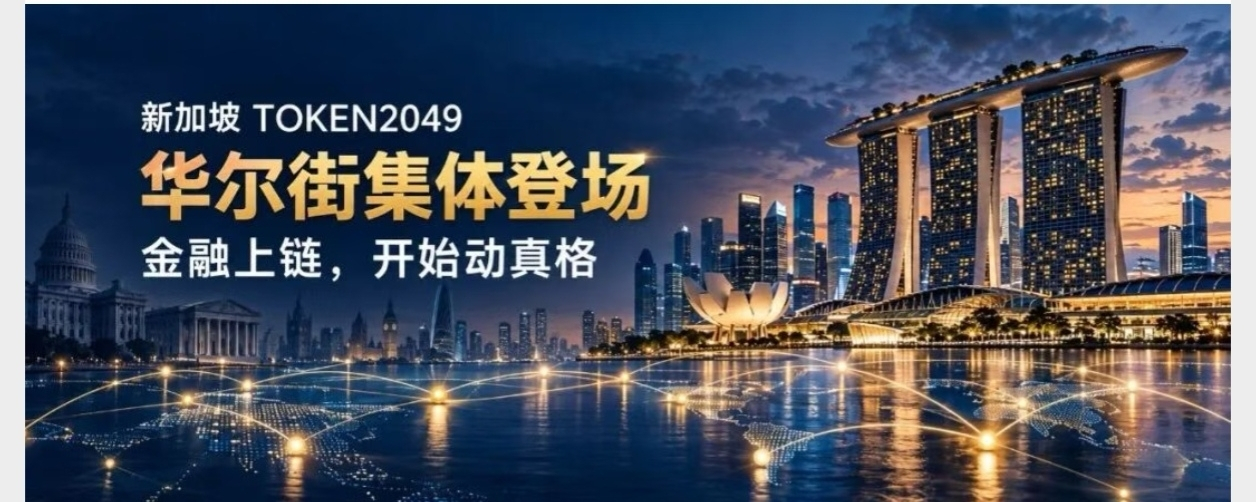


On October 8, 2026, TOKEN2049 Singapore entered its second day.
Institutions including Franklin Templeton, BlackRock, Fidelity, Morgan Stanley, Nasdaq, and Intercontinental Exchange took part in discussions on tokenized assets, global liquidity, on-chain settlement, and round-the-clock markets.
That morning, the panel “Institutional Markets: Tokenized Assets, Global Liquidity, On-Chain Settlement” brought together Franklin Templeton CEO Jenny Johnson, Binance co-CEO Richard Teng, and Canton co-founder and CEO Yuval Rooz.
In the afternoon, representatives from Fidelity, Bitwise, BlackRock, and Morgan Stanley shared the stage for a discussion titled “Tokenization: The Next Investment Revolution.”
The inaugural TOKEN 2049 Institutional brought macro liquidity, institutional capital flows, 24/7 trading, and DeFi infrastructure onto the agenda for a single day. Participation was by invitation and individual vetting, and the event was aimed at senior leaders in global finance and digital assets.
The official institutional track on October 8 was “packed,” with a lively atmosphere. The specific topics institutions discussed are more worth recording than the crowd itself: Can tokenization change fund recordkeeping? Can fund shares become collateral directly? Can disclosure keep pace with asset circulation? How can AI-driven decisions connect to financial execution? How can stablecoins reach users through wallets they already use?
One. Franklin Templeton: Tokenized funds cannot simply be “digital twins” of traditional products. In a discussion on October 8, Jenny Johnson criticized the structure of some tokenized funds.
Original: “many remain ‘digital twins’ of traditional products instead of using blockchain as the primary recordkeeping layer.” “Many products remain ‘digital twins’ of traditional products instead of using blockchain as the primary recordkeeping layer.”
In one model, the traditional system continues to maintain the authoritative record of fund shares, while on-chain tokens represent those shares. In another, blockchain becomes part of the formal transaction processing and ownership registration system. Johnson cited Franklin Templeton’s BENJI as an example of the latter approach. This view shifts the evaluation of tokenization from “whether there is a token” to “whether the token changes how the business operates.” However, BENJI should not be simplistically understood as putting all customer information on a public blockchain. Citing an SEC staff document, the report explained that its internal system stores private shareholder information, while the blockchain stores anonymized transaction data. The two are connected in real time to form the official shareholder record; the transfer agent retains the ability to correct, freeze, or restore records.
To evaluate finance moving on-chain, we should look at the role on-chain records play in legal and operational contexts, and whether they genuinely change recordkeeping, transfers, and reconciliation.
Two. BlackRock: Money market fund shares can become collateral directly. During the conference, Nikhil Sharma, BlackRock’s head of digital assets, outlined a more specific application: tokenized money market funds need not first be redeemed for cash before being used as collateral.
Original: “tokenized money market funds could be posted as collateral directly.” “Tokenized money market funds could be posted directly as collateral.” The change being discussed is very concrete.
Under the traditional approach, holders may first need to redeem fund shares for cash and then use the cash as collateral. The direction Sharma emphasized is to let tokenized fund shares serve directly as collateral, reducing redemption steps and the time spent waiting for cash settlement.
This application focuses not on how an asset is presented, but on how funds are used: Can an institution holding fund shares use them directly when collateral is needed? From an analytical perspective, the value of a tokenized asset depends not only on whether it can be traded, but also on its ability to be used in other financial activities. However, there is still a gap between “can be designed to serve as collateral” and “will be accepted by all counterparties.” The specific scope of use depends on the product and transaction arrangements.
Three. Binance: Demand for tokenized stocks exists, while private markets are more constrained by information flows. During the conference, Richard Teng said there was strong demand for tokenized stocks and private market products, but that the development of some private markets was still constrained by insufficient information flows.
Original: “appetite for tokenized stocks and private market products is high, but poor information flow is limiting growth in some private markets.”
“Demand for tokenized stocks and private market products is high, but insufficient information flows are limiting growth in some private markets.” The report further noted that public stocks, with their regular disclosure and price discovery mechanisms, are more readily brought on-chain than private company equity.
This view adds a condition to the institutional discussion that is easy to overlook: transfer technology cannot create asset information by itself. The ability to transfer an asset does not mean investors already have the information they need to assess its value.
If business operations, rights arrangements, or the basis for valuation are inadequate, turning an asset into a token will not automatically solve these problems. From the perspective of asset organization, digital trading infrastructure therefore needs to work alongside reliable data, ongoing disclosure, and valuation. The information barriers Teng identified illustrate this point.
Four. Canton: Making blockchain a widely used infrastructure. On October 8, Yuval Rooz said the current regulatory environment should be used to advance institutional adoption and make blockchain widely used before the next political cycle.
Cointelegraph recorded the direct quote: “there is no going back.” “There is no going back.” He used Uber and Airbnb as examples to show that once a service becomes widely used in the market, its development is harder to reverse completely.
This reflects infrastructure providers’ focus on business continuity.
Signing a partnership, completing a trial, and officially launching a product are all signs of progress. But whether it becomes part of routine workflows and can be used continuously determines whether it generates stable demand.
Extending this perspective, assessing institutional adoption of on-chain systems calls for further questions: Are participating institutions merely trying them out? Are transactions recurring? Has the system become part of regular operations? Can usage continue to scale?
What can truly support institutional adoption is sustainable business demand and operational capacity.
Five. Binance and Franklin Templeton: Looking to long-term legislation while moving forward under the current framework. In the discussion, Richard Teng said he hoped the (CLARITY Act) would ultimately become law, and argued that legislation could reduce regulatory backsliding and encourage institutions to enter the market.
He described the possibility that current progress could be reversed as “the biggest fear”—“the biggest concern.” Jenny Johnson emphasized that although legislation could provide greater certainty, the industry cannot rely entirely on the bill passing. Cointelegraph’s report summarized her remarks as: “the industry should not rely on the CLARITY Act passing.” “The industry should not rely on the (CLARITY Act) passing.” The two views are not in conflict.
Institutions need stable rules over the long term, as well as a way to determine what business can already be conducted under the current framework. This discussion can be summed up in three interconnected themes: Rooz emphasized generating sustained demand through applications, Teng emphasized improving regulatory stability through legislation, and Johnson emphasized continuing to move forward within the current regulatory framework.
Six. BlackRock: AI analysis and tokenized execution begin to connect. Nikhil Sharma on combining AI and tokenization
Excerpt from the original: “AI as a source of context for financial decisions”
“Treating AI as a source of context for financial decisions.” The report went on to summarize that tokenized assets can provide the infrastructure for executing those decisions.
This approach brings two capabilities into a single business process: AI processes information and provides analysis, while digital asset systems connect to execution. From a business perspective, combining the two still requires arrangements for permissions, rules, and accountability.
A model’s ability to analyze assets does not mean it automatically has authorization to operate accounts or transfer assets. What makes this noteworthy is that large asset managers are beginning to discuss the practical connection between AI and financial infrastructure.
What can be tracked in the future is not only whether analytical tools become more powerful, but also whether their results can enter manageable, traceable execution workflows.
Seven. Samsung: Stablecoin payments should happen in wallets users already know. The Samsung Wallet discussion at the institutional track on October 8 explored how to bring USDC into Samsung Wallet.
Samsung executive Woncheol Chai said: “Sending money abroad should feel as convenient as using the wallet already on your phone.” “Sending money abroad should be as convenient as using the wallet already on your phone.”
The announcement set out a clear plan: in the last week of October, stablecoin wallet functionality would roll out to eligible Galaxy users in the United States, initially supporting USDC.#RWA赛道
