

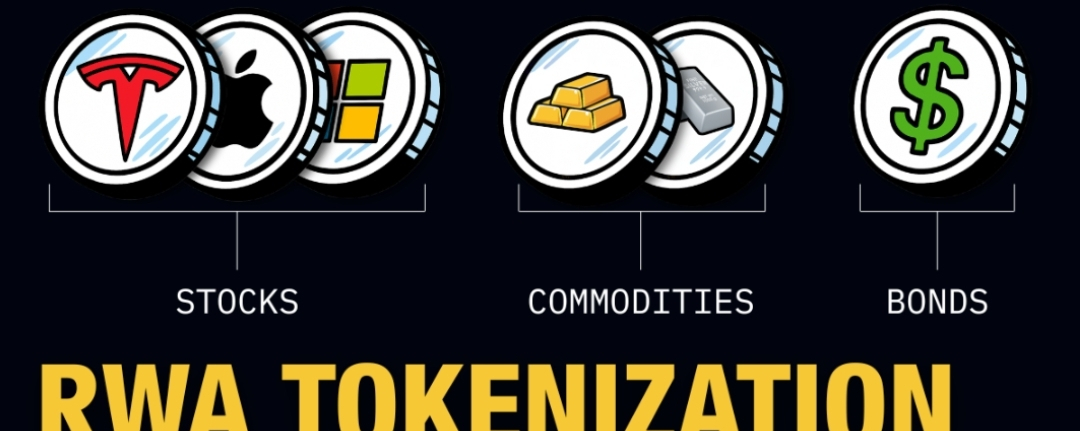


Everyone in crypto is always searching for the next big trend. First, it was DeFi, then NFTs, meme coins, and AI tokens. Now there's another word popping up everywhere: RWA.
Some people are calling it the future of finance. Others believe it could become one of crypto's biggest narratives heading into 2027.
But here's the real question.
What even is RWA, and why is everyone suddenly talking about it?
Don't worry. It's actually much easier to understand than it sounds.
First, What Does RWA Mean?
RWA stands for Real-World Assets.
In simple words, it means bringing traditional financial assets onto a blockchain through a process called tokenization.
Think about things like real estate, government bonds, gold, and other financial products.
Normally, buying and managing these assets involves banks, brokers, paperwork, and different financial systems.
Blockchain technology could make certain parts of that process faster, easier to track, and more accessible.
Instead of handling everything through traditional records, ownership or financial rights can be represented by digital tokens.
But these tokens still need proper legal structures and real assets supporting them.
Let's Understand RWA With a Simple Example
Imagine a commercial building worth $1 million.
Buying the entire building would be impossible for many people.
Now imagine a company creates digital tokens representing legally defined interests in that property.
Instead of buying the whole building, eligible investors might be able to purchase smaller portions.
If the structure allows it, those tokens could represent certain economic rights connected to the property.
That's one way real-world asset tokenization could work.
However, owning a token doesn't automatically mean owning part of a building. The actual rights depend on the legal agreement behind the investment.
And that's an important difference.
Why Is Crypto Suddenly Interested in RWA?
Because this narrative isn't only about another coin pumping.
It's about connecting blockchain technology with assets and financial markets that already exist.
Traditional finance handles enormous amounts of value through systems involving multiple intermediaries.
Tokenization could potentially simplify how certain assets are issued, transferred, and managed.
For example, blockchain-based records may help reduce administrative work and improve transparency.
Some tokenized products could also support faster settlement and more flexible ownership structures.
But these benefits depend on the technology, regulations, and market infrastructure involved.
RWA isn't magic. It's a different way of organizing financial assets.
Big Financial Institutions Are Paying Attention
Here's where things get interesting.
RWA isn't just a conversation happening inside crypto communities.
Major financial institutions have been exploring tokenization and blockchain-based financial products.
The fund demonstrates how traditional financial products can use blockchain infrastructure.
Other financial institutions have also explored tokenized bonds, deposits, and investment products.
This doesn't mean traditional finance is abandoning its existing systems.
Instead, institutions are testing whether blockchain can make certain financial activities more efficient.
And that's a much bigger story than another short-term crypto trend.
Could RWA Make Investing Easier?
Potentially, yes.
One of the biggest ideas behind tokenization is fractional ownership.
Instead of requiring someone to purchase an entire asset, a tokenized structure might allow smaller investments.
This could make certain products accessible to a broader range of eligible investors.
Blockchain systems may also allow transactions to be recorded and verified more efficiently.
But there's a catch.
Not every tokenized asset is available to everyone.
Some products have minimum investment requirements, identity checks, geographic restrictions, and investor eligibility rules.
So while RWA could improve accessibility, it doesn't automatically remove traditional financial barriers.
Wait, Is RWA the Same as Cryptocurrency?
Not exactly.
Bitcoin and many other cryptocurrencies exist as native digital assets.
RWA tokens, on the other hand, are generally connected to assets or financial rights outside the blockchain.
For example, a tokenized government bond might represent an interest in a traditional debt instrument.
Its value and legal rights depend on the underlying product and its structure.
This makes RWA different from cryptocurrencies whose prices are primarily driven by market demand, network activity, and speculation.
However, RWA tokens can still experience market, liquidity, technical, and regulatory risks.
Being connected to a real-world asset doesn't automatically make a token safe.
What About RWA Crypto Coins?
Now comes the part crypto investors are especially interested in.
Some blockchain projects focus on infrastructure for tokenization, financial data, or connecting traditional assets with decentralized systems.
Projects such as Chainlink, Ondo Finance, and Centrifuge are often discussed in conversations about the RWA ecosystem.
But here's something important.
A project being connected to the RWA narrative doesn't guarantee that its token price will increase.
A platform could attract users and tokenize more assets without creating equivalent demand for its native token.
Token supply, fees, competition, revenue models, and actual token utility all matter.
That's why investors should understand how a project's token fits into its business model instead of buying simply because RWA is trending.
Could RWA Become Bigger Than Meme Coins?
This is an interesting comparison.
Meme coins often attract attention through online communities, humor, and speculation.
RWA projects focus more on financial infrastructure and connecting blockchain networks with traditional assets.
The two serve very different purposes.
RWA could potentially support long-term adoption because financial institutions and businesses may find practical uses for tokenization.
But that doesn't mean RWA-related cryptocurrencies will necessarily outperform meme coins or other digital assets.
A technology can become widely adopted without every associated token becoming a successful investment.
That's something the market often forgets during periods of hype.
Why 2027 Could Be Interesting for RWA
Looking toward 2027, tokenization could remain an important topic as financial institutions continue experimenting with blockchain technology.
Government bonds, investment funds, private credit, and other financial products are among the areas where tokenization is being explored.
If more institutions adopt these systems, the amount of financial activity using blockchain infrastructure could grow.
Clearer regulations and improved technology could also support further development.
However, progress may happen gradually rather than through one massive overnight breakthrough.
And there are still challenges involving legal ownership, investor protection, liquidity, and compatibility between different systems.
The future looks interesting, but it isn't guaranteed.
The Biggest Risk Nobody Should Ignore
Here's the part that deserves more attention.
Just because something is called a real-world asset doesn't mean it's automatically trustworthy.
Investors need to understand who holds the underlying asset, what legal rights the token provides, and whether those rights can actually be enforced.
Liquidity is another major concern.
A token might exist on a blockchain, but that doesn't mean someone will always be available to buy it.
There are also risks involving smart contracts, custodians, regulations, and the financial health of the organizations involved.
The technology might be new, but many traditional investment risks still exist.
Final Thoughts: Is RWA Really Crypto's Next Big Thing?
RWA has the potential to become one of blockchain's most important real-world applications.
Unlike trends built mainly around social media excitement, tokenization aims to solve practical problems in traditional finance.
It could help improve settlement, recordkeeping, transparency, and access to certain financial products.
But there's a huge difference between RWA technology becoming successful and every RWA crypto token becoming valuable.
That's why understanding the technology matters more than chasing the hype.
For me, RWA is one of the most interesting crypto narratives to follow heading into 2027, not because it promises quick profits, but because it connects blockchain with financial markets people already use.
The next big crypto story might not be about creating something completely new. It might be about bringing the financial world we already know onto blockchain.
Now I Want to Hear From You
Do you think RWA could become bigger than AI and meme coin narratives in 2027, or is the crypto community getting too excited too early?