



A company delivered the most profitable quarter in the history of its country’s corporate sector, yet its share price fell that day and is down about 30% from its peak six months earlier. Put those two facts together, and the question shifts from how good the results were to what the market is pricing in. This article first examines the results themselves, then looks at where the profits came from and where they went, before explaining how to read the share price and placing Samsung’s numbers in the context of the entire AI hardware supply chain.
1. The results themselves: quarterly profit was about 2.5 times that of all of 2025
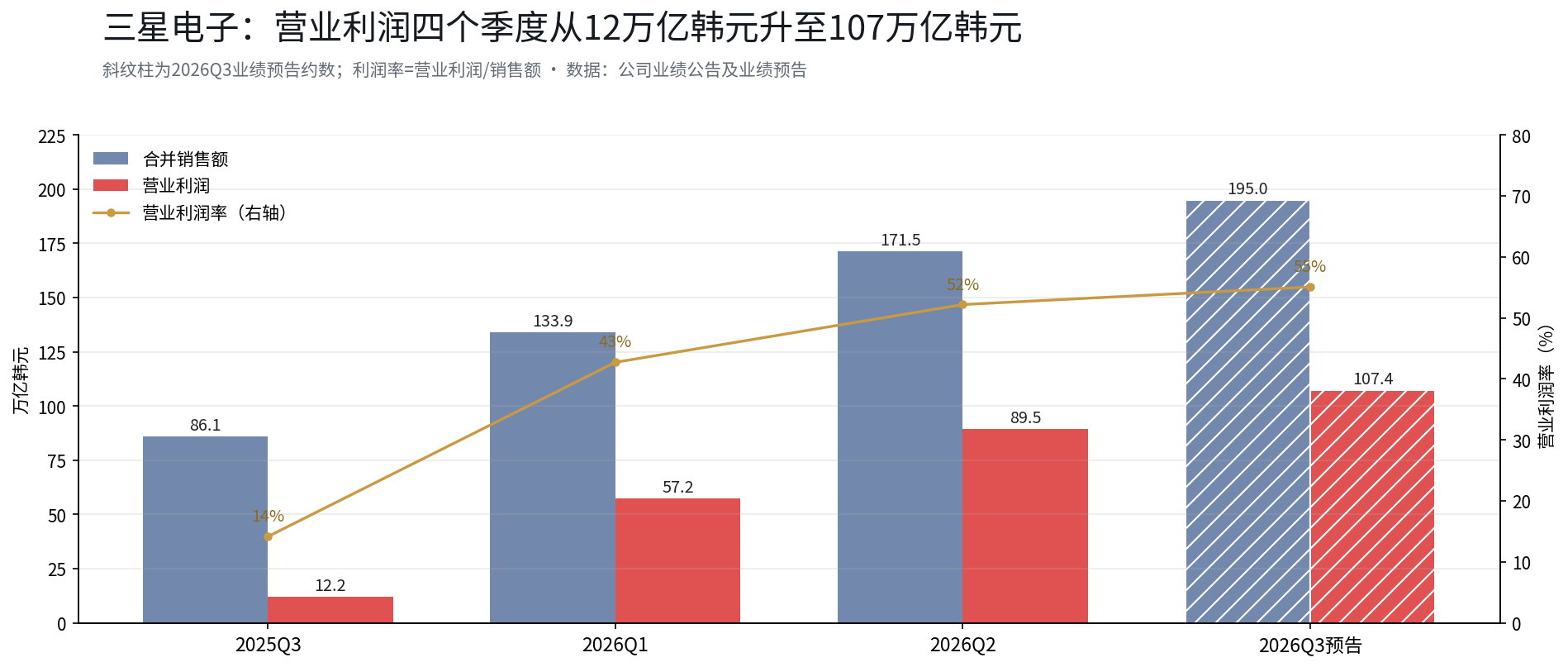
First, let’s check the numbers. Third-quarter 2026 earnings guidance: consolidated sales of approximately 195 trillion won, up 126.6% year over year; consolidated operating profit of approximately 107.4 trillion won, up 782.5%. This marks the first time a South Korean company has recorded quarterly operating profit exceeding 100 trillion won. For comparison, Samsung’s operating profit for all of 2025 was 43.6 trillion won—so in a single quarter, it earned about 2.5 times its profit for the entire previous year.
Look at the past four quarters and the growth trajectory itself tells a story: operating profit was 12.17 trillion won in the third quarter of 2025, 57.2 trillion won in the first quarter of 2026, 89.5 trillion won in the second quarter, and a projected 107.4 trillion won in the third quarter. The operating margin climbed from 14% to about 55%.
But the same number can be read in two ways. The first is the level: 107.4 trillion won is a record. The second is the growth trajectory: year-over-year growth was 1,813.8% in the second quarter, then fell to 782.5% in the third. Both readings are true, but the share price has opted for the second. One technical point is worth noting: such a high year-over-year growth rate is largely due to the low base in the same period of 2025. Looking at the two-year period, the memory industry is in the middle of a historic upcycle. Past performance does not represent future results.
II. Where the money comes from, and where the losses go
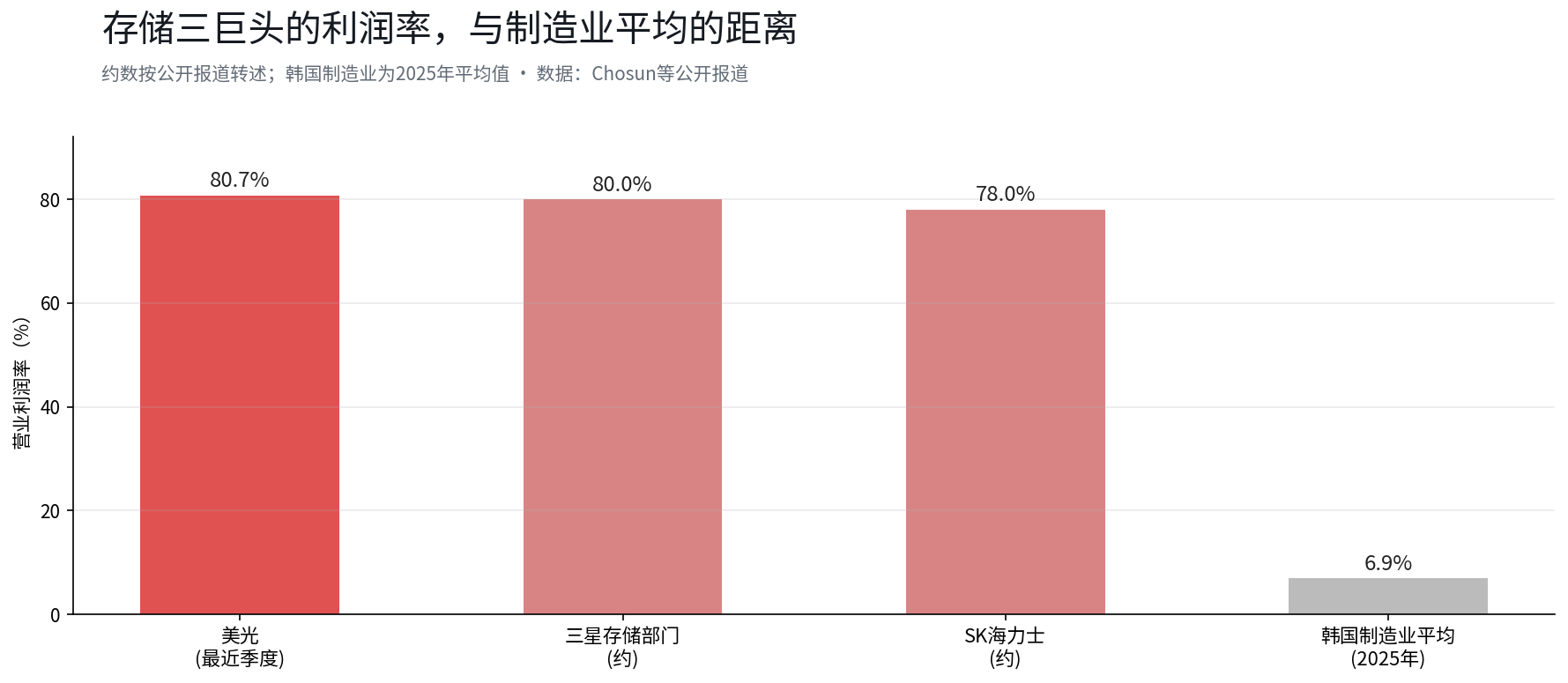
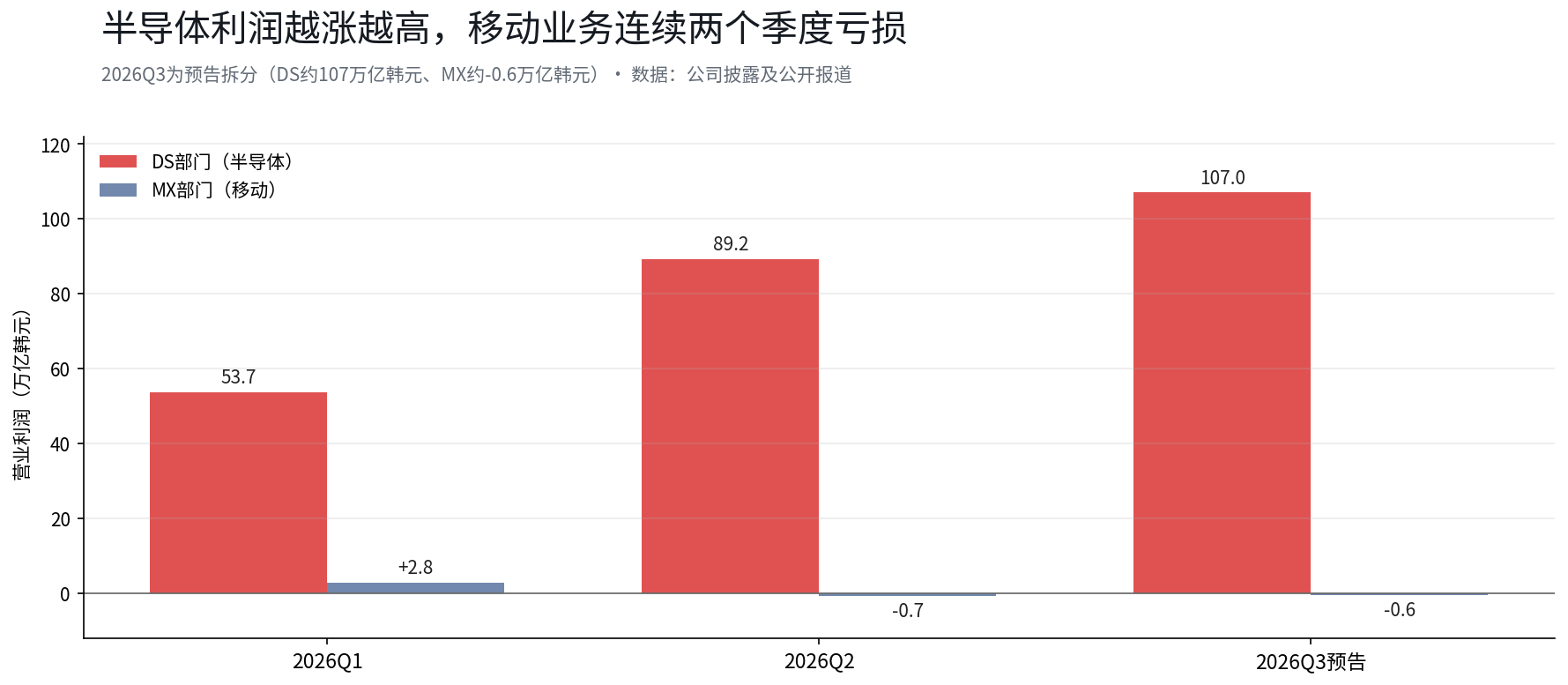 According to Citi’s breakdown, Samsung’s semiconductor division generated operating profit of about 107 trillion won in the third quarter, up further from 89.2 trillion won in the second quarter. The profitability of the Big Three memory makers is rewriting conventional wisdom about manufacturing: according to public reports by Chosun and others, Micron’s operating margin was 80.7% in its most recent quarter, Samsung’s memory division’s was about 80%, and SK hynix’s was about 78%. For comparison, South Korea’s manufacturing sector had an average operating margin of just 6.9% in 2025.
 At the other end of the same income statement, money is flowing in the opposite direction. The mobile and consumer electronics divisions are expected to post a combined loss of about 0.6 trillion won in the third quarter, marking a second consecutive quarterly loss. Smartphone shipments fell 9% quarter on quarter to 58 million units. The more direct action is on the supply side: according to Korean media reports, Samsung’s Mobile eXperience division has notified suppliers that it plans to cut smartphone production by 20% to 30% in the fourth quarter. The company has also raised prices for the Galaxy S26 series. According to reports, the starting price of the S26 has increased by 800 yuan to 7,799 yuan, while the S26+ and S26 Ultra have each risen by 1,000 yuan.
These are two sets of books belonging to the same company, and they affect each other. Higher memory chip prices have pushed the semiconductor division’s margin to around 80%; those same price increases are directly driving cost overruns in the mobile division. Morgan Stanley expects Samsung’s mobile division to potentially post cumulative operating losses of $16 billion from 2026 to 2028 (as reported from its industry report published on July 21). Some of the money earned by semiconductors is being lost in the company’s own finished-device business.
III. Why the share price isn’t buying it
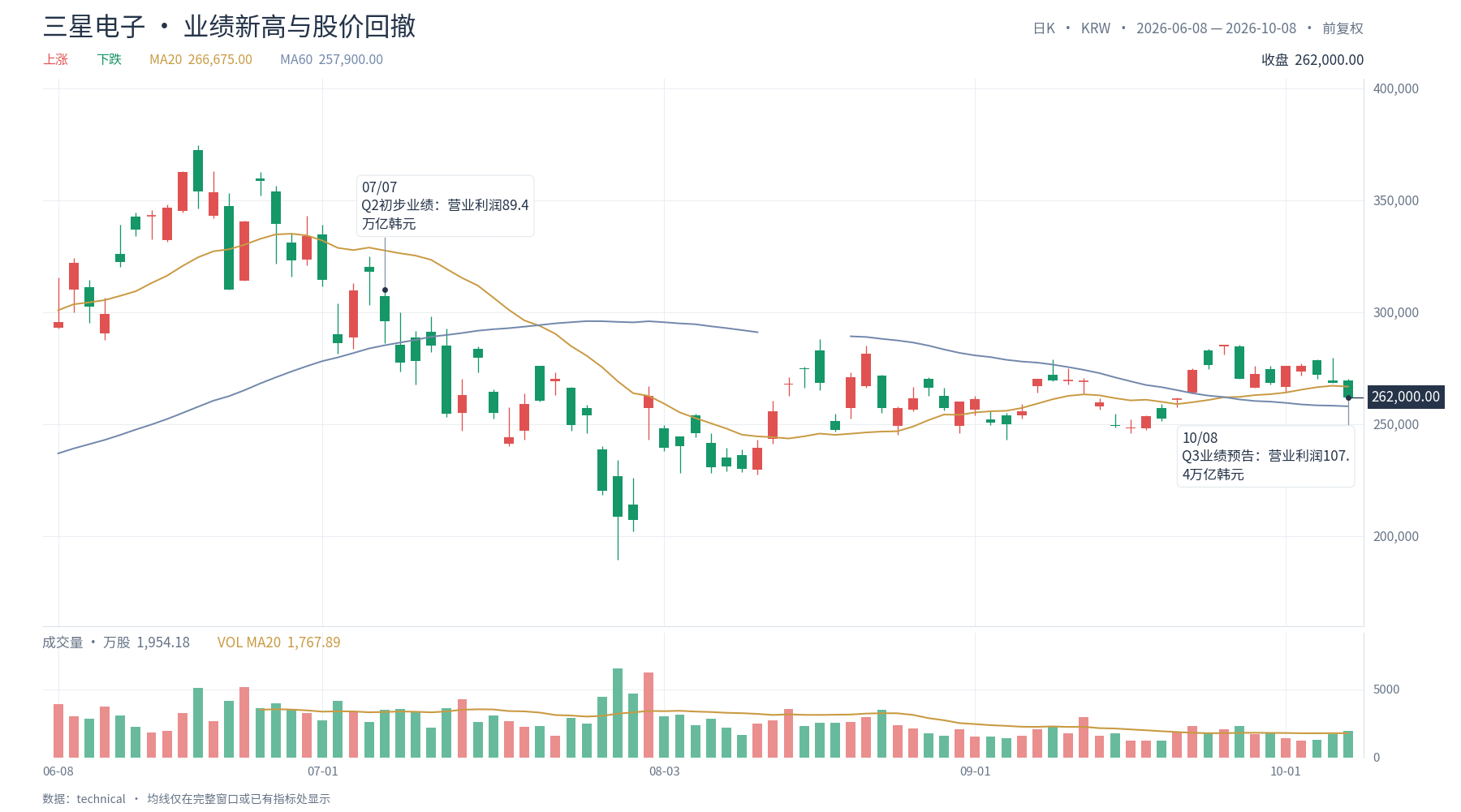
At the October 8 close, Samsung Electronics stood at 262,000 won, down 2.42% for the day. It fell 5.07% over the three trading days in October, and was down about 30% from its intraday high of 374,500 won on June 18. The share price fell on the day the earnings guidance was released, indicating that the market had priced in the record results before the announcement; the disclosure itself offered no fresh impetus for further gains.
Three questions have converged. First, the gap: third-quarter revenue was 195 trillion won, below securities firms’ estimate of about 201.9 trillion won; operating profit was 107.4 trillion won, below the estimate of about 108.67 trillion won. The shortfall was only around 1%, usually not enough to move a share price, but when expectations are highly aligned, even a slight miss can send an amplified signal. Second, the growth trajectory: year-over-year growth slowed from 1,813.8% in the second quarter to 782.5% in the third, while quarter-on-quarter growth in operating profit also eased from 56% in the second quarter. Third, inventories and the momentum behind estimate upgrades: according to Morgan Stanley’s July report, momentum behind earnings upgrades for memory makers is weakening, with the net earnings revision ratio falling from a peak of 92% to 77%. Year-over-year growth in DRAM contract prices has retreated from its cyclical high, and inventories of both DRAM and NAND increased in the second quarter.
Capital expenditure is another source of pressure, further down the income statement. In the second quarter, Samsung’s capital expenditure was 16.8 trillion won, of which 15.4 trillion won was for the semiconductor division. To address capacity shortfalls, the company has launched expansion projects over the past year and plans to continue investing tens of trillions of won over the next two years to expand its memory wafer fabs. If it steps up spending on construction and depreciation in the second half to meet HBM4 production targets, these costs may show up in its financial statements over the next one or two quarters. The market’s concern is whether this spending could consume most of the incremental profit in a given quarter.
IV. Citi’s thesis and a more fundamental question
According to public reports, Citi maintained its Buy rating on Samsung and a 12-month price target of 430,000 won, implying about 60% upside from the October 7 closing price of 268,500 won; this view represents only the judgment of the relevant institution. Citi’s core rationale is HBM4’s pricing flexibility: according to reports, its estimates suggest that the average price per GB for HBM4 12hi could rise from about $2 in 2026 to a range of $4 to $5 in 2027, while HBM4 8hi could command a 20% to 30% premium on top of that. At its second-quarter earnings briefing, Samsung management also said it expected HBM4 sales to grow more than threefold in the third quarter and account for over 60% of total HBM revenue in the second half (as relayed from the earnings call).
The bullish case rests on pricing power; the opposing question is how much demand can bear. According to Morgan Stanley’s estimates, global cloud providers’ capital expenditure could reach $1.2 trillion in 2027, with more than half going to memory. At the same time, capital expenditure as a share of EBITDA for Google, Amazon, Microsoft, and Meta already exceeded 70% in 2026, and some companies’ capital expenditure could exceed EBITDA in 2027. Pricing power in memory lies on the supply side, but supply-side profits ultimately depend on spending by the demand side. If buyers’ spending approaches or even exceeds their earnings capacity, how far the price curve can extend will depend on a balance sheet that Samsung itself cannot control.
V. Samsung’s books are also the books of the entire AI hardware supply chain
Samsung’s results contain two facts pointing in opposite directions. One is that demand for HBM and DRAM from AI data centers is still surging, the tight supply-demand balance in memory may persist, and industry margins are at historic highs. The other is that the consumer electronics business at the same company is cutting production, raising prices, and posting losses, as rising memory prices squeeze margins on end products. These facts are not merely coincidental; the latter is partly caused by the former: the more expensive computing becomes, the harder it is to make end products. Similar pressure is spreading throughout the AI hardware supply chain, though each segment is feeling it differently.
We believe the key to interpreting Samsung’s share price is that the market is valuing growth rates, not profit levels: the level has already been delivered, while the slope is part of the valuation. This interpretation has one prerequisite and one counterexample. The prerequisite is that cloud providers’ spending growth holds up; if 2027 capital expenditure guidance is systematically revised downward, both memory volumes and prices will come under pressure. The counterexample is that if long-term supply agreements and the 2027 supply-demand outlook at the October 29 earnings briefing point to tighter conditions, concerns about the growth trajectory could ease for a time. Whether profits have reached the peak of this cycle cannot be established in advance. The only things that can be checked are the three answers on October 29: the 2027 supply-demand outlook, progress on long-term agreements, and details on capital expenditure and shareholder returns. It remains to be seen how much of this quarter’s profit is already reflected in the share price.
Data notes
Samsung earnings and segment breakdown: company announcements (2026/10/8, 7/30, 5/6).
2025 Q3 comparison and full-year operating profit: company disclosures, Yonhap News Agency (2026/4/7, 7/7).
Samsung share price and drawdown: publicly available market data, as of the close on 2026/10/8; the 6/18 high is an intraday price.
Citi’s view: Citi research report, as reported by the media.
Morgan Stanley’s view: Morgan Stanley industry report dated 2026/7/21, as reported by the media.
Smartphone production cuts, shipments, and S26 pricing: Korean media, TrendForce.
Profit margins of the Big Three memory makers: public reports by Chosun and others.
Disclaimer:
This article is for general information and market commentary only, and is based on publicly available information as of the times specified in the text. Market data, expectations, and probabilities cited may change as market conditions evolve. The views and investment strategies of third-party institutions, analysts, or other individuals cited in this article represent only those third parties’ views at a particular point in time and do not represent the views or recommendations of BIT. This article does not constitute investment advice, investment research, an offer, solicitation, or recommendation concerning any security, investment product, or trading strategy, and should not be relied upon as the basis for any investment decision. Financial markets involve risk, and securities prices and market performance may fluctuate. Past performance and historical market trends do not represent or guarantee future results. Investors should independently assess the relevant risks in light of their own circumstances and seek professional advice where necessary.