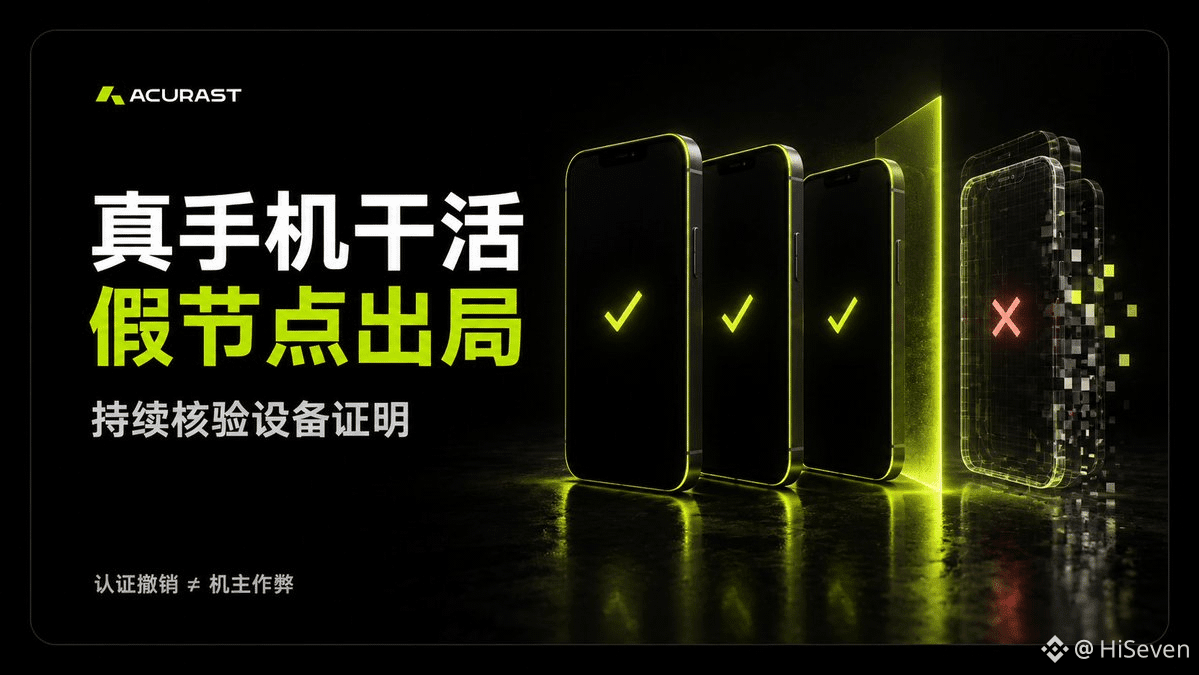

Real phones are doing the work, but fake nodes want to collect rewards too?
@Acurast’s device verification guide, published on October 7, highlighted a risk of cheating.
If a device’s authentication key is leaked, an attacker could use it to forge proofs, making an emulator pose as a real phone—or even clone one device identity hundreds of times. The dashboard may show the device as online, when behind the scenes it’s just a script sending periodic heartbeats.
This affects the interests of legitimate participants. You provide a phone, using its hardware, power, and network—why should scripts with fake identities be allowed to claim rewards?
Acurast will continue checking the revocation status of device proofs. Nodes with revoked proofs will be removed from the compute pool, become ineligible for rewards, and stop receiving deployment tasks.
But these rules come at a cost. Some older phone models share authentication keys, so if a key is revoked, legitimate phones may be affected too. Seeing “Revoked” in Hub doesn’t prove the owner cheated, and Acurast can’t reverse a revocation on behalf of the device manufacturer.
I support strict checks against fake nodes, and I hope legitimate users who are affected receive a clear explanation. People contributing computing power need to know why their devices suddenly stop receiving tasks.
If you’re already running a node, you can check the status of your device proof in Hub. If you’d like to learn about the project or take part in official tasks
@Acurast’s device verification guide, published on October 7, highlighted a risk of cheating.
If a device’s authentication key is leaked, an attacker could use it to forge proofs, making an emulator pose as a real phone—or even clone one device identity hundreds of times. The dashboard may show the device as online, when behind the scenes it’s just a script sending periodic heartbeats.
This affects the interests of legitimate participants. You provide a phone, using its hardware, power, and network—why should scripts with fake identities be allowed to claim rewards?
Acurast will continue checking the revocation status of device proofs. Nodes with revoked proofs will be removed from the compute pool, become ineligible for rewards, and stop receiving deployment tasks.
But these rules come at a cost. Some older phone models share authentication keys, so if a key is revoked, legitimate phones may be affected too. Seeing “Revoked” in Hub doesn’t prove the owner cheated, and Acurast can’t reverse a revocation on behalf of the device manufacturer.
I support strict checks against fake nodes, and I hope legitimate users who are affected receive a clear explanation. People contributing computing power need to know why their devices suddenly stop receiving tasks.
If you’re already running a node, you can check the status of your device proof in Hub. If you’d like to learn about the project or take part in official tasks