



Original | Odaily Planet Daily (@OdailyChina)
Author | Asher (@Asher_ 0210)
Last night, BTC continued to fall, briefly dropping below $80,500. Major altcoins broadly pulled back, but STRK bucked the trend, rising by more than 40% at one point over the past 24 hours. It is currently trading at $0.0684.
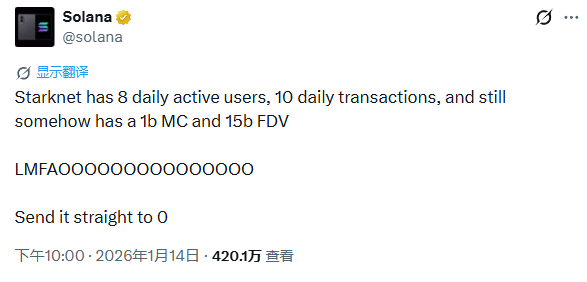
At the beginning of this year, this L2 was widely mocked by the market for having “just 8 daily active users and only 10 daily transactions.” Now, it has suddenly become the center of attention. The rally was mainly driven by remarks from StarkWare CEO Eli Ben-Sasson. Yesterday afternoon, he said that to accelerate its quantum-resistant upgrade, the team was considering moving Starknet off Ethereum and turning it into an independent L1. After the news spread on social media, STRK’s price surged.
Can the two new narratives—post-quantum security and an L1 transition—change Starknet’s image as a chain “nobody uses,” or will they bring only another short-lived hype cycle?
Post-quantum narrative heats up as Starknet tests on mainnet
StarkWare had already published Starknet’s post-quantum roadmap on June 30 this year, outlining a three-phase security upgrade plan to address the risk of future attacks enabled by quantum computing. Starknet’s underlying architecture, based on STARK proofs, provides a technical foundation for this upgrade.
StarkWare later announced a mainnet transfer test. A wallet account using OpenZeppelin’s experimental Falcon-512 post-quantum signature scheme completed a real transfer on Starknet, paying about 6 cents in fees. The account is still an unaudited experimental version, intended primarily for research and testing.
Post-quantum signatures address wallet security. When users transfer funds, they must sign transactions with their private keys to authorize them. If quantum computers can one day break traditional signature algorithms, attackers could forge authorization and steal assets. Post-quantum signatures use different cryptographic schemes to defend against these attacks.
Starknet’s advantage is that wallets can upgrade their signature schemes directly. Each account is a smart contract that can define its own signature verification rules, making it possible to introduce post-quantum signatures while retaining the same addresses and assets—without requiring a network-wide hard fork.
However, one experimental transfer does not mean the entire network is now post-quantum secure. Beyond wallet signatures, there are other parts of the network that need upgrading, some of which depend on Ethereum.
Why consider becoming an L1? Post-quantum upgrades are still constrained by Ethereum
As an Ethereum L2, Starknet still relies on Ethereum for settlement and underlying security. Even after completing its own post-quantum upgrade, it would still depend on Ethereum for data availability, bridging, and messaging, among other things, and could not unilaterally determine the upgrade timeline for every security component. So if Starknet wants to complete a full post-quantum upgrade sooner, it needs to consider whether to continue relying on Ethereum.
Yesterday afternoon, Eli Ben-Sasson said the team was considering several options, including moving to L1, to address cryptographic risks that quantum computing and AI could pose. In his view, if Starknet can control its upgrade process independently, it could become fully quantum-safe as early as 2027—before the end-of-2029 target he cited for Ethereum.
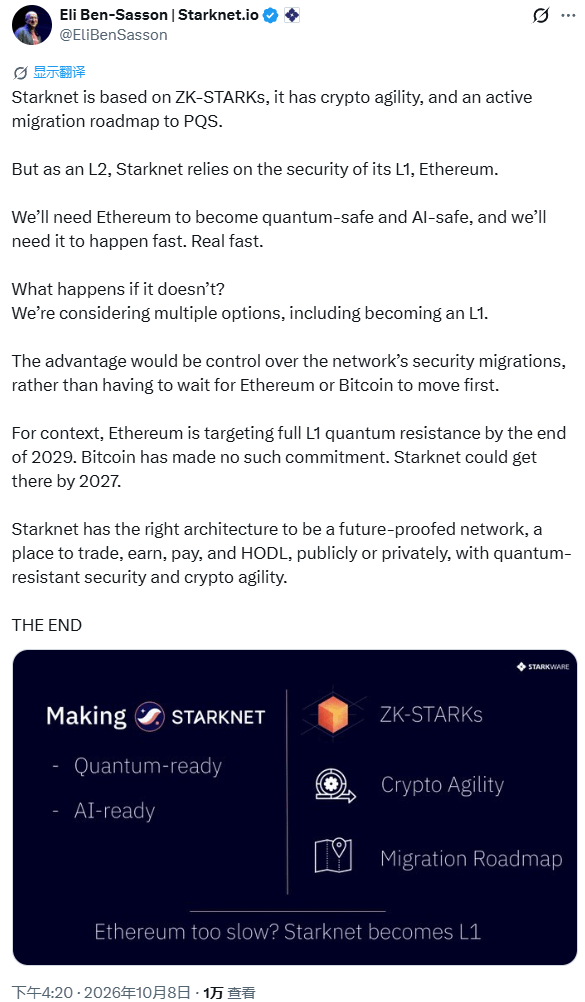
These remarks linked Starknet’s earlier exploration of post-quantum security with the possibility of becoming an independent L1. This gave the market a new expectation: the established L2 might no longer just scale Ethereum, but could instead build its own blockchain and set its own security upgrade roadmap. This also became a major catalyst for STRK’s rally against the broader market.
However, the team has yet to decide whether to become an L1, and completing a full post-quantum upgrade in 2027 is only a projection; the timeline remains unconfirmed.
Could be a short-term hype cycle; network revenue will be the real test
Starknet has made tangible progress in exploring post-quantum security, and there are clear technical reasons to become an independent L1. But for now, one side of the equation is an experimental solution that still needs auditing and adoption, while the other is an undecided discussion about a transition. There is still a lot of work to do before either is fully implemented.
The more immediate issue is that, in the eyes of many users, Starknet remains an L2 “nobody uses.” Post-quantum security and an L1 transition can attract attention, but whether users are willing to move funds onto the network and trade on it over the long term also depends on whether it offers worthwhile products, ample liquidity, and a good trading experience.
According to Nansen’s (Starknet H1 2026 report), Starknet averaged around 239,000 transactions and 50,000 active addresses per day in the second quarter of this year. While it would be inaccurate to say that nobody uses the network, trading activity remains highly concentrated: AVNU and Cartridge together accounted for about 91% of transaction volume, underscoring the ecosystem’s reliance on a small number of applications.
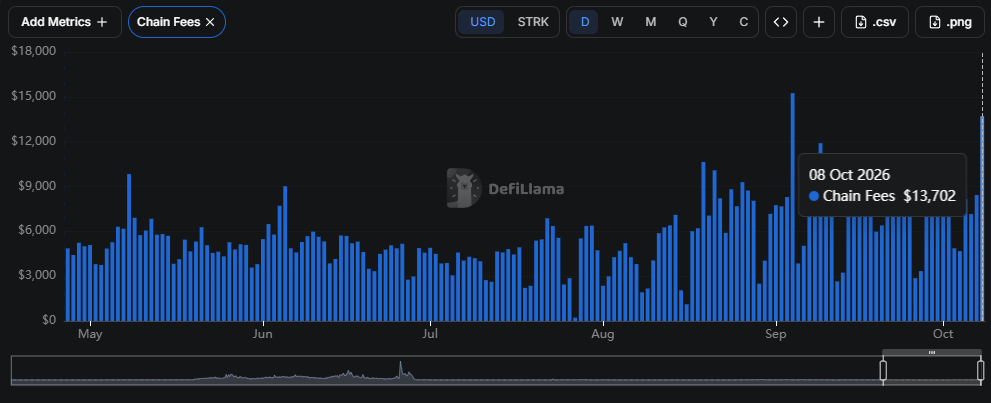
Beyond the token price, growth in on-chain usage and revenue is what really deserves attention. According to DefiLlama data, Starknet generated just $13,700 in fees over the past 24 hours. Compared with STRK’s gain of more than 30%, the chain’s actual revenue remains limited. STRK’s rally against the broader market may simply be a “false boom” fueled by a new narrative, and a circulating market cap of nearly $500 million may already be expensive.
A more meaningful signal to watch for may come when on-chain activity on Starknet continues to grow and generates steadily increasing fee revenue for the network.