



A browser-based physical AI data engine
As AI technology continues to mature, the next major frontier may well shift directly to embodied intelligence and physical AI. However, this form of real-world AI faces enormous challenges.
For physical robots to understand three-dimensional space and accurately perform physical interactions, they rely heavily on vast and diverse datasets of real-world physical interaction trajectories. To make progress, they must overcome challenges such as hardware costs and the time required to collect real-world data.
A virtual browser with no hardware requirements
In the past, training robots through imitation learning often required labs or companies to purchase expensive robotic arms costing tens of thousands of dollars, then spend a great deal of labor manually labeling data and providing demonstrations in controlled physical environments.
The subject of this article, Axis Robotics, has developed a high-fidelity physics simulation engine using WebGL and cloud rendering. Users don't need specialized hardware or a high-performance workstation; they can load a 3D virtual workspace instantly in their computer browser.
Global Crowdsourced Robotic Arm Collaboration
In physical AI, a model's ability to adapt to the ever-changing, unstructured environments of the real world depends on the edge cases covered by its training data and the diversity of human demonstrations.
Through its crowdsourcing network, Axis Robotics can collect user behavior from people with different backgrounds, operating habits, and reaction times. Changes in joint angles, end-effector trajectories, and force-feedback data are all recorded precisely.
Data as the Smallest Economic Unit
In the traditional Web2 AI training pipeline, data providers often have no clear way to quantify the value of their contributions. Axis Robotics, by contrast, presents users with a digital record of the results of each training session.
These precisely labeled, information-rich operational data directly address the pressing needs of commercial clients and leading AI labs training general-purpose embodied models. This allows the project to collect data while planning its future reward programs.
Axis Robotics: Funding and Technical Background
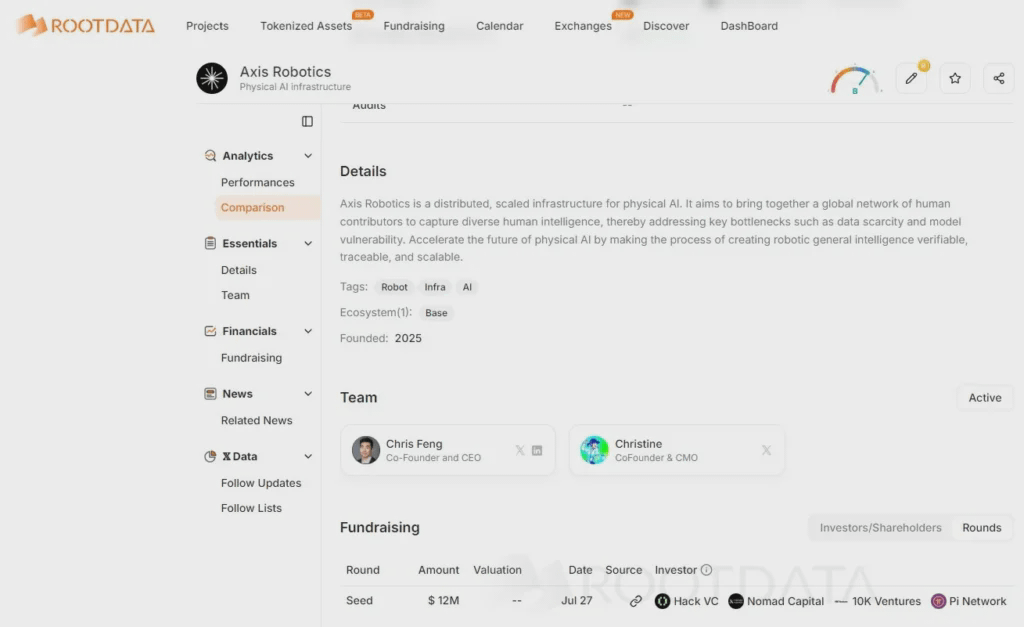
From its founding, Axis Robotics has attracted strong interest thanks to its distinctive decentralized physical AI architecture. It raised $12 million in its seed round.
This funding not only provides substantial development capital for Axis Robotics' physics simulation engine and distributed data infrastructure, but also signals growing investor interest in the emerging field of embodied intelligence powered by Web3 crowdsourced data.
Institutions Enter the Physical AI Data Infrastructure Space
The round was led by Hack VC, which has a long-term focus on Web3, AI infrastructure, and DePIN. Other participating investors included Nomad Capital, Pi Network Ventures, and 10K Ventures.
This also suggests that, as large language model AI approaches its limits, institutions are beginning to allocate some of their capital to embodied physical AI projects like Axis Robotics. Leaders in a new sector often gain a significant competitive moat.
Cloud Rendering and a High-Precision Physics Engine
For operational data collected in a browser to be used by leading robotics models, the simulated environment must accurately reproduce complex physical properties such as gravity, collision volumes, friction, and joint degrees of freedom.
What seems like a highly complex set of requirements is addressed by Axis Robotics’ underlying WebGL and cloud-based distributed computing architecture, allowing the interface to render a realistic 3D environment and provide real-time physics feedback even with extremely low network latency.
Anti-Cheating Verification Algorithms and Data Cleaning
In an open crowdsourced data architecture, preventing large volumes of invalid activity generated by automated scripts is one of the challenges Axis Robotics must address.
To tackle challenges that many protocols have failed to solve, Axis Robotics deploys multidimensional trajectory analysis algorithms on the backend. These monitor changes in users' acceleration curves, reaction times, hand tremors, and path plausibility in real time, reducing the likelihood that automated scripts will pass.
A Breakdown of the Explicit Airdrop Outlook and Allocation Weights
Axis Robotics' core team has adopted an unusually transparent incentive policy. To prevent users from working for nothing, it published the rules and weightings directly on X, breaking with the vague airdrop criteria of the past.
With clearly defined weightings and economic logic, Axis Robotics enables participants with different areas of expertise to accurately assess the return on their contributions and customize an airdrop strategy to suit their individual interests and skills.
Daily Operational Tasks Carry the Most Weight
In designing the token allocation, the project treats valid data trajectories as the smallest unit—and as the basis for airdrop allocations. The operational data generated by these users forms the fundamental foundation that enables Axis Robotics to provide data to AI labs and generate commercial revenue.
Participants complete daily robotic arm control tasks in their browser and accumulate Axis Points. These points will directly correspond to the largest and most heavily weighted core allocation in the future airdrop pool.

Kaito Yapping: A Competitive Edge for KOLs
Recognizing that creators skilled in writing, community analysis, and marketing may not have an advantage in robot simulations, Axis Robotics puts their strengths to use to maximize the project's visibility.
Axis Robotics has allocated a fixed 0.2% of the token supply to users who participate in Kaito platform yap interactions and referral-based promotion, allowing writers and KOLs to earn rewards by producing high-quality research content and driving community growth.
Discord Community Roles Are Not Required
Many airdrop hunters try to earn community roles by spamming meaningless messages. Axis Robotics has made its position clear: Discord is not a development channel the project prioritizes. So if users are mainly interested in the airdrop, they should focus first on completing the daily tasks.
This report is for informational purposes only and does not constitute investment advice or a basis for making any investment decision. The data, analysis, and opinions cited are based on the author's research and publicly available sources, and may be uncertain or subject to change at any time. Readers should make investment decisions carefully, taking their own circumstances and risk tolerance into account. For further guidance, consider consulting a professional advisor.