

Does MiCA Mark the End of the Wild-Growth Era?
The EU’s Markets in Crypto-Assets Regulation (MiCA), now officially in force, may become the benchmark for how governments around the world approach virtual assets. It is set to put an end to more than a decade of disorderly regulation, in which the industry developed first and rules came later.
This comprehensive regulatory framework covers all 27 EU member states and affects more than 400 million people. Its primary aims are to curb market manipulation and financial crime, while providing the general public with a safe way to enter the market.
The EU Leads the World in the Rule of Law
As the world’s first comprehensive cross-border legal framework purpose-built for crypto-assets, MiCA reflects the EU’s ambition to shape the rules as Web2 gradually merges with Web3.
MiCA fundamentally redefines the legal status of crypto-assets. Its forward-looking, clearly structured provisions set a benchmark for other countries and regions, and its influence is widely described within the industry as the GDPR of the crypto world.
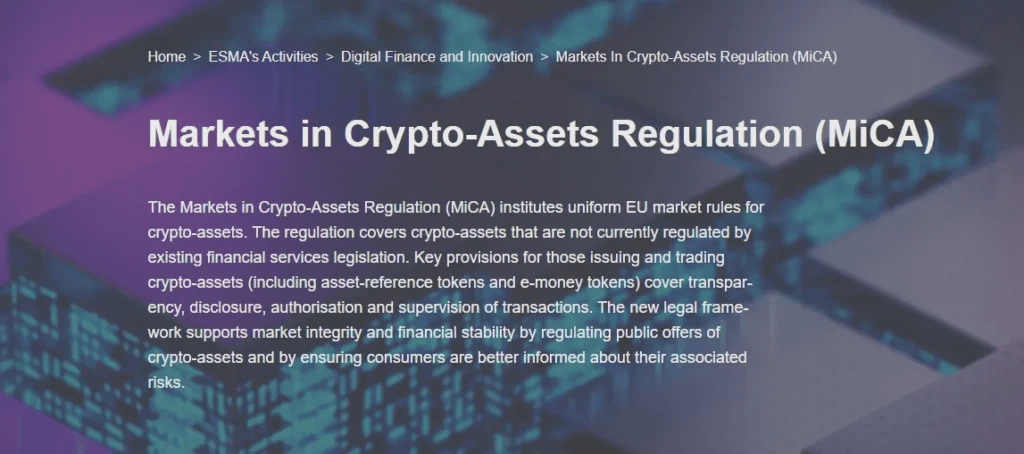
Image source: ESMA
Putting an End to Bad Money Driving Out Good
Over the past several years, and even now in 2026, the crypto sector has continued to see incidents such as wash trading, insider trading, and issuers absconding with funds. Many investors have suffered severe losses, in some cases losing their entire livelihoods.
MiCA’s full implementation effectively creates a formidable compliance firewall in the European market, requiring all crypto businesses operating in the EU to make their operations transparent. If malicious activity occurs, protocol founders could face criminal penalties.
A New Era of Comprehensive Regulation
MiCA’s implementation does not mean regulators will completely stifle innovation in decentralized protocols. On the contrary, MiCA brings blockchain technology in from the dangerous fringes and onto a mainstream path that balances safety with convenience.
When the rules of the game are clear, traditional banks, asset management companies, and major sovereign wealth funds can enter the market while remaining compliant, accelerating the growth of the RWA sector.
MiCA’s Three Regulatory Categories
The EU’s MiCA framework aims to break down the vague notion that all cryptocurrencies are the same type of asset. It precisely classifies them based on how they maintain a stable value and the financial risks they may pose.
MiCA divides the blockchain assets within its scope into three distinct categories, each subject to graduated compliance requirements: the higher the risk and the closer an asset’s ties to the traditional monetary system, the stricter the regulatory oversight.
Electronic Money Tokens (EMTs)
These stablecoins are pegged to the value of a single fiat currency. They are the asset category subject to MiCA’s strictest and least flexible oversight, with tokens such as USDC, USDT, and EURC, which is pegged to the euro, serving as examples.
MiCA requires issuers of these tokens to be EU-based banks or legal entities established as electronic money institutions. Reserves must be held in full on a 1:1 basis in segregated accounts, and the law strictly prohibits issuers from paying holders any interest on deposits.
Asset-Referenced Tokens (ARTs)
This category covers hybrid stablecoins that maintain a stable value by referencing multiple fiat currencies, commodities, or even other crypto-assets. It was originally designed to address projects such as Meta’s Libra/Diem, which never came to fruition.
MiCA requires ART issuers to obtain a specific license in the EU and establish highly liquid reserve custody arrangements, along with strict capital adequacy requirements. These measures ensure that users can redeem their tokens for the corresponding underlying assets at any time, even during periods of extreme market panic.
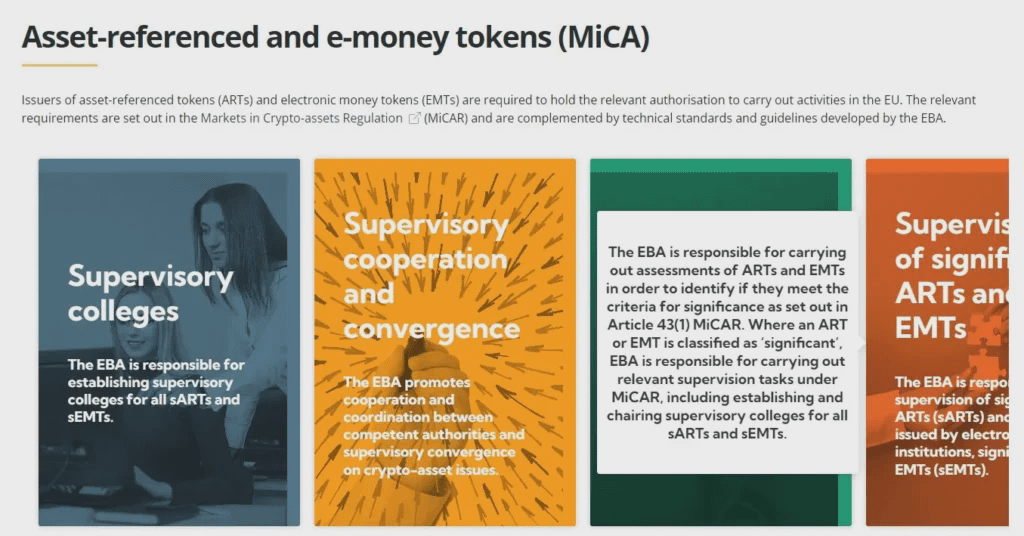
Image source: EBA
Other Crypto-Assets
Crypto-assets that do not fall into either of the two stablecoin categories are placed in the third category. This includes some of the market’s largest cryptocurrencies by market capitalization, such as BTC and ETH.
Compared with the first two asset categories, MiCA’s baseline issuance requirements for this category are more flexible. Issuers generally do not need a high-threshold financial license, but they must publish a standardized compliance white paper that is accurate and fully transparent.
MiCA’s Tangible Impact on the Global Crypto Ecosystem
As MiCA’s transitional grace period draws to a close, the law’s tangible impact on the global Web3 industry has moved from theory to a formal regulatory framework poised to define the market.
As the world’s first cross-border crypto law, MiCA’s provisions function like a filter, gradually removing offshore operations, anonymity, and unchecked growth from the crypto-asset sector.
A Major Shake-Up in the Stablecoin Ecosystem
Because the law requires issuers to hold a locally licensed EU financial institution charter and keep substantial reserves in custody at designated banks, USDT—the world’s largest stablecoin by market capitalization—faces a significant risk of being delisted and serious compliance challenges within the EU.
By contrast, USDC and EURC, issued by Circle and fully compliant with the rules for electronic money tokens, are well positioned to benefit and rise. As the balance shifts, USDC’s market share could well catch up with USDT’s.
Challenges for SMEs and Decentralized Protocols
MiCA’s stringent anti-money laundering and funds transfer rules eliminate the minimum reporting threshold. This means crypto-asset service providers must conduct institution-level compliance checks on every transfer.
These high compliance and legal costs are pushing underfunded SMEs to the brink. In the future, many of these businesses and DeFi projects may choose to join the European system through mergers and acquisitions.
Established Players Move In Faster
The legal certainty provided by the law is now paving the way for traditional finance to accelerate its move into Web3. With the law closely aligned with the EU’s traditional financial instruments, commercial banks, asset management companies, and large investment firms can legally onboard users and enable them to purchase RWA products.
Following MiCA’s adoption, the global crypto ecosystem will split into two camps: compliant players that fully embrace the EU’s high standards, and non-compliant players that retreat to more permissive offshore jurisdictions.
This report is provided for informational purposes only and does not constitute investment advice or a basis for making any investment decision. The data, analysis, and views cited in this report are based on the author’s research and publicly available sources, and may be uncertain or subject to change at any time. Readers should make investment decisions carefully, based on their own circumstances and risk tolerance. For further guidance, we recommend seeking advice from a professional adviser.