


What is Paid, and how does it work?
For a long time, memecoins have been launched by anonymous developers riding trending topics or celebrity accounts, who then quickly drain the liquidity after investors buy in to make a profit.
However, this long-standing playbook may be getting rewritten by Paid. Paid breaks away from the creator economy’s monetization models of high-barrier ad revenue sharing and fan-driven tipping, and instead ties into the X social platform. Even if you’ve never used Web3, you can earn as long as your name becomes the center of attention.
Paid integrates Pump.fun’s on-chain revenue-sharing mechanism
Under Pump.fun’s model, a portion of the fee from each transaction is deducted as a creator reward. Paid has adopted the same rule, distributing those rewards to X creators.
When deploying a token, Paid allows issuers to set the recipient address for creator fees directly to the Paid protocol treasury and specify a particular X user account as the token beneficiary. Once the token begins trading, the earnings are automatically sent to Paid and held there until claimed.
Profit sharing and deflation of the platform token
When the contract periodically settles accumulated creator fees, it automatically splits the assets according to a fixed 80/20 ratio.
Eighty percent of the fees go directly to X creators as earnings, while the remaining 20% is used by Paid to buy back and burn its own PAID tokens, with the goal of keeping the platform token perpetually deflationary.
Creators only need to verify their identity through their social media account
For designated X creators, no prior registration on the Paid platform is needed. They can claim their earnings directly without any on-chain experience or a Web3 wallet.
Paid’s unique mechanism works as follows: once creators reach the claim threshold, they simply need to open the claim page on the official Paid website and verify ownership through X’s official login feature to claim their earnings.
Reflections on the frenzy and the pause in X Money
In a very short time, the Paid frenzy demonstrated the enormous explosive potential of combining social media attention with on-chain capital flows. But the ensuing payment disruptions and feature restrictions also dampened enthusiasm for this emerging protocol.
When a new technology becomes widely known in the fast-growing decentralized world, it may already have attracted the attention of regulators around the world.
Surging transaction volume overwhelms settlement channels
At its peak, Paid’s creator fees reached the million-dollar mark in a single day. The team had initially promised to convert the on-chain assets into fiat through X Money’s third-party payout channel and distribute them to creators.
But this idea was held back by traditional banks’ business hours and could not proceed, since the on-chain world operates nonstop, 24 hours a day, 7 days a week.
Compliance pressure looms over centralized platforms
Directly converting on-chain fees from memecoins with complex origins into creator income is bound to cross regulatory red lines around anti-money laundering and customer identity verification.
At the same time, X itself is working to obtain money transmitter licenses in U.S. states to establish its official X Payments system. As a Web3 protocol, Paid urgently announced that it would not use X Money to make payouts.
Claiming entirely on-chain adds another hurdle
Faced with a deadlock over fiat payment channels, Paid ultimately set aside fiat settlements and switched to payouts in SOL, Solana’s native token.
This shift from an approach that originally anticipated fiat payouts to a compromise involving purely on-chain wallet signatures demonstrates the challenges Web3 protocols face when entering the real world. After all, to gain mainstream acceptance, a protocol must first clear the hurdle of regulatory compliance.
How can creators check and claim their fees?
Under the Paid protocol, creators do not need to issue tokens themselves or have extensive blockchain experience. If their social media account has ever become a market sensation, the system may already have deposited the corresponding creator revenue share into an on-chain contract.
To help social media users with no crypto experience safely convert these liquid assets, the official team has now standardized the entire claiming process.
Visit Paid and link your X account
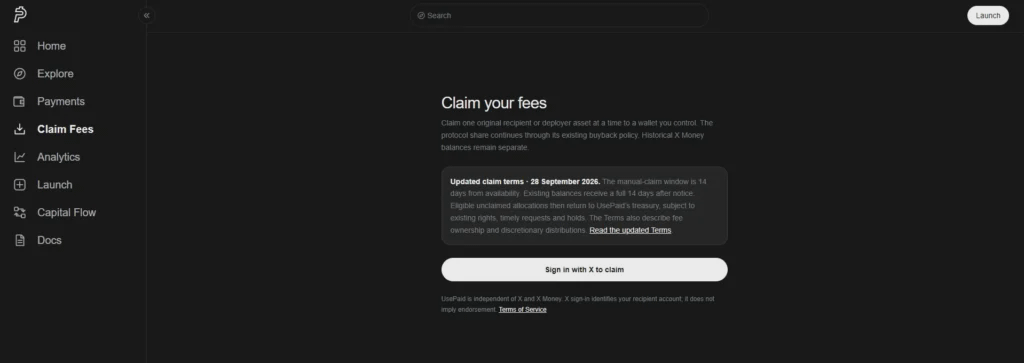
To check whether they have a claimable share, creators should first link their X account through the official Paid website. Paid will then check whether the X account has been linked by a token creator. If it has and the trading volume is substantial, the amount will be displayed.
However, when you log in with X, the system uses OAuth authorization to verify that your account is the identity credential associated with the on-chain treasury’s claim to earnings. Before connecting, make sure the Paid website URL is correct to avoid phishing sites.
Recognizing on-chain phishing threats and clarifying claim rules
When using emerging protocols such as Paid, make sure you have the correct website URL before proceeding. Never authorize access on an unverified lookalike site, or hackers could compromise your X account or even your Web3 wallet.
Creators should also pay close attention to the distinction between asset categories. The web-based claim portal currently only allows claims for creator fees generated after the policy change. If an account had an older fiat balance before X Money payments were paused, those funds remain separately held and subject to compliance processing. Creators will need to wait for the official team to release a separate claim process before they can access them.
This report is for informational purposes only and does not constitute investment advice or a basis for making investment decisions in any form. The data, analysis, and opinions cited are based on the author’s research and publicly available sources, and may be uncertain or subject to change at any time. Readers should make investment decisions carefully, based on their own circumstances and risk tolerance. For further guidance, consider seeking advice from a professional advisor.