

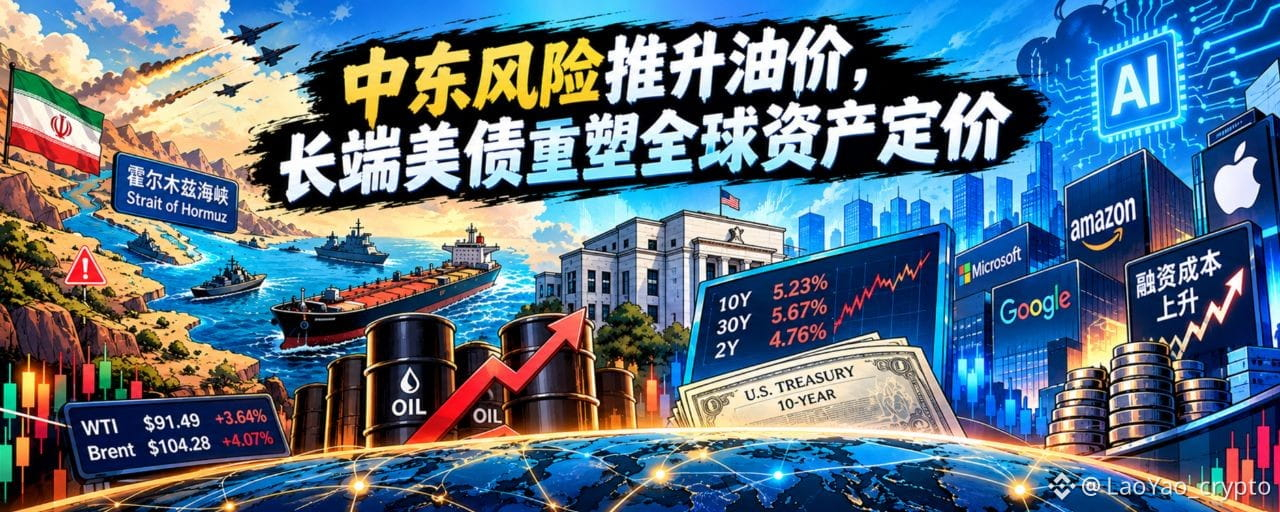

Over the past 24 hours, the central tension in global capital markets remains—
Geopolitical risks in the Middle East are driving up energy prices,
Inflation expectations and long-term financing costs are jointly constraining risk-asset valuations.
Crude oil surged, long-end U.S. Treasury yields remained elevated, chip stocks and crypto assets came under simultaneous pressure, while the energy sector proved relatively resilient. The crypto market saw concentrated liquidations, as leveraged longs were rapidly forced out.
What the market is trading is not just the geopolitical conflict itself, but the combined effects of energy prices, long-term interest rates, and expectations for AI earnings.
🧱 Geopolitical Tensions:
① U.S.-Iran tensions persist, bringing renewed risks to Middle Eastern energy supplies
According to (The Wall Street Journal), a small oil-and-chemical tanker near Qatar was hit by a projectile. The risk of attacks linked to Houthi forces has risen, and reports have also emerged of an attack and casualties at a Saudi airport.
Trump said the United States would not attack Iran before the midterm elections in November.
Meanwhile, according to reports, Saudi Arabia is in talks with customers about routing some crude exports for loading outside the Strait of Hormuz starting next year, to reduce reliance on this critical shipping lane.
International oil prices rose about 4% amid supply risks and geopolitical uncertainty.
② Trump administration suspends PERM applications for some tech companies
According to reports, on October 8 the U.S. Department of Labor announced an indefinite suspension of Microsoft's, Adobe's, and certain IT outsourcing companies' participation in the PERM permanent labor certification program, covering both new applications and those still pending.
Vice President Vance publicly criticized Microsoft, accusing it of abusing the system.
Citing data on Microsoft's layoffs, H-1B visas, and green card applications, the U.S. government questioned whether some companies were bringing in foreign workers while laying off American employees. It also alleged that these companies may have made false statements, suppressed wages, or replaced domestic workers.
PERM is an important step in many employer-sponsored employment-based immigration applications. This measure targets the labor certification application process for specific companies; it does not amount to a blanket cancellation of the H-1B program, nor does it mean that all immigration applications by tech companies have been suspended.
📌 Market Implications:
The implications of this dispute go beyond immigration policy itself.
The U.S. government is tightening scrutiny of tech companies' hiring practices, recruitment of foreign talent, and domestic employment. This could increase HR compliance costs for some companies and create new uncertainty around the global allocation of talent in the tech industry.
💹 Capital at Work:
Current market pressures can be summarized in three themes:
Energy: Developments in the Middle East are pushing crude oil prices higher, increasing the risk of renewed inflation ahead.
Interest rates: Long-term U.S. Treasury yields remain elevated, raising the valuation hurdle for stocks, crypto assets, and other long-duration assets.
Industry: AI capital expenditure remains substantial, and the market is paying closer attention to the relationship between commercial revenue, realized earnings, and financing costs.
Together, these three factors are making the market less tolerant of highly valued tech assets.
When rising energy prices coincide with elevated long-term financing costs, the market faces more than a bout of short-term volatility: it must reassess future earnings, cash flows, and asset valuations.
📊 Bond Market: Long-End Yields Remain Elevated
10-year U.S. Treasury: 5.23%, edging lower;
30-year U.S. Treasury: 5.67%;
2-year U.S. Treasury: 4.76%
Japan 10-year bond: 3.05%;
Long-term yields are under notably more pressure than short-term yields.
The key tension in global asset pricing today: short-term monetary policy expectations may shift, but the long-term cost of capital may not fall in tandem.
For the AI industry, the larger the capital expenditure and the longer the path to realizing earnings, the more important it is to watch changes in financing costs and valuation discount rates.
📈 U.S. Stocks: Chip Stocks Under Pressure
Nasdaq: -1.25%
S&P 500: -0.47%
Dow Jones: +0.10%
U.S. stocks showed a clear divergence: the Nasdaq led the declines, with chip stocks the main drag. The energy sector benefited from rising oil prices, while the Dow managed to close slightly higher, supported by some energy and industrial stocks.
Market pressure is primarily coming from three sources:
- A sharp rise in crude oil prices;
- U.S. Treasury yields remain elevated;
- Reports that OpenAI's revenue expectations have been revised downward.
AI-related news is worth watching, but changes in one company's revenue expectations should not be equated directly with a reversal in the broader AI industry trend.
What is more important to watch is whether the market is shifting from simply chasing the AI growth narrative to rigorously testing revenue realization, investment returns, and the cost of capital.
🛢️ Crude Oil: Geopolitical Risk Premium Rises Again
WTI: $91.49 / barrel, +3.64%;
Brent: $104.28 / barrel, +4.07%;
Whether higher oil prices persist will still depend on the extent of actual supply disruptions, the availability of alternative transportation routes, global demand, and how geopolitical conditions develop.
Short-term risk premiums do not necessarily translate into long-term trends.
🥇 Precious Metals / FX:
Gold: $4,158.3 / ounce, +0.43%;
Silver: $59.43 / ounce, -1.43%;
The U.S. dollar index edged lower as dollar bulls took profits; the yen strengthened slightly, while the euro and pound also made modest gains;
The U.S. dollar is relatively strong against major currencies, in line with elevated Treasury yields;
The yen remains weak, with the interest rate differential between Japan and the U.S. and risk appetite acting as the main constraints;
💸 Web3 Overview: Markets Test Risk Tolerance
Over the past 24 hours, crypto markets weakened overall. Altcoins underperformed Bitcoin, while leveraged longs faced concentrated liquidations.
Total crypto market capitalization: Around $2.77 trillion, down about 4% over 24 hours;
$BTC : Around $81,700–$82,000, down about 2% over 24 hours; at one point during the session, it fell successively below the $83,000, $82,000, and $81,000 levels;
$ETH : Around $2,410–$2,480, down about 4%–6% over 24 hours, significantly underperforming Bitcoin;
Spot ETFs: According to market data, spot BTC ETFs saw a small net outflow overall, suggesting institutional investors remain cautious.
Amid rising macroeconomic pressure, crypto markets are being hit by both declining risk appetite and leveraged liquidations. Falling prices can trigger liquidations, which in turn may intensify short-term selling pressure and create a negative feedback loop.
ETH and some altcoins fell further, reflecting how, during periods of risk reduction, the market often first cuts exposure to more volatile and relatively less liquid assets.
However, short-term liquidations do not necessarily signal a reversal in the long-term trend. What is more important to watch next is whether Treasury yields stabilize, ETF flows improve, and market leverage is sufficiently flushed out.
🧘 Crypto Mindset:
— Industry trends set the direction; the cost of capital affects prices
Risks in the Middle East are pushing oil prices higher, which could add to inflationary pressure;
Long-term inflation, government financing, and the term premium also jointly influence Treasury yields;
The high cost of capital ultimately feeds through to tech company valuations, returns on AI investment, and liquidity and risk appetite in crypto markets.
This chain of transmission is key to understanding current market volatility.
The long-term industry trend for AI will not automatically change because of a single U.S. stock market pullback or crypto market liquidation.
But industry prospects and asset prices are not the same thing.
Industry trends determine where value may grow, the realization of earnings determines whether value can materialize, and the cost of capital determines how much the market is willing to pay for the future.
When long-term funding costs rise,
Even if the direction of future industry trends does not change,
Today's valuations may also need to be recalculated.
In the current market, rather than rushing to decide whether every dip is a bottom, it is better to keep an eye on three things:
First, whether Middle East risks turn from a geopolitical premium into a sustained shock to energy supplies;
Second, whether long-term U.S. Treasury yields remain elevated and become a key constraint on global asset valuations;
Third, whether revenue and profits in the AI industry can justify its massive capital expenditure and financing costs.
As these three questions become clearer, the logic driving the next phase of global asset pricing will also come into sharper focus.
Long-term U.S. Treasury yields matter not because they can explain everything about the market,
but because it is becoming an important benchmark for measuring future cash flows, risk compensation, and the opportunity cost of capital.
⚠️ The above reflects personal views and is intended solely for market observation and discussion.
Geopolitical conditions are changing rapidly. Please be mindful of position sizing and leverage risks. This is not investment advice.
📌 LaoYao(@LaoYao_crypto )
View capital through the lens of mindset, and discern trends through the cycle;
Find certainty amid uncertainty, and anchor value amid volatility.