



Data as of around 9:00 a.m. Beijing time on October 9.
1. The situation in the Middle East continues to drive up global inflation risks. Brent crude briefly topped $105 last night and ultimately closed near $104, up about 4% on the day. Although Trump said there would be no new attacks on Iran before the November 3 midterm elections, Houthi forces continue to attack Saudi airports, while the U.S. is stepping up sanctions on Iran’s oil transportation network. Now that oil prices have climbed back above $100, the risk of the Fed continuing to raise rates toward the end of the year is hard to rule out entirely. This remains one of the biggest external pressures on BTC.

2. The results of the U.S. 30-year Treasury auction were significantly better than expected. The $22 billion in 30-year Treasuries were awarded at a yield of 5.618%, with a bid-to-cover ratio of 2.54, above the recent average. Indirect bidders accounted for 72.3% of bids. After the auction, the 10-year Treasury yield fell back to around 5.23%. Long-dated bonds are finally seeing sustained genuine buying, but risk-free yields above 5% remain very high. Over the coming days, as long as the 10-year yield stays below 5.25%, that’s relatively favorable for crypto. If it breaks back above 5.30%, keep reducing altcoin exposure.
3. BTC fell below $81,000 last night, briefly touching around $80,300, before recovering to around $81,800 this morning. It is still down about 1.7% over the past 24 hours. This pullback from $87,000 to $80,000 has cleared out a large number of leveraged longs. Binance BTC open interest had been approaching 100,000 BTC again, but has now fallen to around 92,800. The $80,000 level is starting to offer trading value, but for now, this is only the first attempt at support after the decline—not a confirmed bottom.
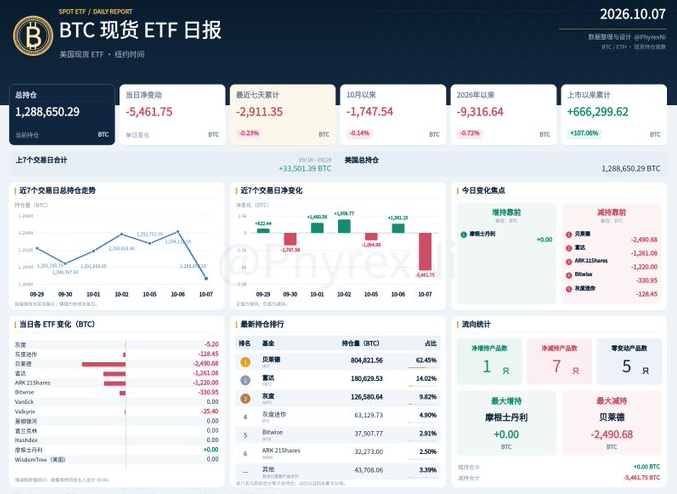
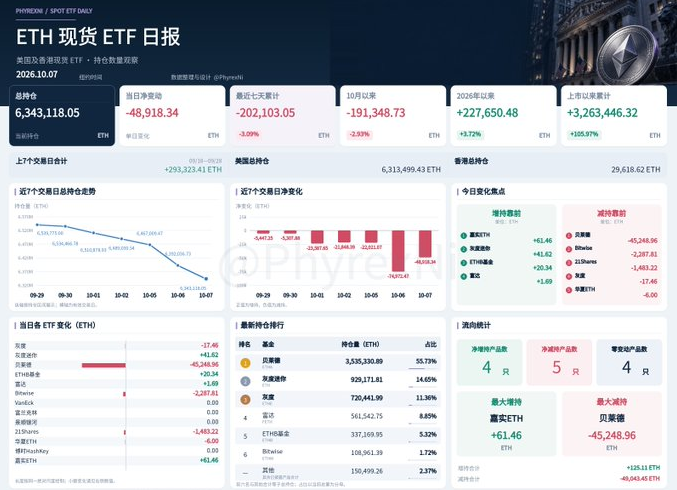
4. U.S. spot BTC ETFs saw net outflows of about $485 million on October 7, while ETH ETFs saw net outflows of about $161 million, for a combined total of more than $640 million. This was a particularly significant reversal in flows for BTC ETFs, with outflows from IBIT, FBTC, and ARKB all at the same time. ETFs had been providing a floor for the market, but that support has temporarily disappeared. So there’s no rush to increase overall risk exposure before BTC gets back above $83,000–$83,500.
5. Another large BTC transfer has occurred from a wallet associated with the U.S. government. About 12,267 BTC seized in the Bitfinex hacking case were transferred to an unmarked wallet, worth close to $1 billion at current prices. The transfer itself doesn’t mean the government is preparing to sell, but BTC has just fallen to around $80,000, so a government-held amount of this size must be included in potential supply monitoring. The key thing to watch is whether it continues moving to trading channels such as Coinbase Prime.
6. Securitize has officially brought 12 U.S. stocks to Solana. The first batch includes Apple, Microsoft, Nvidia, Google, Tesla, Meta, Amazon, Netflix, Circle, SpaceX, Strategy, and Palantir, with USDC used for settlement. The biggest difference between these products and many previous price-tracking stock tokens is that they are backed by actual securities and regulated brokerage channels. Tokenized stocks are moving beyond crypto experimentation and into genuine securities infrastructure.
7. The bigger opportunity for Securitize Stocks lies ahead in credit. The team has explicitly discussed integrating these stock tokens with lending protocols like Aave in the future. If stocks can be used directly as onchain collateral, users will be able to maintain exposure to stocks like NVDA and TSLA while borrowing USDC. In terms of long-term beneficiaries, I’ll be watching SOL, AAVE, the USDC ecosystem, RAY/JUP, and LINK most closely. But stock tokens have only just launched, and real trading volumes, holder numbers, and lending demand have yet to be tested by the market.
8. Sui has also seen a high-quality new catalyst. Bitcoin financial infrastructure provider Hashi announced that it will launch its mainnet in phases this month. It has secured more than $500 million in capital commitments, with over 20 participating institutions, including Anchorage Digital, BitGo, FalconX, and Cumberland. Hashi plans to make native BTC programmable collateral on Sui for lending, credit, and structured finance. Note that the $500 million is a capital commitment, not TVL already deposited in contracts. So it’s reasonable to watch SUI, but don’t count the $500 million as new onchain funds just yet.
9. SOL was around $109.30 this morning, down nearly 6% over the past 24 hours and briefly reaching a low of $105.60. I was reluctant to chase it above $120 a few days ago; it’s now back at a more attractive risk-reward level. Securitize’s stock token launch on Solana adds another institutional-finance angle, but BTC hasn’t stabilized yet. So $106–$109 is a reasonable area to start watching for an initial entry, with a reassessment below $103. There’s no need to go all in at once.
10. HYPE was around $84.40 this morning, with a low of $82.60 over the past 24 hours, bringing it back into the range I’ve been waiting for. After 3.75 million HYPE were unstaked, 1.875 million have now been distributed to five OTC buyer wallets, with 375,000 tokens in each wallet. The key now is to keep tracking these addresses: restaking would be a strong institutional signal, while holding long term without moving the tokens would also be a positive sign. If large amounts start flowing to CEXs, we should raise the supply risk assessment. HYPE protocol revenue remains very strong, so $81–$83 would be my preferred second entry tier.
11. AAVE and LINK are back at levels worth taking seriously. AAVE was around $166 this morning, with a 24-hour low of about $159.60, bringing $160–$165 back into our accumulation zone. LINK was around $12.74, with a low of $12.08, bringing $12.10–$12.50 back into the range we’ve been waiting for. Neither thesis is broken: AAVE is a credit play, while LINK is infrastructure for RWAs, oracles, and cross-chain functionality. What’s missing now is confirmation that BTC has stopped falling—not strong fundamentals.
12. UNI has already broken below the $7.70 risk level from the previous plan, briefly hitting around $7, so the original trading plan is invalid and needs to be reset. CME UNI futures on October 19 remain a confirmed catalyst, but for now, the key question is whether the $7–$7.25 area can provide new support. If it continues to fall below $6.85, don’t mechanically buy the dip just because “CME is launching.”
13. After surging against the market yesterday, RAY and MET have started to pull back. RAY is worth looking at again around $2.20–$2.30, given Raydium’s clear fee-based buyback mechanism for RAY and the rapid growth in stock-token trading. MET has good product and protocol-revenue metrics, but protocol revenue doesn’t directly translate into income for MET holders. Of the two, I currently prefer RAY for its value capture; MET remains on the watchlist.
14. Aptos has announced a relatively aggressive tokenomics reform proposal: reduce the annualized staking reward from about 5.19% to 2.6%, increase transaction fees tenfold, set a proposed cap of 2.1 billion APT on total supply, and have the foundation permanently lock and stake 210 million APT. The estimated annual rate of new token unlocks would fall by about 60%. These changes still need governance approval, but if implemented, they would significantly alter APT’s long-term supply structure, making it worth adding back to the watchlist.
【Bitcoin Market Analysis】
BTC was around $81,800 this morning, after briefly hitting around $80,300 last night. Since falling from $87,000, BTC has repeatedly flushed out leveraged longs. Open interest has now fallen from nearly 100,000 BTC to around 93,000, leaving the trading structure significantly cleaner than it was near $87,000. But with nearly $485 million in daily ETF outflows and oil near $104, the most sensible move is still to wait for a second confirmation around $80,000, rather than trying to call the bottom.
$80,000–$80,400 is the first line of defense. If that level holds and BTC reclaims $83,000–$83,500, I’ll significantly upgrade my short-term rebound outlook. If $80,000 fails, the next key level is around $78,000. To the upside, BTC first needs to reclaim $83,000, then $84,500. The macro conditions are also straightforward: if the 10-year Treasury yield stays below 5.25% and Brent falls back to around $100, the quality of BTC’s rebound will improve significantly.
CEX priorities today: BTC, HYPE, AAVE, LINK, SOL, UNI, and RAY. Add SUI to the watchlist.

The biggest change today is that quality assets are finally offering better prices. HYPE is back at $84, AAVE briefly neared $160, LINK hit a low of $12, and SOL hit a low of $105. These are all much more comfortable entry points than chasing higher prices a few days ago. But overall exposure still needs to stay low, because BTC itself hasn’t confirmed a bottom.
Three new onchain themes to watch today: Securitize is bringing real U.S. stock ownership to Solana; Hashi is turning BTC into financial collateral on Sui; and HYPE’s institutional OTC tokens are entering the actual distribution phase. I won’t repeat the Robinhood Chain, Arc, and Tempo theses that I’ve already discussed over the past few days.
Reduce current risk assets to 20%–25%, with stablecoins at 75%–80%. Consider adding only after BTC reclaims and holds $83,000–$83,500. If it falls below $80,000, keep protecting cash.

The three most important numbers today:
BTC at $80,000.
U.S. 10-year Treasury yield at 5.30%.
Brent crude at $100.